Connecting an agent to your apps is the easy part
For about a year now, the hard part of wiring an AI agent up to your software has been quietly going away.
The Model Context Protocol gave agents a standard way to talk to applications. Point an agent at an MCP server for Slack, another for Jira, another for your database, and it can read messages, open tickets, and run queries on your behalf. The glue code that used to eat an afternoon now fits in a config file. Access, the thing everyone worried about first, turned out to be the tractable part.
Then you wire it all up and ask the agent to do something a new hire could do in a minute. "Find that Asana ticket about the auth config we argued over last month." "Pull up the Stripe charges from the customer who emailed asking for a refund." And the agent stalls. It has a live connection to Asana. It has a live connection to Stripe. What it does not have is any idea where the thing you asked for actually lives, or how to tell the one record you want from the ten thousand you don't.
That gap is the problem Airweave set out to close.
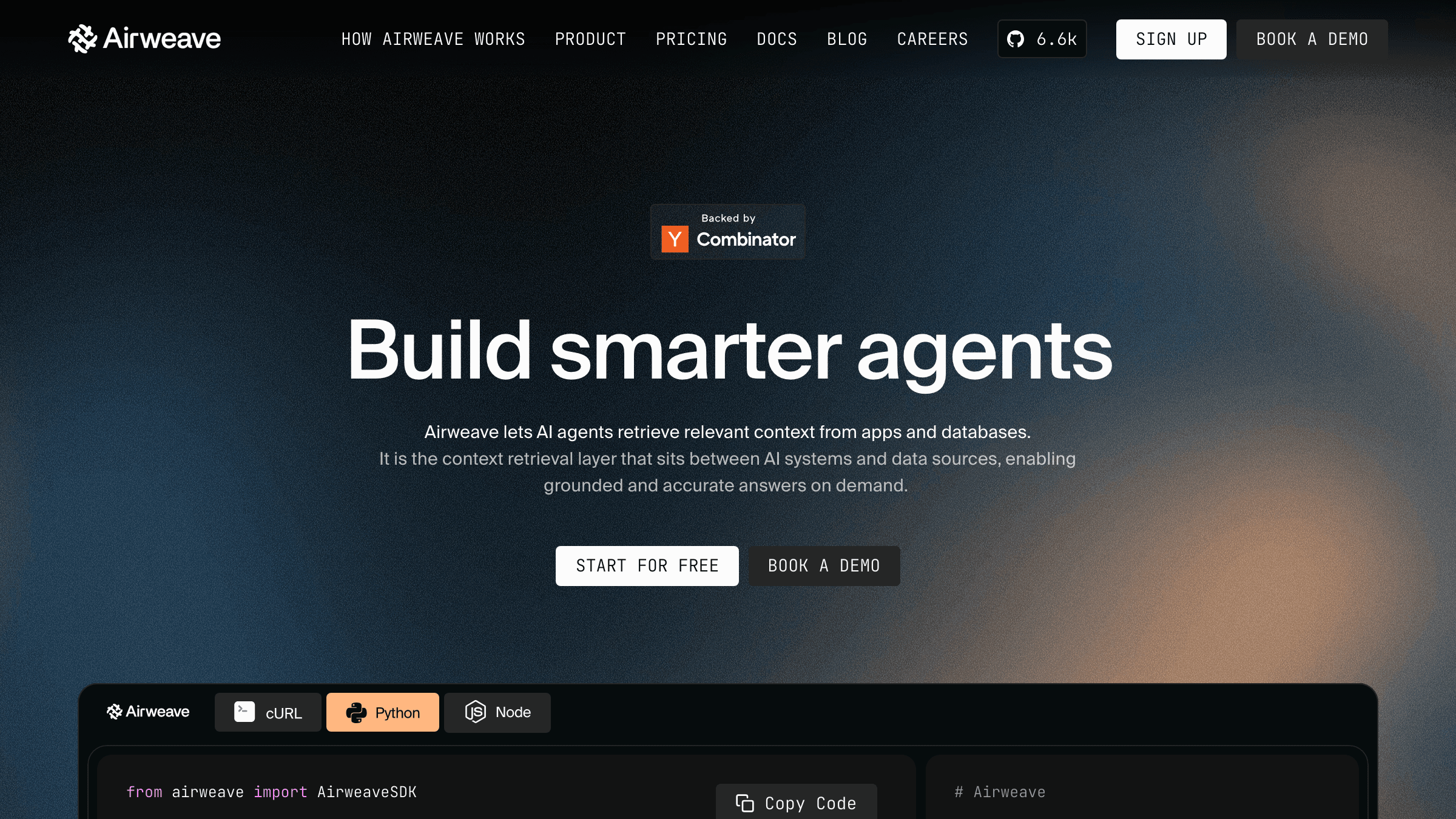
Airweave is an open-source context retrieval layer for AI agents. It connects to the apps, databases, and document stores a company already runs, keeps their contents in sync, and exposes all of it through a single search interface an agent can call. The framing is deliberately narrow. Instead of handing an agent a pile of connections it doesn't know how to use, give it one place to search across everything.
A connection is not an answer
It's worth being precise about why access alone falls short, because it's easy to assume MCP already solved this.
MCP is a protocol for interaction. It lets an agent invoke functions an app exposes: send a Slack message, create a Jira issue, read a specific file by its ID. That is genuinely useful, and it is not the same thing as search. An MCP server for Notion can fetch the page you name, but it can't answer "which of our 4,000 Notion pages describes the onboarding flow," because nothing in the connection understands what those pages are about. The agent is left doing what agents do when they can't find something: guessing, chaining together long sequences of function calls hoping to stumble onto the right object, or confidently making up an answer.
Retrieval is a different discipline from interaction. To answer a vague, human request against a real workspace, you have to pull the data out of each source, break it into units you can reason about, understand what each unit means, and rank thousands of candidates by how well they match an intent that was never phrased as a database query. None of that happens for free when you open a socket to an API. It's the part everyone underestimates, and it's the part Airweave is built around.
What Airweave actually does
Under the hood, Airweave is less a search box than a pipeline that ends in one.
It starts with connectors. Airweave ships with more than a hundred prebuilt integrations to the tools companies actually live in: Google Drive, Gmail, Slack, Notion, Jira, GitHub, Stripe, HubSpot, Salesforce, Shopify, Zoom, and a long tail beyond them. Each connector handles the unglamorous work that makes a source usable: authenticating, pulling the data, and keeping it current. Some sources sync in real time over webhooks, so a new Slack thread or a freshly closed GitHub issue shows up in search within moments. Others sync on a schedule the developer sets, anywhere from every fifteen minutes to once a day.
From there, Airweave breaks what it pulls into entities. A Notion workspace becomes pages. A Jira project becomes tickets. A Drive folder becomes files. A database becomes rows. Turning a raw API response into clean, typed units is what makes the data searchable rather than just stored, and it's the step a homegrown integration usually skips or botches.
Those entities land in storage built for retrieval rather than record-keeping. Airweave is not itself a vector database. It uses Qdrant to hold the embeddings that power semantic search and PostgreSQL to track metadata, and it organizes everything into collections, logical groupings of sources that an agent can search as one. The sync jobs that keep it all fresh run on Temporal, so a failed pull retries and resumes instead of silently leaving the index stale. The result is an index that reflects the current state of a company's tools, not a snapshot from whenever someone last ran a script.
The payoff of all that machinery is a single query surface. An agent asks Airweave a question in plain language and gets back the relevant entities from across every connected source, already ranked, without needing to know which app the answer came from.
Search is a systems problem, not a prompt
The reason a company can't just build this in a weekend is that good retrieval is a stack of hard problems, and each one has to work for the whole thing to feel effortless.
Authentication alone is a project. Every SaaS tool has its own OAuth quirks, token refresh rules, and rate limits, and keeping dozens of them healthy is ongoing work rather than a one-time integration. Incremental sync is another. Re-ingesting an entire Google Drive every fifteen minutes is wasteful and slow, so the system has to know what changed and touch only that. Then comes the retrieval itself, where matching a loosely worded request to the right record takes more than embedding a string and grabbing the nearest neighbors.
Airweave leans into that last point. It supports semantic search for meaning, keyword search for exact terms, and hybrid search that blends the two, along with recency-aware ranking so a question about "the latest contract" surfaces the current version instead of one from two years ago. It also offers an agentic mode, where the system reasons about intent and relationships across sources rather than treating a query as a single lookup. Getting this mix right is the difference between an agent that finds the ticket you meant and one that returns something adjacent and plausible, which in practice is worse than returning nothing.
Building all of that once, well, and behind a clean interface is a real product. Building it again inside every company that wants agents to work is the kind of undifferentiated effort that infrastructure exists to absorb.
Built to be called by an agent
The most telling design choice in Airweave is who it expects the caller to be.
Plenty of search tools assume a human at a keyboard. Airweave assumes the thing running the query is another piece of software, usually an agent, and shapes its surface accordingly. Developers can reach it through a REST API, through Python and TypeScript SDKs, or through native hooks into common agent frameworks. It also runs as an MCP server, including a hosted option, which means an agent that already speaks MCP can treat "search everything this company uses" as one more tool it knows how to call.
That last part matters more than it looks. The same protocol that made access easy is where retrieval was missing, and by exposing search over MCP, Airweave slots into the exact place developers are already building. The agent doesn't learn a new integration pattern. It just gains a tool that reliably answers "where is the thing I need," which is the tool it was missing all along.
Open source as the strategy
Airweave is open source, and the code lives in public on GitHub. That's a considered choice, not a giveaway.
Retrieval infrastructure sits close to a company's most sensitive data, which is exactly the kind of thing engineering teams are reluctant to hand to a black box. Being open lets them read the code, run it themselves, and trust what it does with their Slack history and their customer records. Open source also turns the connector library into something the community can extend. The long tail of business apps is effectively endless, and a model where anyone can add a source scales in a way a single vendor's roadmap never could. For a product whose value grows with every app it can reach, that's the right shape.
It's the same pattern that has played out repeatedly in developer infrastructure. The tools that win the trust of engineers early, by being inspectable and easy to self-host, tend to be the ones that end up embedded everywhere later.
The people behind it
Airweave was founded by Lennert Jansen and Rauf Akdemir, who met at university about seven years before starting the company. Jansen came from AI research work at Amazon and IBM; Akdemir worked as a data platform engineer. That pairing is a good fit for the problem, since making messy real-world data searchable is as much a data-engineering job as a machine-learning one, and the company needs both instincts to build the pipeline and the retrieval on top of it.
The company came through Y Combinator's X25 batch and has raised a $6 million seed round. The investor list is a useful signal in its own right: LUX Capital, Y Combinator, Orange Collective, and Pioneer Fund all took part, alongside Shay Banon, the creator of Elasticsearch. It's hard to think of a more relevant angel for a company building search infrastructure than the person who built one of the most widely deployed search engines in the world.
The retrieval layer
Step back, and Airweave is a bet on where the effort in building agents is about to concentrate.
The first wave of agent tooling was about capability: can the model reason, can it use tools, can it reach the systems it needs. Those questions are mostly answered now, and a new bottleneck has taken their place. An agent is only as good as the context it can pull in at the moment it needs to act, and most enterprise context is scattered across dozens of apps that were never built to be queried together. Closing that gap is thankless, and it decides whether an agent is genuinely useful or just a convincing demo that falls over on real work.
Airweave's wager is that this retrieval layer becomes standing infrastructure, the same way authentication, payments, and observability each became a thing you buy rather than rebuild. If agents keep moving from novelty into the core of how companies operate, every one of them will need a reliable answer to "find me the right thing across everything we use." Airweave is trying to be the layer that answers it, and to be open enough that developers reach for it before they reach for a blank editor and start writing connectors of their own.
Access to your apps was the part that felt hard and turned out to be easy. Finding what matters inside them is the part that looked easy and turned out to be the whole game.