Akkari wants the customer-ops loop to close itself
Every B2B company runs on promises that never get written down.
On a sales call, someone says, "We can get you SSO by the end of the month." In a shared Slack channel, a customer reports a bug and an engineer replies, "Good catch, I'll file it." During a quarterly review, an account manager agrees to look into a second use case that could double the contract. Each of these is a real commitment. Each one implies a chain of work: file the ticket, ship the fix, tell the customer it shipped, follow up on the expansion. And most of them live in exactly one place, which is the memory of the person who made them.
That memory is a fragile system. People get pulled into the next fire. The engineer who said "I'll file it" closes the laptop. The account manager who spotted the expansion is in back-to-back calls for the rest of the week. Two months later the customer renews at the same tier, mildly annoyed that the bug they reported in the spring never got acknowledged, and nobody on the vendor's side ever quite understands why the relationship cooled.
This is the quiet way customer relationships decay. Not from a bad product or a rude interaction, but from ordinary follow-through that slips between the cracks. The work is knowable. It was said out loud. It just never made it into a system that would carry it to completion.
That gap is what Akkari is built to close.
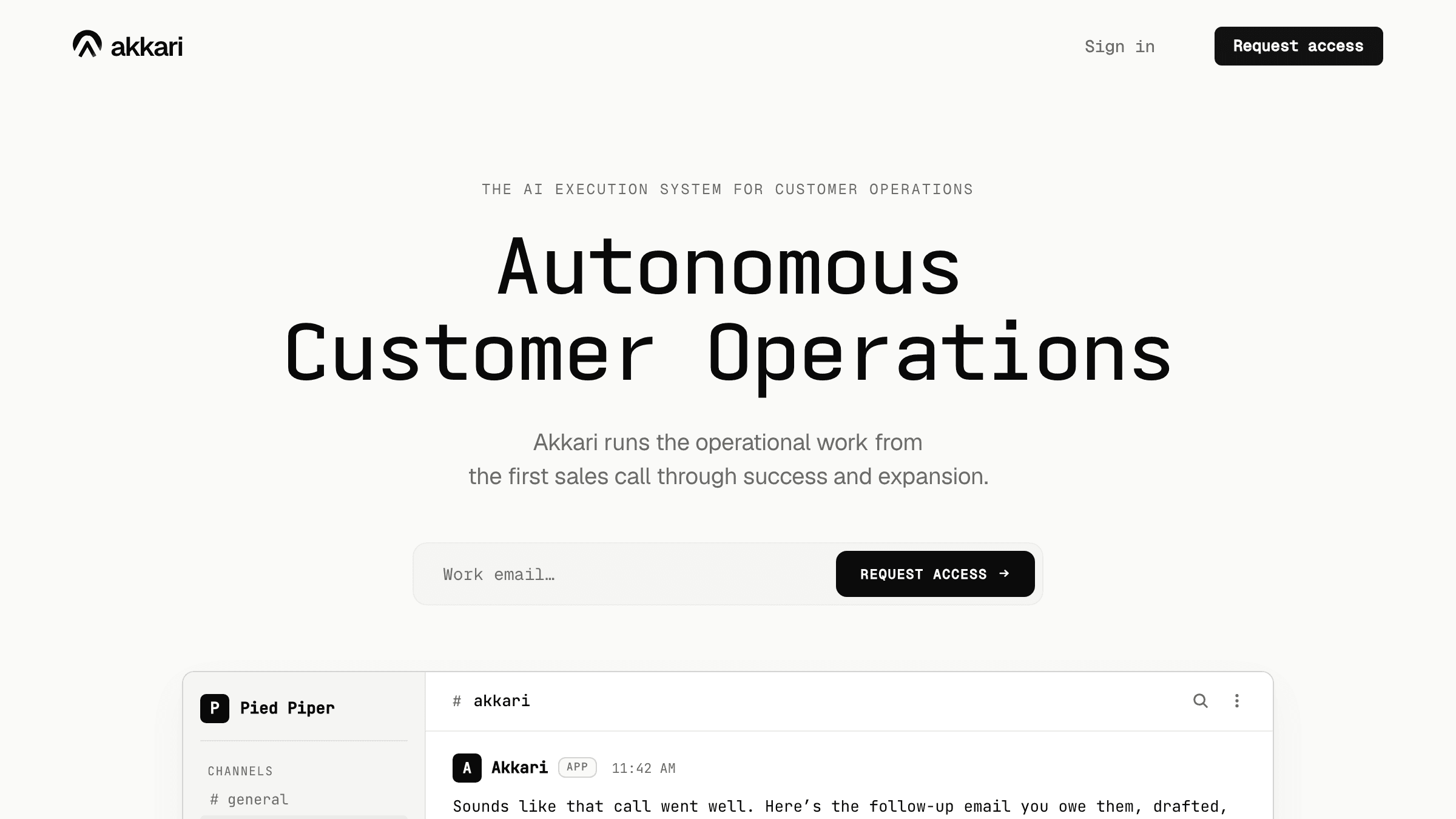
Akkari is an autonomous customer operations platform. It listens across the channels where a company already talks to its customers, captures every commitment, issue, request, and opportunity, and then does the operational work to close each one. Its own description of the goal is refreshingly literal: the loop closes itself.
The work that lives between the tools
Most companies already own software for pieces of this. The CRM records the deal and its stages. The support desk logs formal tickets. Linear or Jira tracks the engineering work. The data warehouse knows which accounts are using which features.
What none of those tools owns is the connective tissue: the specific things people promised each other in conversation. A commitment made on a Zoom call doesn't automatically become a CRM task. A bug mentioned in a customer Slack channel isn't a support ticket until a human decides to make it one. The request buried in the third paragraph of an email thread only becomes work if the reader remembers to act on it.
So companies paper over the gap with human effort. Account managers keep running notes. Support engineers triage Slack channels by hand. Someone owns a spreadsheet of "things we owe customers" that is always a little out of date. As a company grows from ten customers to a few hundred, this manual layer becomes both essential and impossible to staff. There are simply more conversations happening than any team can track by memory.
Akkari's premise is that this middle layer, the operational glue between the customer conversation and the systems that record work, should not be a person's job to hold in their head.
Capture is the easy part
A skeptic's first reaction is that this sounds like a note-taker. The last two years have produced a wave of tools that transcribe calls, summarize meetings, and post a tidy recap into Slack. Useful, but limited. A summary you still have to read, interpret, and act on is not a solution to the follow-through problem. It just relocates the same backlog into a cleaner format.
Akkari treats capture as table stakes. Yes, it reads the calls, the meetings, the email, the Slack and Discord threads, and it surfaces what matters. But surfacing is the beginning of the product, not the end of it. The company's whole argument is that value lives in the part everyone else stops short of: actually doing the work.
That distinction is the reason "autonomous" is doing so much work in the phrase "autonomous customer ops." An assistant that hands you a list of eight things you owe customers has, in a sense, made your day worse. You now have a documented backlog and the same twenty-four hours. An agent that clears six of those eight items itself is a categorically different thing.
A system of action, not a system of record
The cleanest way to understand Akkari is to contrast it with the category it borders. A CRM is a system of record. It is a place where humans write down what happened so the organization has a memory. It is only ever as current and as complete as the people typing into it, which is to say, not very. The running joke about CRM hygiene exists because keeping a system of record accurate is tedious work that produces no immediate reward for the person doing it.
Akkari positions itself as a system of action instead. It does not wait for a human to log the commitment and then remind that human to go do it. It takes the commitment straight to execution. In the company's own words, Akkari drafts the replies, creates the pull requests, provisions the access, updates Linear, schedules the meetings, and stays on top of each loop until it is closed.
Read that list again and notice how varied the tasks are. Drafting a customer reply is a communication task. Creating a pull request is an engineering task. Provisioning access is an IT task. Scheduling a meeting is a coordination task. In most companies these live with different people on different teams, and the work of routing each item to the right place is itself a job. Collapsing that routing, and then acting on the far side of it, is the harder and more valuable half of customer operations.
Watching the loop until it closes
The mechanics get concrete when you follow a single thread from start to finish.
A customer drops a message in a shared Slack channel: a feature is broken. Akkari recognizes it as an issue, not just chatter, and files a ticket in Linear with the relevant context attached. So far this is helpful but not remarkable. The interesting part is what happens next. Akkari watches that ticket. When an engineer merges the fix, Akkari notices the merge and sends the customer a message telling them the problem is resolved, tailored to the conversation they originally had. Nobody had to remember to circle back. The loop closed on its own.
The same pattern extends past support into growth. When a conversation reveals that an account is a candidate for expansion, Akkari can trigger the play that moves it forward rather than leaving the opportunity to evaporate in someone's inbox. Running from the first sales call through onboarding, success, and expansion means the platform treats the entire customer lifecycle as one continuous stream of loops to be opened and closed, rather than a set of disconnected stages owned by different departments.
This is where the company's integration choices matter. Akkari is designed to work inside Linear, GitHub, and the other places engineering and go-to-market teams already operate, so closing a loop means acting in the tools of record rather than creating a new silo alongside them. The work shows up where the work already lives.
Meeting teams where they already are
There is a companion idea in how people interact with Akkari day to day. Rather than asking a team to adopt a new dashboard and remember to check it, Akkari is reachable in any channel or direct message. Someone can ask it for a daily brief, pull an account snapshot before a call, or run an ad-hoc question about a customer, and get the answer in Slack where they already spend their day.
That design choice reflects a hard-won lesson about operational software. Tools that make people leave their workflow to go somewhere else tend to get used for a month and then quietly abandoned. The systems that stick are the ones that meet people inside the software they already have open, and Akkari is built to live in the conversation layer rather than beside it.
Founders who have felt this pain at scale
Customer operations is one of those problems that is easy to underestimate from the outside and painful to live through from the inside. Akkari's founding team has lived through it.
The company was started by Jeffrey Byun and Henry Lee, repeat founders who previously built OrderAhead, a Y Combinator company they scaled to millions of users before it was acquired by Square. After that they built BLADE, a crypto derivatives exchange that reached more than $1.2 billion in monthly trading volume. Rounding out the team is Michael Moore, who was chief revenue officer at OrderAhead and brings the go-to-market perspective directly to a company building go-to-market infrastructure.
That combination is worth pausing on. A pair of technical founders who have twice scaled products to large user bases understand the engineering side of closing loops, the tickets and the merges and the provisioning. A revenue leader who ran GTM at one of those companies understands the commercial side, the commitments and expansions and the slow bleed of a neglected account. Building autonomous customer ops well requires holding both of those truths at once, because the loops the product closes cross from engineering into revenue and back again. This is a team that has stood on both sides of the handoff.
The company is part of Y Combinator's 2026 cohort and is backed by Orange Collective, the fund run by YC alumni that invests alongside the accelerator in companies like this one.
Why this is buildable now
The idea of software that runs your customer follow-through is not new as an aspiration. What is new is that it has become buildable.
For most of the last decade, a product that promised to "do the work" would have been forced to fall back on rigid automation: brittle if-this-then-that rules that broke the moment a real conversation strayed from the expected script. Human language is too messy for that approach. Distinguishing a genuine commitment from an offhand remark, understanding what a customer actually asked for, drafting a reply that fits the specific history of a relationship, these require reading context the way a person does. Until recently, machines could not.
Large language models changed the input side of that equation, and the current generation of agentic systems changed the output side. A model can now read a sprawling Slack thread and correctly extract the one sentence that represents a promise. An agent can now take that promise, decide which system it belongs in, and act there. Akkari sits precisely on top of these two capabilities, and it is arriving at the moment they became reliable enough to trust with real customer relationships rather than just with summaries.
The category label the company uses for itself, autonomous customer ops, is a bet that this whole function is on the verge of being reorganized. For years, customer operations software has meant systems of record that humans feed and then act on. The bet is that the feeding and the acting are both about to move to software, and that the human role shifts from doing the operational work to deciding what the operational work should be.
What changes when nothing gets dropped
Step back and the appeal is almost mundane, which is part of why it is compelling. Akkari is not promising a dramatic new capability that a company never had. It is promising that the ordinary commitments a company already makes will actually get kept.
That is a bigger deal than it sounds. A large share of churn and stalled expansion does not come from losing to a competitor or shipping a bad release. It comes from the accumulation of small dropped balls: the reported bug that was never acknowledged, the expansion the account manager meant to chase and forgot. Each one is minor. Together they teach a customer that the vendor is not quite paying attention.
If the loops close on their own, that particular failure mode goes away. The customer who reports a bug hears back when it ships. The promise made on the sales call gets tracked to completion. The expansion signal turns into an actual conversation instead of a missed one. For a growing company, that is the difference between customer operations that scale with headcount and customer operations that scale with software.
Akkari is betting that the second kind is what the next generation of companies will run on, and that the teams who get there first will simply stop dropping the things they said they would do.