Durate wants to retire the physician scheduling spreadsheet
In most hospitals, one of the highest-stakes documents in the building is maintained by hand.
The physician schedule decides who covers the emergency department at 3am, whether the ICU has an intensivist on Saturday, and whether a resident is about to exceed the hours the ACGME allows. Getting it wrong means an uncovered shift at best and a compliance violation at worst. And in a remarkable number of health systems, the person producing it is a senior physician or program coordinator who spends days each month moving names around a spreadsheet, trading clinical time for clerical work.
That is the job Durate is automating. The company, founded in 2024 by Michael Mounajjed and Ben Liu and part of Y Combinator's Fall 2024 batch, builds AI scheduling software for hospitals, physician groups, clinics, and residency programs. Its pitch is blunt: set your rules once, and Durate generates a full, balanced schedule in seconds, syncs it with the systems you already run, and warns you about coverage gaps while there's still time to fix them cheaply.
The company says it now schedules thousands of providers across more than 100 sites. The most striking number comes from Brown Emergency Medicine, which runs emergency departments across seven hospitals on the platform and reports a 96% drop in locum usage since switching. To see why that one statistic is the whole business case, it helps to understand what physician scheduling actually involves.
The hardest timetable in the building
Physician scheduling looks like a calendar problem and behaves like a constraint-satisfaction problem that happens to involve exhausted humans.
Start with coverage: every shift at every site needs a physician with the right credentials, and some need specific subspecialists. Layer on regulation. Residency programs live under ACGME duty-hour rules, which cap weekly hours and mandate rest periods, so a perfectly covered schedule can still be an illegal one. Then fairness, which is where most of the pain lives. Nights, weekends, and holidays have to be distributed evenly over months, not just within a single schedule. Doctors have vacations, conferences, clinic days, and personal constraints. Two physicians may be fine individually but shouldn't anchor an overnight together. Each group accumulates dozens of these rules, most of them unwritten.
A human scheduler holds all of this in their head and produces one schedule, which is out of date the moment someone gets sick or a hospital adds a shift. The legacy software that dominates the category mostly digitized the artifact rather than the process: you get a nicer grid, but a human still resolves every conflict, and a mid-cycle change still means reworking the whole thing by hand. Durate's own comparison pages go after QGenda, the category's giant, on exactly this point.
The failure mode has a price tag. When a schedule gap surfaces too late to fill internally, the group calls a locum tenens agency, and a temporary physician arrives at a steep premium over staff rates, plus agency fees and travel. Locums exist for good reasons, but using them as a recurring patch for schedule misses is one of the most expensive habits in hospital operations.
Rules in, schedule out
Durate's core design decision is to treat the rules, not the grid, as the source of truth.
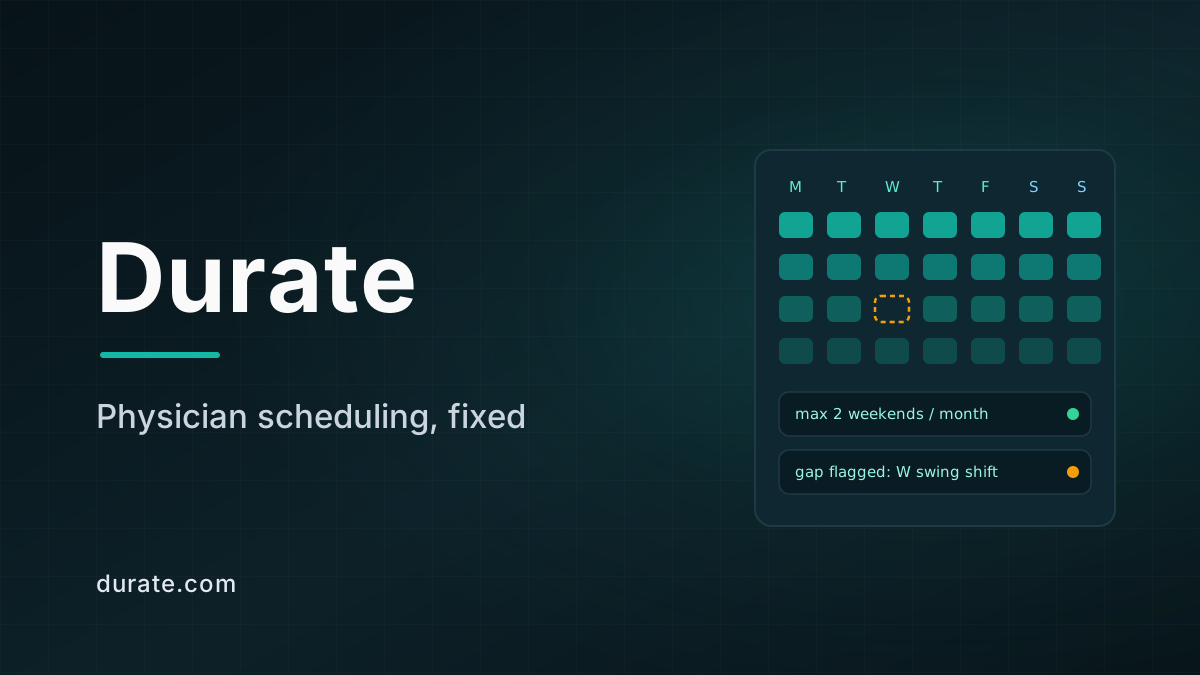
A group encodes its constraints once: coverage requirements per site and shift, credential rules, duty-hour limits, fairness targets, individual preferences. From there, Durate's optimizer generates the schedule in seconds. When something changes, a new hire, a leave of absence, a hospital opening two extra swing shifts, the group changes the rule and regenerates instead of hand-repairing the old grid. The company says teams can make those changes in plain English, with the AI translating a sentence like "no one works more than two weekends a month" into enforced constraints.
Because the system can see the whole board, it also catches problems early. Durate flags coverage gaps weeks in advance, when the fix is asking a staff physician to swap, rather than days in advance, when the fix is an agency phone call. It generates reports and flags unusual patterns in how hours actually land across the group, which is the raw material for fairness conversations that today run on vibes and grievance.
The operational details suggest a team that has sat in real scheduling meetings. Every change is logged with who made it and when, which matters in a world of payroll disputes and compliance audits. Physicians get a mobile app for viewing schedules, submitting preferences, swapping shifts, and picking up open ones, with updates in real time. Durate connects to Epic, Oracle Cerner, and ADP among what it says are more than 1,000 integrations, so the schedule flows into the EHR and payroll instead of living in a silo. The platform carries SOC 2 Type II certification, with SSO, role-based access, and MFA, the table stakes for selling into health systems. Implementation runs two to four weeks and includes simulations before go-live, because no scheduler earns trust by failing on its first real month.
None of these pieces is exotic on its own. The product argument is that they only pay off together: a dynamic schedule you can regenerate at will is only safe if the rules are complete, auditable, and connected to the systems that pay people.
The locum math
Brown Emergency Medicine's numbers, as reported on Durate's site, are worth taking apart.
The group staffs emergency departments across seven hospitals, a scale where scheduling stops being a chore and becomes an operations discipline. After moving from a static legacy scheduler to Durate, the group reports that about 95% of scheduling and operations now run automatically, that it saved roughly two months of scheduling time, and that locum usage fell 96%. A quote on Durate's page credits the software with making the integration of the seven hospitals workable at all, with providers' hours tracked accurately across sites. Physician complaints about scheduling reportedly fell by more than 75% once fairness rules were enforced by the system instead of negotiated shift by shift.
These are vendor-published figures from a flagship customer, so apply the usual discount. But the mechanism behind the locum number is credible, and it's the part worth understanding. Groups don't call locum agencies because staff physicians are unavailable in some absolute sense. They call because a gap surfaced too late for anything else. Visibility is the fix: software that holds every site's coverage in one model can surface a hole in week six the moment a rule change creates it, while there's still time to solve it with a swap or an open-shift pickup at staff rates. The 96% is what happens when the expensive last resort stops being the only option that fits the timeline.
For a multi-site group, cutting locums by anything close to that is worth more per year than the scheduling software costs. That's an enviable position for a vendor: the ROI case is a subtraction problem the CFO can do.
From a Rice dorm to the ED
Durate's founders met during their first few weeks at Rice University, where they studied computer science and applied math before dropping out to build the company. Mounajjed, the CEO, had already founded Calceus Mining, an Ethereum mining operation that processed tens of millions in transactions. Liu runs operations.
The company started life as Docflow, a residency shift scheduling tool, and according to Rice's own news office it was the first Rice student startup accepted into Y Combinator. Residency scheduling is a shrewd wedge, arguably the hardest version of the problem: ACGME duty-hour rules pile on top of rotation requirements, clinic days, and call hierarchies. Durate's YC profile cites work with Harvard's psychiatry residency program, where the schedule had to absorb dozens of interacting rules and regulations. A scheduler that survives a residency program has already handled more constraint complexity than most attending schedules will ever throw at it.
From there the company broadened into the general physician scheduling market under the Durate name, selling to emergency medicine, radiology, urgent care, and hospital groups. The team is still tiny, two people in San Francisco as of its YC listing, which makes the Brown deployment all the more notable. Health systems do not casually hand a two-person startup the document that decides who staffs the ER; getting there requires the product to carry the sales call.
Schedules as living systems
The bet underneath Durate is that the physician schedule is about to change category: from a document someone produces to a system that continuously maintains itself.
The old model made sense when recomputing a schedule cost a coordinator a week. Every incumbent workflow, the quarterly scheduling marathon, the swap-request email chains, the locum patch, exists because regeneration was expensive. Once regeneration costs seconds, the sensible defaults invert. You stop protecting the artifact and start maintaining the rules. Fairness becomes something you measure over a year instead of argue about per month. Gaps become forecasts instead of emergencies.
Healthcare is late to this shift for familiar reasons: integration drag, compliance stakes, and buyers who have been burned before. But the structural pull is strong. Physician burnout is a staffing crisis, and schedule unfairness is one of its most fixable inputs. Locum spending is a line item every system wants smaller. And the people currently making schedules are often clinicians whose time is worth far more at the bedside.
Durate is a young company making vendor-reported claims in a market with entrenched incumbents, and it will need many more Browns before the category concedes. But it's attacking a problem whose cost is visible in every hospital budget and every physician satisfaction survey, with a product thesis, rules in, schedule out, that fits how the problem actually behaves.
Somewhere right now a department chair is spending a Sunday rebuilding next month's call schedule by hand. Durate's wager is that this is the last generation of physicians who will ever have to.