Fuse checks every claim against the contract the insurer signed
Imagine running a business where you ship the product, send the invoice, and then accept whatever number shows up in your bank account.
Not roughly that business. Exactly that business. A medical practice treats a patient, submits a claim to the insurer, and some weeks later a remittance arrives for an amount the practice did not set and usually cannot verify. The payment references a contract, one of dozens the practice has signed with different payers, each with its own negotiated rate for each of thousands of procedure codes, plus amendments, carve-outs, and annual adjustments. Checking whether the number is right would mean digging the contract out of a drawer, finding the applicable fee schedule, and doing the math. Per claim. Nobody does that. The remittance looks like a payment, so it gets booked like one.
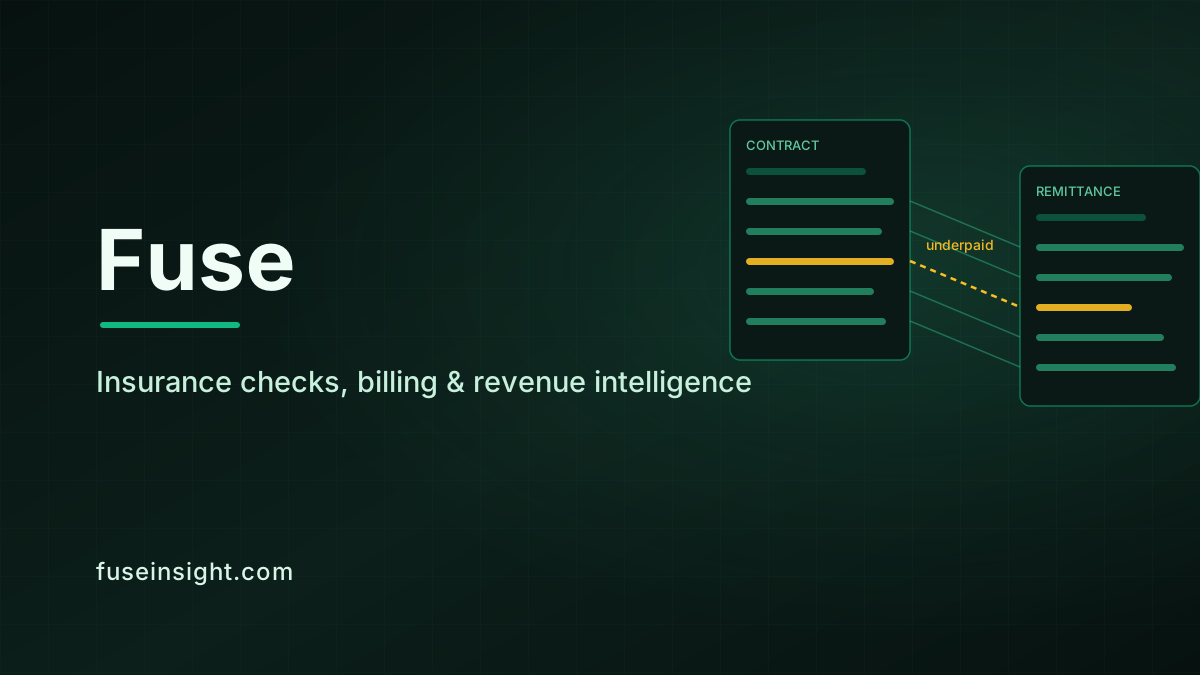
This is the gap Fuse was built to close. The company, a Y Combinator Summer 2024 graduate founded by Sho Sugihara and Oscar Wilsby, uses AI to read the contracts that govern how providers get paid and reconcile them against what insurers actually paid. When the two disagree, Fuse flags the underpayment and generates the appeal. From that wedge it has grown into a broader revenue platform for medical practices, covering eligibility checks, patient billing, and the analytics layer on top.
The money is missing and nobody is counting
The numbers that pushed the founders into this problem are blunt. By Fuse's accounting, US healthcare providers lose up to 10% of their revenue to billing errors and underpayments. Orange Collective's profile of the company puts the figure at up to 11%. Either way, for a sector running on thin and shrinking margins, that is often the difference between a practice that works and one that sells to a hospital system.
What makes the loss strange is how quietly it happens. When Sugihara and Wilsby interviewed healthcare executives before starting the company, the refrain they kept hearing was that leaders had no idea whether their revenue was accurate. Not that underpayments were rare, or that recovery was hard. That no one could say whether the problem existed at all, or how big it was.
The structure of the industry explains it. An average hospital holds more than 50 contracts with insurers, and the same procedure reimburses at a different rate under each one. The contracts themselves are long PDFs written by lawyers, revised over years, with payment terms scattered across fee schedules and amendments. The remittances come back in their own formats with their own adjustment codes. Matching one against the other is a document problem, a data problem, and a volume problem at once, and the billing team is already underwater just getting claims out the door.
So the audit never happens. An insurer that pays 85 cents on the contracted dollar does not get a phone call, because nobody can see the missing 15 cents. The practice's software confirms a payment arrived. It has no idea what the payment should have been.
Reading the contract was always the hard part
Underpayment detection is not a new idea. Revenue cycle consultants have sold recovery audits for decades, usually as periodic projects that sample claims, find a settlement's worth of errors, and take a cut. What was never practical was doing it continuously, on every claim, for every payer.
The blocker was the contracts. Payment terms live in unstructured legal documents, and until recently there was no economical way to turn a stack of 50 payer agreements into a machine-readable rate table. You could pay analysts to key them in, which is slow, expensive, and immediately stale when the payer amends the agreement. Most providers did neither and flew blind.
This is the specific thing large language models changed. Fuse uses LLMs to extract the payment terms from each payer contract, the allowed amounts and the conditions attached to them, and turns the drawer full of PDFs into data. From there the pipeline is reconciliation: every remittance gets compared against the contracted rate for that procedure, that payer, that plan. Discrepancies surface as underpayments with the evidence attached, and Fuse auto-generates the appeal rather than leaving the finding in a dashboard for someone to act on later.
That last step matters more than it sounds. A flagged underpayment is a to-do item for a team with no spare capacity. A drafted appeal, citing the contract language and the expected amount, is nearly done. The practice gets recovered revenue without hiring anyone, which for most of them is the only version of this that was ever going to happen.
From one wedge to the whole revenue cycle
Detection turned out to be an entry point. The same capability, machine-readable knowledge of what every payer owes for every procedure, is useful before the claim ever goes out, and Fuse has built forward along that thread into what its site now calls insurance checks, billing, and revenue intelligence.
The eligibility product runs verification at the level of individual CPT codes rather than the plan-level yes or no that a portal check gives you. That granularity catches the failure modes that later turn into denials: coverage carve-outs for a specific procedure, prior authorization requirements, plan-specific restrictions, and whether the patient carries primary and secondary coverage. Fuse says this has cut insurance verification administration by over 95% for its partners, which tracks with what it replaces, a staff member on hold with a payer or clicking through portals for each scheduled visit.
Knowing coverage and contracted rates up front also means the practice can tell patients what they will owe before care, so Fuse generates automated fee estimates, then handles the invoicing and payment reminders after the visit. On top of all of it sits the analytics layer: claims, denials, underpayments, aged accounts receivable, and payer and patient payments in one place, with contract benchmarking and rollups across sites and legal entities for groups that have grown by acquisition. The platform is HIPAA compliant and SOC 2 Type II certified, which is the price of admission for touching this data at all.
The through-line is a single source of truth about what should happen financially, applied at every stage. Before the visit it predicts cost. At billing it prevents avoidable denials. After adjudication it catches the shortfall. The industry calls this revenue cycle management, and it is usually assembled from separate vendors and spreadsheets. Fuse is making the case that it collapses into one system once the contracts themselves are data.
Fintech people, healthcare problem
The founders did not come out of healthcare administration. They came out of consumer credit, and the fit is better than it first appears.
Sugihara and Wilsby previously built Pave, a fintech focused on credit access, where Wilsby built credit and payments analytics models that, per his YC profile, outperformed incumbents like Experian by a significant margin. Their YC profile also notes they grew their last company from zero to $6 million in annual recurring revenue in twelve months. Before that, Sugihara spent his McKinsey years on healthcare financial data analytics for some of the largest providers and payers in the world, which is presumably where he first saw how much money goes missing between a contract and a bank account.
Finance solved reconciliation a generation ago. Card networks, banks, and payment processors match enormous transaction volumes to the penny, automatically, every day, and treat any discrepancy as an exception to be worked. Healthcare runs comparable money through a system where discrepancies are not even visible. Founders who built matching engines against messy real-world payments data, and who measure themselves against incumbents like Experian, are importing a standard of rigor the sector has never had the tooling to afford.
Opacity is the product being replaced
Fuse's own account of why it exists is a blog post titled "Why We Started Fuse: Fixing US Healthcare's Opacity," and the framing is worth taking seriously because it names both victims of the same defect. Patients routinely have no idea what care will cost them until the bill arrives. Providers routinely have no idea whether they were paid correctly for delivering it. One opaque system, two blind parties, and an incumbent on the other side of the table that can see everything.
That is also why the founder-stated mission and the business model line up unusually well here. Every feature that makes the practice financially legible, CPT-level eligibility, upfront estimates, contract-true payment checking, makes the patient's experience more legible too. The practice recovers revenue it earned. The patient stops getting surprise bills. The only party worse off is whoever was benefiting from nobody doing the math.
There is a long list of startups trying to apply AI to healthcare administration, and most of them are automating a task. Fuse is doing something slightly different: it is restoring an audit function that the industry's complexity had effectively abolished. Insurers have always had the data and the systems to know exactly what they owe. Now the other side of the table gets the same visibility, one extracted contract at a time.
Trust, but reconcile.