Series A Labs treats your next raise as a marketing problem
There is a specific moment in the life of a seed-stage startup that nobody warns founders about. The product works. The first customers are real, they pay, and some of them even renew. The founders did everything right. And then growth just... flattens.
I have watched this happen at startups backed by a16z, Sequoia, Benchmark, and Y Combinator, and the pattern is remarkably consistent. The first ten or twenty customers came from somewhere that does not scale: the founders' network, a well-timed launch post, a warm intro from an investor, a conference hallway. Those channels are wonderful and they are also finite. The moment they run dry, the company discovers it has traction but no engine. Revenue came from effort, not from a system.
That distinction matters enormously at the next fundraise. A seed round gets raised on a story and early proof. A Series A gets raised on repeatability. The partner across the table is not asking "can you get customers?" You already answered that. They are asking "do you know, mechanically, where your next hundred customers come from, and what each one costs?" A surprising number of companies with genuinely great products cannot answer that question, and it is the single most common reason a strong seed-stage company stalls out between rounds.
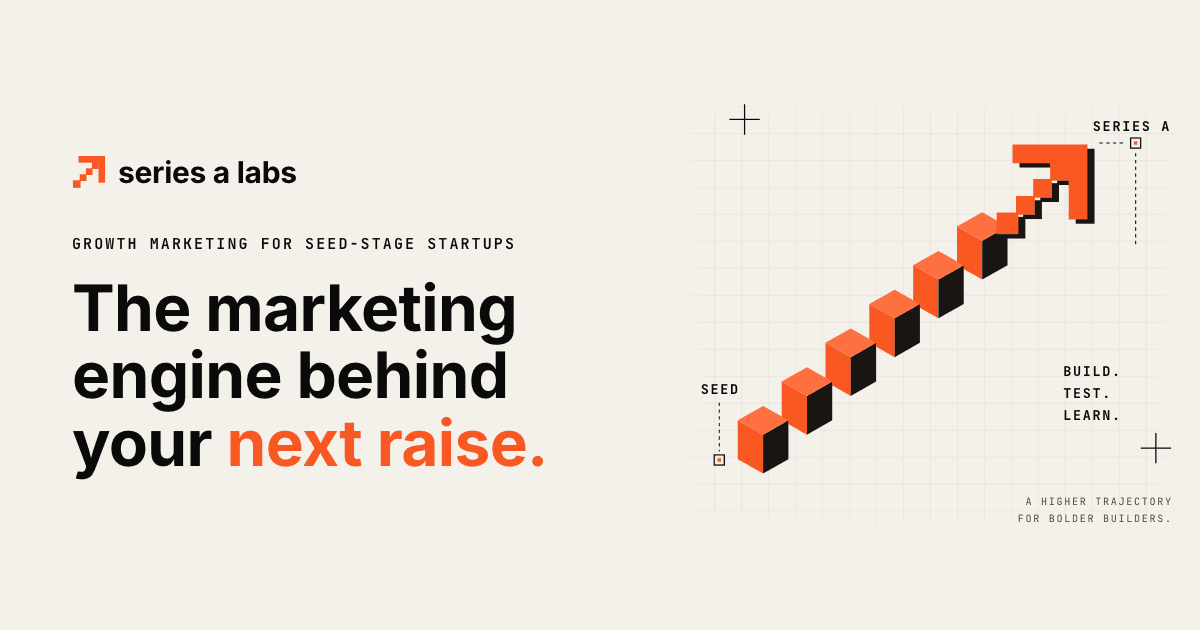
Series A Labs exists for exactly this window. Their tagline states the thesis without any hedging: the marketing engine behind your next raise.
The repeatability gap
What makes the seed-to-A gap so treacherous is that the skills that got you here are not the skills that get you there. Founder-led sales is high-touch, intuition-driven, and unfalsifiable. You closed the deal because you were in the room. Nobody can tell you which part of the pitch worked, which channel the buyer actually came through, or whether the next founder-shaped effort will produce the same result.
An engine is the opposite. It is boring on purpose. A specific channel, a specific message, a specific cost, a conversion rate you can write on a whiteboard and defend in a partner meeting. Building one is less about creativity than about discipline: you have to be willing to run small, honest tests and let a lot of your favorite ideas lose.
Most seed-stage teams get this wrong in one of two directions. Either they hire a full-time head of marketing eighteen months too early and hand that person a blank canvas and no data, or they scatter money across five channels at once, get muddy signal from all of them, and conclude that "marketing doesn't work for us." Both failure modes come from the same root: treating go-to-market as a thing you set up once, rather than a sequence of experiments you run until something proves itself.
Choose the test, measure the result, build on what works
Series A Labs runs the experimental sequence as a service. Their framework is three steps, and the plainness of it is the point: choose the test, measure the result, build on what works.
In practice that means picking one channel and one hypothesis at a time and running it to a real conclusion. The firm concentrates on three channels, which is itself a telling choice — not a dozen, three:
SEO and GEO. Technical SEO plus conversion-focused content, with explicit attention to showing up in AI search answers. The GEO piece is worth pausing on. A growing share of buying research now happens inside ChatGPT, Perplexity, and Google's AI results rather than on a results page of blue links, and companies that only optimized for the old surface are quietly losing the new one. For a seed-stage company, being the answer an AI engine cites when someone asks "best tool for X" is the modern version of ranking first — and almost none of your competitors are working on it yet.
Google Ads. Run against acquisition cost, not clicks. The distinction sounds pedantic until you have watched a startup celebrate cheap traffic that never converted. A campaign that produces expensive clicks and qualified pipeline is a success; a campaign that produces cheap clicks and nothing else is a smoke machine.
LinkedIn Ads. Used less as a volume channel and more as a message-testing instrument. Because LinkedIn lets you target specific roles at specific companies, it is one of the few places a B2B startup can put three different value propositions in front of exactly its buyer and find out which one gets a response. The winning message then feeds everything else — the ads, the landing pages, the content, even the sales deck.
The philosophy tying it together shows up in one of the lines on their site: you don't need to be everywhere, you need to show up where your buyers are. For a company with eighteen months of runway, that is not a slogan. It is triage.
Why this fits the seed stage specifically
The obvious question about any agency is why you would not just do this in-house. At later stages you should. But the seed stage has a shape that makes the experimental-partner model unusually rational.
First, the work is spiky. The experimentation phase needs senior judgment across three or four disciplines at once — search, paid, positioning, analytics — and no single early hire covers all of them. Hiring four people to find out which two you need is exactly backwards.
Second, the timeline is fixed. The next raise arrives whether or not the engine is ready, and every quarter spent on a channel that was never going to work is a quarter of runway converted into a lesson. A partner who has already watched dozens of seed-stage companies run these same tests can compress the search, because they have seen which experiments tend to pay off for which kind of company. What they sell is not really marketing execution. It is a shorter path through the search space.
Third — and this is the part I find most clarifying — the output of the engagement is not just customers. It is the Series A narrative itself. "We tested five channels, two of them work, here are the unit economics, and this round funds pouring fuel on the two that work" is close to the platonic ideal of an A-round pitch. The experiments are the raise.
Series A Labs puts it as "your first customers weren't a fluke — let's find more," and that framing is exactly right. The seed round proved that somebody wants what you built. The job between now and the A is proving that you know how to find the rest of them, on purpose, at a price that makes sense. That is not a mystery. It is a sequence of tests, and the companies that get to the next round are usually just the ones that started running them earliest.
Bridget Landry works with startups backed by top-tier funds including a16z, Sequoia, Benchmark, and Y Combinator, helping them run the marketing and GTM experiments that carry them to their next fundraise.