The insurance call doesn't end when the caller hangs up
Call your insurance carrier about a fender bender and you already know how the next twenty minutes go. You wait on hold. You repeat your policy number to a person who then repeats it back. You describe what happened, they type it into a form, and at some point they say a version of "someone will follow up." The call ends, but the actual work is only starting: a claim has to be opened, the policy has to be checked, notes have to land in the right system, and a follow-up has to go out. Most of that happens out of your view, by hand, and slowly.
That gap between the conversation and the work behind it is where insurance operations quietly break down. Carriers, agencies, and brokers run on phone calls, email threads, and chat windows, and each of those interactions kicks off a chain of data entry across systems that rarely talk to each other. The call is the easy part. The paperwork it triggers is the expensive part.
This is the problem Strada is built around.
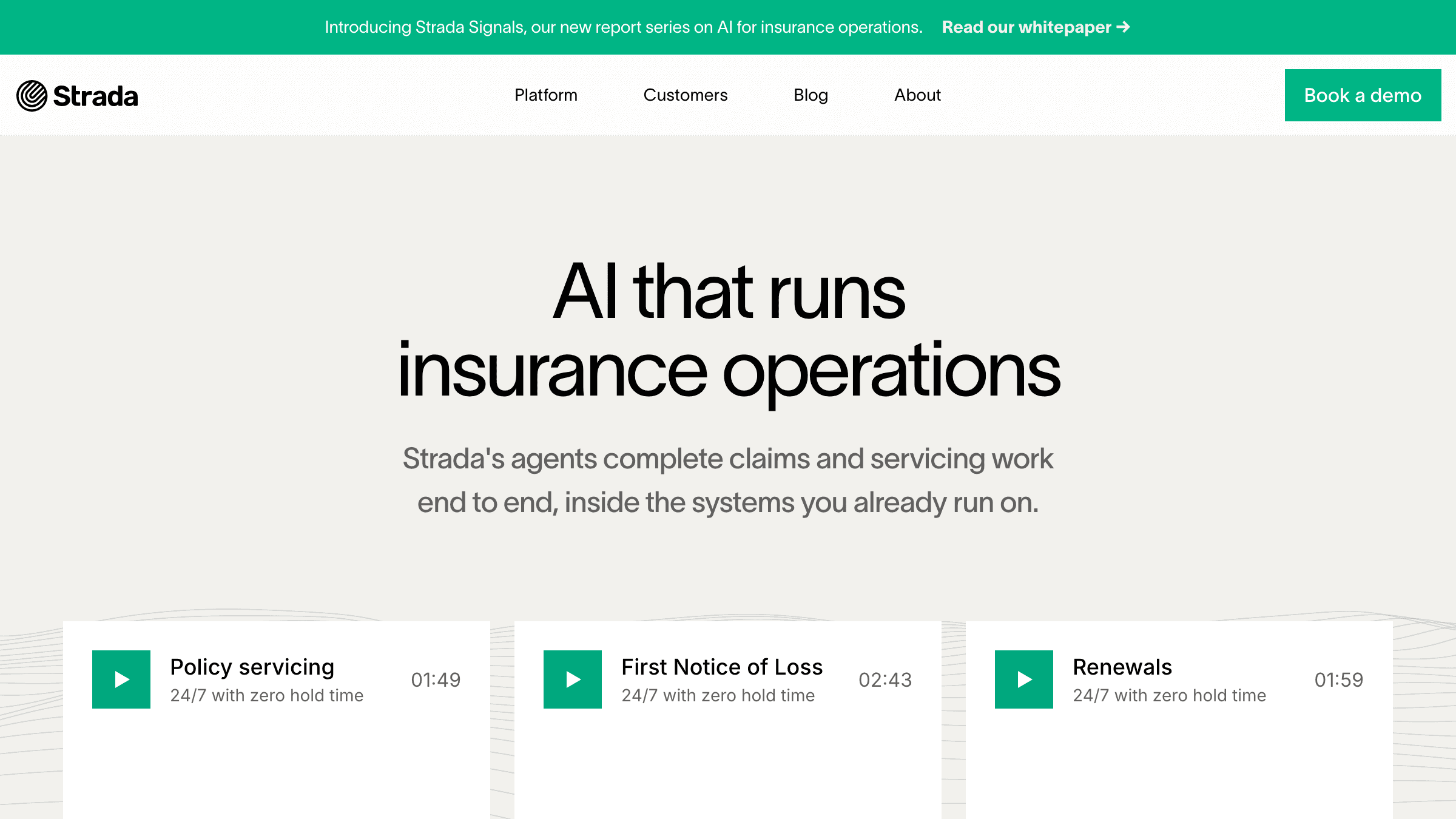
Strada builds AI agents that handle insurance conversations across voice, email, chat, and SMS, and then complete the work those conversations create inside the systems a carrier or agency already runs on. The agents take first notice of loss, handle renewals and quote intake, answer questions about claim status, and make outbound follow-up calls. What sets the approach apart is the second half: when the call ends, the agent updates the policy admin system, the CRM, the claims platform, and the agency management system in real time, rather than leaving a summary for a person to key in later.
Why insurance still runs on the phone
Plenty of industries have moved their routine customer contact to self-serve apps and chat. Insurance has been slower, and not because the incumbents are lazy.
The interactions are genuinely complicated. A renewal call can turn into a coverage question, a billing dispute, and a change of address in the space of a few minutes. A first notice of loss involves a person who is often stressed, describing an event that has to be captured accurately because the details drive everything downstream. The language is specialized, the stakes are real, and a wrong entry can mean a mispriced policy or a mishandled claim. So the phone has stuck around, because a trained human on the line can follow a messy conversation in a way a rigid phone tree or a generic chatbot cannot.
The cost of keeping the phone is staffing. Carriers, managing general agents, and brokers all run large service teams whose days fill up with the same recurring calls: where is my claim, can you send proof of insurance, I need to add a vehicle, my payment didn't go through. This work needs expertise to handle correctly, but most of it does not need a person's full judgment. It needs someone who understands insurance, listens carefully, and then does the follow-up accurately. That is a narrow enough shape for AI to take on, and it is the shape Strada is going after.
The work that starts when the call ends
The part of Strada that matters most is the part the caller never sees.
A conversational agent that can hold a natural phone call is impressive on its own, and voice AI has gotten good enough that a caller may not always be sure they are talking to software. But a call that ends with "we've noted your request" has only moved the bottleneck. Someone still has to open the claim, update the policy record, and trigger the next step. If that handoff stays manual, the AI has automated the easy 30 seconds and left the hard 15 minutes untouched.
Strada's agents are wired into the systems where the work actually lives. During a call they pull the relevant policy, claim, or account details, and after the call they write the results back: a claim opened in the claims platform, a policy change recorded in the policy admin system, a note logged in the CRM, a task created in the agency management system. Strada describes its agents as understanding insurance terms and acting instantly on what they hear, and the point of that is not the conversation itself but everything the conversation is supposed to set in motion.
This is what "AI operations for insurance," the phrase Strada uses, is meant to capture. The company is not selling a smarter answering service. It is selling an agent that closes the loop between the interaction and the record.
Why generic chatbots never fit insurance
There have been chatbots in insurance for years, and most of them have been disappointing, for reasons that have nothing to do with how well they chat.
A generic bot can answer a scripted question, but it does not know what a certificate of insurance is, cannot tell an endorsement from a rider, and has no way to act on either. Bolt one onto an insurance workflow and it becomes a front door with no rooms behind it. The customer types their problem, the bot deflects or escalates, and the interaction lands back in a human queue with nothing accomplished. The friction moved; it did not disappear.
Strada's argument is that the model has to be purpose-built for the domain. The agents are trained on insurance language and connected to insurance systems, so a caller reporting an accident can give the details once and have them captured correctly, and a broker's client asking for proof of coverage can get the document generated rather than a promise that someone will send it. The difference is not conversational polish. It is that the agent knows what the words mean and has somewhere to put the answer.
Voice, email, chat, and the systems underneath
Insurance customers do not all reach out the same way, and neither do the parties an agency deals with. A policyholder calls, an underwriter emails, a claimant texts, a partner agency uses a portal. Strada spans those channels rather than picking one, running agents across voice, email, chat, and SMS so the same servicing and claims work can be handled wherever it arrives.
Underneath, the integrations are the product. An agent is only as useful as its reach into the CRM, the agency management system, the policy admin platform, and the claims system, because those are the systems of record that make an action real. Strada leans on inbound and outbound voice agents that extract the relevant data during a conversation and immediately trigger the follow-up workflow afterward, which is what lets a single call move from spoken request to completed task without a person retyping anything.
Outbound matters as much as inbound here. A lot of insurance work is proactive: chasing a lapsed renewal, collecting a missing document, following up on an open claim. Those are exactly the tasks that slip when a service team is busy, and they are well suited to an agent that can make the call, have the conversation, and log the result.
Built for regulated work, not just demos
Insurance is regulated, and that shapes what a serious product in this space has to include from the start.
An agent that handles claims and policy changes is touching decisions with financial and compliance consequences, so a convincing demo is not enough. Strada builds quality assurance, escalation rules, and audit trails into its workflows, so that interactions can be reviewed, edge cases can be routed to a human, and there is a record of what the agent did and why. The company also publishes an enterprise security posture aimed at carriers and brokers who will not hand customer calls to a vendor without it.
This is the unglamorous scaffolding that decides whether vertical AI actually gets deployed. A carrier evaluating Strada is not only asking whether the agent sounds good on a call. It is asking what happens when the agent is unsure, who can see the transcript, and whether the whole thing will survive an audit. Building for those questions up front is a large part of why a domain-specific approach can win where a general one stalls.
Founders betting on the boring middle
Strada came out of Y Combinator's Summer 2023 batch and is backed by Orange Collective, the fund made up of YC alumni that invests alongside the accelerator.
The founders are Amir Prodensky, the CEO, who was a product manager at Revolut, and Arash Khazaei, the CTO, who led engineering at a fintech and was a tech lead at Microsoft. That is a fintech-and-infrastructure background rather than an insurance-lifer one, and it fits the shape of the bet. The hard part of Strada is not knowing insurance trivia. It is building software that plugs reliably into a mess of legacy systems and behaves well enough to be trusted with regulated work. That is an engineering and product problem as much as a domain one.
Prodensky frames the company's intent in a way its buyers can repeat comfortably: "We're not replacing people. We're making teams more productive." For an industry whose service teams are stretched thin by repetitive calls, that framing is not just diplomacy. The realistic near-term outcome is that agents absorb the high-volume routine work so that human staff can spend their time on the cases that actually need judgment.
The bet on vertical AI operations
Step back and Strada is a specific instance of a broader shift in how AI is getting sold to industries that run on operations.
The first wave of business AI was mostly horizontal: a chat assistant, a summarizer, a copilot that helps a person work faster. Useful, but it leaves the person in the loop for every step. The next wave is vertical and agentic, aimed at taking a defined workflow end to end inside the systems a business already uses. Insurance is a strong candidate for that model because so much of its work is high-volume, rule-bound conversation followed by structured data entry, which is precisely the seam where a domain-trained agent can do the whole task rather than assisting with part of it.
Whether Strada becomes the default for insurance operations will depend on execution against exactly the hard parts: the depth of its integrations, how it handles the calls that go sideways, and how much routine work carriers and brokers are willing to hand over. But the thesis is clean. Insurance still runs on conversations, and the value was never in the conversation. It was in everything that was supposed to happen after it. Strada is going after that second half, where the work actually is.