Making Unstructured Data LLM-Ready
One of the easiest mistakes to make right now is to think that AI progress is bottlenecked by models. If you mostly follow demos or benchmarks, that conclusion feels reasonable. But if you spend time with teams actually trying to build real products, a different constraint shows up very quickly. The models are often good enough, but the data they operate on is not.
Most real-world data is messy in ways that are hard to appreciate until you try to use it. It lives inside PDFs, scans, dashboards, and documents that were designed for humans, not machines. These documents mix text, tables, charts, and images in ways that depend heavily on layout and visual structure. When you try to extract meaning from them using simple tools, a lot of that structure gets lost.
This is the quiet failure mode of many AI products. Teams build something that works in a controlled demo, where the data is clean and predictable. Then they plug in real customer data and things begin to degrade in subtle but important ways. Answers become inconsistent, key details disappear, and edge cases multiply faster than engineers can patch them.
The usual instinct is to blame the model and try to improve it. Teams switch providers, tune prompts, or layer on additional logic. Sometimes this helps at the margins, but it rarely fixes the core issue. The underlying problem is that the model is being asked to reason over data that has already lost its structure.
To understand why this happens, it helps to notice that documents are not just text. A table is not a paragraph with odd spacing, and a chart is not just an image with some labels. These are structured objects where meaning depends on relationships between elements. When you flatten them into plain text, you destroy exactly the information that makes them useful.
This is why parsing turns out to be the hard problem. Generating plausible language is something modern models already do quite well. Extracting the correct structure from messy, multimodal documents is much more difficult and much less solved. It is also the step that everything else depends on.
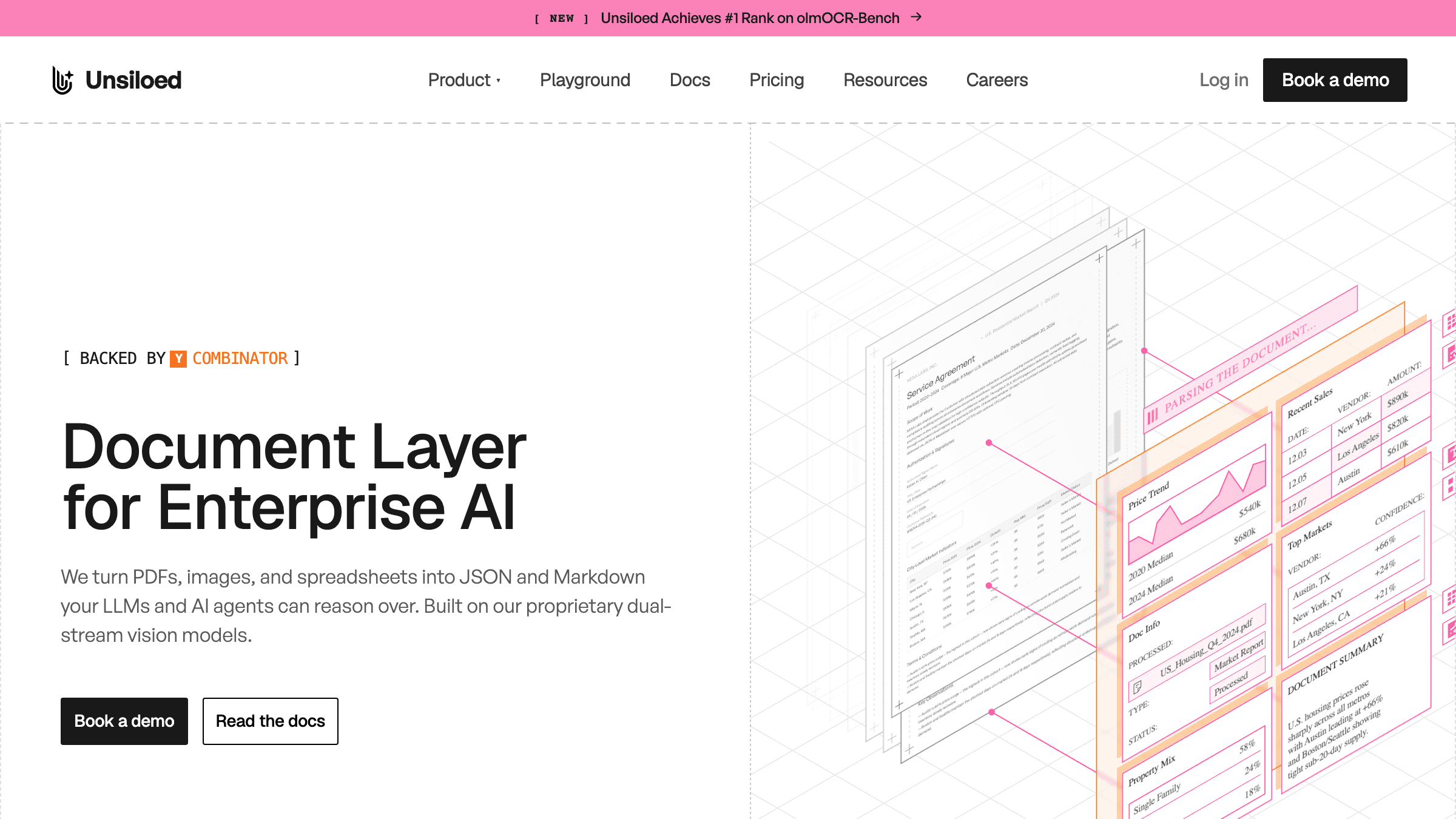
Unsiloed AI starts from this observation and treats parsing as the core product rather than a preprocessing step. Instead of assuming that generic OCR and text parsing are good enough, they built vision models specifically designed to understand documents. These models look at layout, hierarchy, and relationships, not just raw text tokens. The goal is to preserve as much of the original structure as possible.
This difference shows up clearly in practice. When a system understands that a set of numbers belongs to a table, it can preserve rows and columns instead of outputting a confusing stream of text. When it recognizes the structure of a form, it can map fields correctly instead of guessing based on proximity. The output becomes structured data that can actually be queried and used downstream.
Once you have that, many other problems become easier. Retrieval improves because chunks correspond to meaningful units rather than arbitrary slices of text. Answers become more accurate because the model is grounded in better inputs. Automation becomes more reliable because the system can consistently extract the same fields across different documents.
This is especially relevant for RAG systems, which are often blamed for being brittle. In many cases, the brittleness is not in the retrieval layer itself but in the data it is built on. If the parsing step is wrong, everything that follows inherits that error. Fixing the source of the data often has a larger impact than improving the retrieval algorithm.
What is interesting about Unsiloed is that the product surface is quite simple. You send in documents and receive structured, LLM-ready data in return. But behind that simplicity is a large amount of complexity that would otherwise fall on the user. Instead of spending months building and maintaining document pipelines, teams can treat this as infrastructure.
This is a familiar pattern in good startups. They take something that is painful, repetitive, and easy to underestimate, and they turn it into a clean abstraction. Payments used to be this way before Stripe, and logging infrastructure looked similar before companies like Datadog. Unstructured data is now at that stage for AI applications.
The timing also makes sense. There is now real demand for systems that work in production, not just in demos. At the same time, vision models have improved enough to handle complex document layouts with reasonable accuracy. These two shifts together create an opportunity to rebuild a layer of the stack that used to be unreliable.
Early usage reflects this. Unsiloed's APIs are already parsing large volumes of documents for both startups and large enterprises. These are environments where accuracy matters, because mistakes directly affect business outcomes. The fact that teams continue to use the product suggests that it is solving a real and persistent problem.
It is also a category where benchmarks are more meaningful than usual. You can measure whether a table was extracted correctly or whether a field was identified accurately. According to their reported results, Unsiloed outperforms a range of existing tools in these tasks. That kind of improvement tends to compound quickly when it sits at the base of a system.
A useful way to think about this is that Unsiloed is building the data transformation layer of the AI stack. Models sit above it, and applications sit on top of those models. But none of it works well unless the data entering the system is clean and structured. This layer is not the most visible, but it is one of the most important.
When this layer works, it unlocks a different class of applications. You can build systems that reliably answer questions over messy documents, automate workflows that depend on precise extraction, and create vertical AI tools that operate on real-world data. These are the kinds of products that move beyond demos and into everyday use.
If you follow Paul Graham's advice about startups, this direction also makes sense. The best ideas often start with a problem that is both common and poorly solved. Unstructured data fits that description well, because nearly every company has it and very few handle it effectively. Solving it deeply creates leverage across many different applications.
The broader lesson is that progress in AI will not come only from better models. It will also come from improving the layers around them, especially the ones that are easy to overlook. Data infrastructure is one of those layers, and it is likely to matter more over time, not less.
If you are building with AI, it is worth starting from the data rather than the model. The quality of the input determines the ceiling of what the system can do. Improving that input often yields larger gains than swapping out the model itself.
Unsiloed is essentially a bet on that idea. By making unstructured data LLM-ready, they aim to unlock everything that sits above it. So far, the early signals suggest that this is the right place to build.