Why Cua Is Building the Infrastructure Layer for AI Desktop Agents
The AI agent era has a problem most people haven't noticed yet.
Agents can chat. They can write code. They can browse the web. But ask an AI agent to open Excel, navigate a legacy enterprise application, or interact with desktop software that has no API, and it hits a wall.
This is not a minor gap. It is a structural limitation.
Most business software still lives on the desktop. ERP systems, accounting tools, medical records platforms, government portals, industrial control panels. These applications were built for humans clicking buttons and typing into fields. They were never designed for programmatic access.
The browser-based agent wave solved part of this problem. But the desktop remains largely untouched. And that's where Cua comes in.
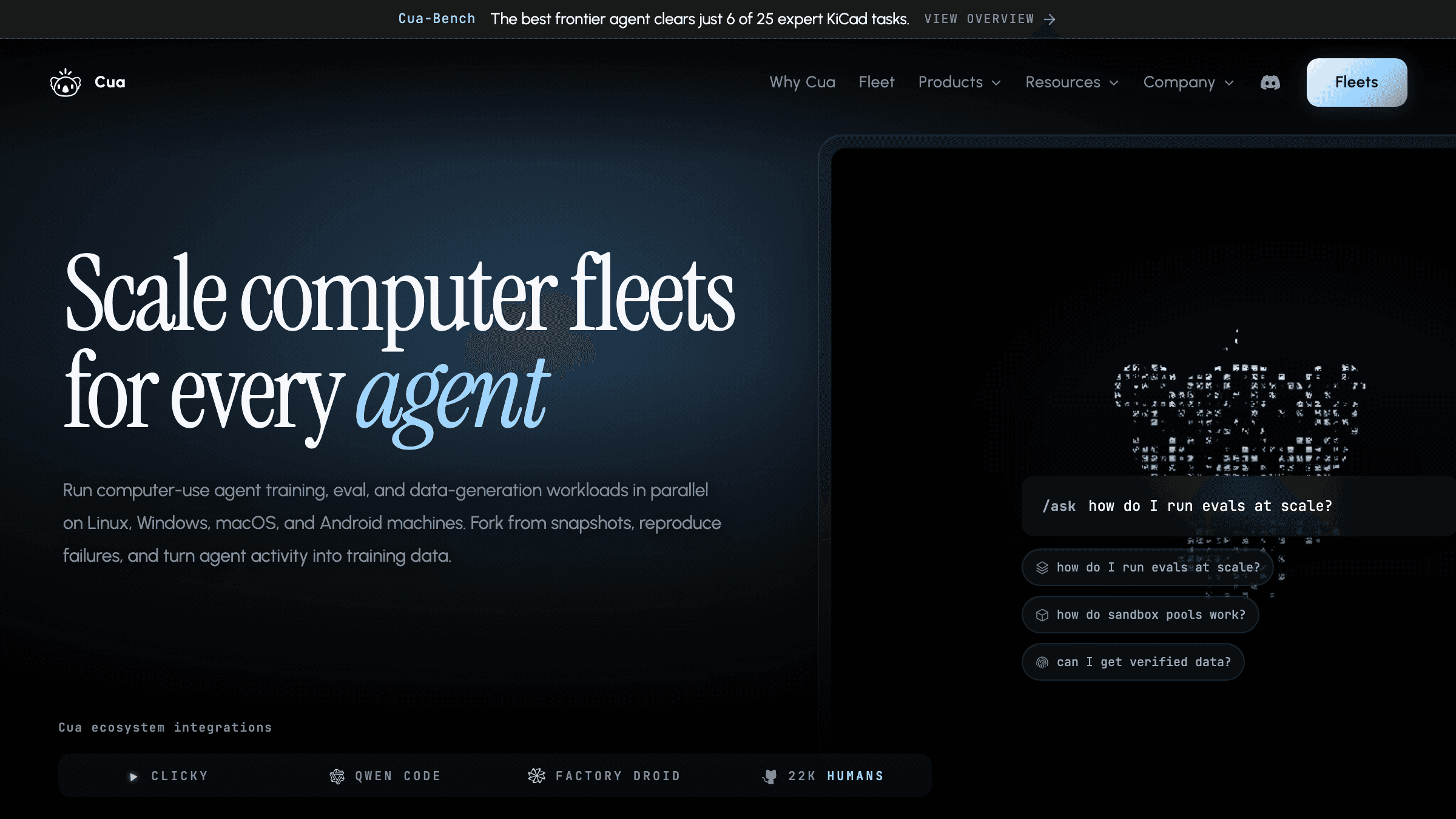
Cua, backed by Y Combinator (W25 batch), is building an open-source framework that gives AI agents the ability to control complete operating systems inside lightweight virtual containers. The tagline is simple: "Give every agent a cloud desktop."
The Desktop Gap
Consider how much critical business work still happens outside the browser.
A tax preparer uses installed software to file returns. A logistics coordinator uses a desktop application to manage shipments. A hospital administrator navigates a thick-client ERP to process credentialing paperwork. A financial analyst runs models in Excel with custom macros.
These workflows cannot be automated by web-scraping tools or API integrations. The software has no API. There is no webhook. There is no export button that produces clean structured data.
For decades, companies addressed this with Robotic Process Automation (RPA). Tools like UiPath and Automation Anywhere built scripted bots that could click through desktop interfaces. But RPA is brittle. It breaks when a button moves. It requires expensive consultants to maintain. It cannot adapt to unexpected states.
AI changes the equation fundamentally. A vision-capable language model can look at a screen, understand what it sees, and decide what to do next. It doesn't need pixel-perfect coordinates or pre-scripted flows. It can reason about the interface the way a human would.
But there's a missing piece: where does this agent actually run?
The Infrastructure Problem
You wouldn't run an AI agent on your production laptop. The agent needs to click, type, open applications, navigate menus, and potentially make mistakes. Running it on a user's actual machine is a security and reliability nightmare.
What's needed is a sandboxed environment where the agent can operate freely without affecting real systems until its work is verified. This is exactly what Cua provides.
Cua's framework spins up lightweight virtual containers that run a full operating system. The AI agent gets its own desktop, its own applications, its own filesystem. It can interact with everything on that virtual machine as if it were a human sitting at the keyboard.
The key technical achievement is performance. These containers run at approximately 97% native speed on Apple Silicon hardware. That means the agent isn't fighting lag or dealing with sluggish rendering. It operates in real-time, the way a person would.
This matters more than it might seem. AI agents that control GUIs rely heavily on visual feedback. They take a screenshot, decide on an action, execute it, then take another screenshot to verify the result. If the environment is slow, this loop becomes impractical. Latency compounds. Tasks that should take seconds stretch into minutes.
By achieving near-native performance, Cua makes the feedback loop fast enough for practical desktop automation.
Why Open Source Matters Here
Cua's decision to build in the open is strategically significant.
Desktop automation touches every industry and every workflow. No single company can anticipate all the use cases. By open-sourcing the framework, Cua benefits from community contributions, third-party integrations, and the trust that comes from transparency.
There's also a practical dimension. Enterprises evaluating AI agents for sensitive workflows need to inspect the code. They need to understand exactly what the agent can access, how the sandbox is isolated, and what security boundaries exist. Open source provides that auditability.
The framework is compatible with various language models, meaning developers aren't locked into a single AI provider. As models improve, as new capabilities emerge, Cua's infrastructure layer remains relevant. It is model-agnostic by design.
This positions Cua not as an AI application but as an AI platform. The applications are built on top.
The Founder's Background
Francesco Bonacci, Cua's founder, previously worked at Xbox and Microsoft AI. That background is directly relevant.
Gaming and operating system engineering require deep understanding of virtualization, GPU acceleration, low-level system interaction, and performance optimization. These are exactly the skills needed to build lightweight, high-performance virtual desktop environments.
The gaming industry has spent decades solving the problem of running complex graphical applications with minimal latency. Cua applies that expertise to a new domain: giving AI agents performant visual environments to operate in.
Where This Fits in the AI Stack
The AI industry is rapidly stratifying into layers:
- Foundation models (OpenAI, Anthropic, Google) provide reasoning and vision capabilities.
- Agent frameworks (LangChain, CrewAI, AutoGen) provide orchestration and tool use.
- Execution environments provide the actual substrate where agents take action.
Cua occupies that third layer. It doesn't compete with model providers or agent frameworks. It complements them. Any agent built with any framework using any model can use Cua's containers as its execution environment.
This is an important distinction. The execution layer is infrastructure. It is the "where," not the "what" or the "how." And infrastructure tends to consolidate. Just as most web applications run on a small number of cloud platforms, most desktop-controlling agents will likely run on a small number of execution environments.
Being early, open-source, and performant in this layer is a strong position.
The Market Opportunity
The total addressable market for desktop automation is enormous. Every manual workflow that touches installed software is a potential use case.
Consider just a few verticals:
- Accounting: Tax preparation software, bookkeeping applications, payroll systems.
- Healthcare: EHR systems, credentialing portals, insurance claim tools.
- Legal: Document management systems, court filing portals, contract review tools.
- Government: Licensing portals, compliance reporting systems, procurement platforms.
- Finance: Trading platforms, risk modeling tools, regulatory reporting systems.
In each of these, billions of dollars in labor are spent on humans navigating desktop applications. Not because the work requires human judgment, but because the software requires human hands.
Cua's infrastructure makes it possible to remove that constraint.
Why Now
Three trends converge to make this the right moment:
First, vision-capable language models have reached sufficient quality. GPT-4V, Claude's vision capabilities, and Gemini can all interpret screenshots with high accuracy. The "eyes" for desktop agents now exist.
Second, Apple Silicon has made high-performance virtualization accessible. Running lightweight VMs at near-native speed was not practical on previous hardware generations. The M-series chips changed the economics of virtualization.
Third, enterprise appetite for AI automation is surging. Companies that were cautious about AI in 2023 are now actively seeking implementations. The question has shifted from "should we use AI?" to "where can we deploy it fastest?"
Desktop automation sits at the intersection of all three trends.
The Bigger Picture
The most important AI infrastructure companies often look boring from the outside. They provide the pipes, not the water. AWS didn't build applications. It built the platform others used to build applications.
Cua is making a similar bet at a different layer. It isn't building the agent that files your taxes or processes your insurance claims. It's building the environment where any agent can do those things safely and quickly.
If desktop-controlling AI agents become widespread, and every signal suggests they will, the infrastructure layer will be foundational. Every agent needs somewhere to run. Every enterprise needs that environment to be secure, fast, and inspectable.
Cua is positioning itself to be the default answer to that need.
The company is still early. The technology is still maturing. But the structural logic is sound: AI agents need operating systems to operate. Cua gives them one.
And in the emerging AI stack, the company that owns the execution layer often ends up owning more than it initially appears.