RevisionDojo Is Building an AI Tutor That Knows the Exam Cold
Every serious exam divides students into two groups, and the line between them has almost nothing to do with intelligence.
On one side are the students whose parents can afford a good private tutor—someone who has read the syllabus, seen a decade of past papers, knows exactly how the examiner awards marks, and can sit beside them every week and say, "Here's the specific thing you're getting wrong." On the other side is everyone else: bright, hardworking students left to grind through textbooks and hope they're practicing the right things in the right way.
The gap isn't effort. It's access to a person who actually knows the test. Private tutoring is a scarcity good—expensive, geographically limited, and wildly variable in quality. A great tutor can be transformative. Finding one, affording one, and keeping one is a lottery most families lose.
That is the problem RevisionDojo is built to solve.
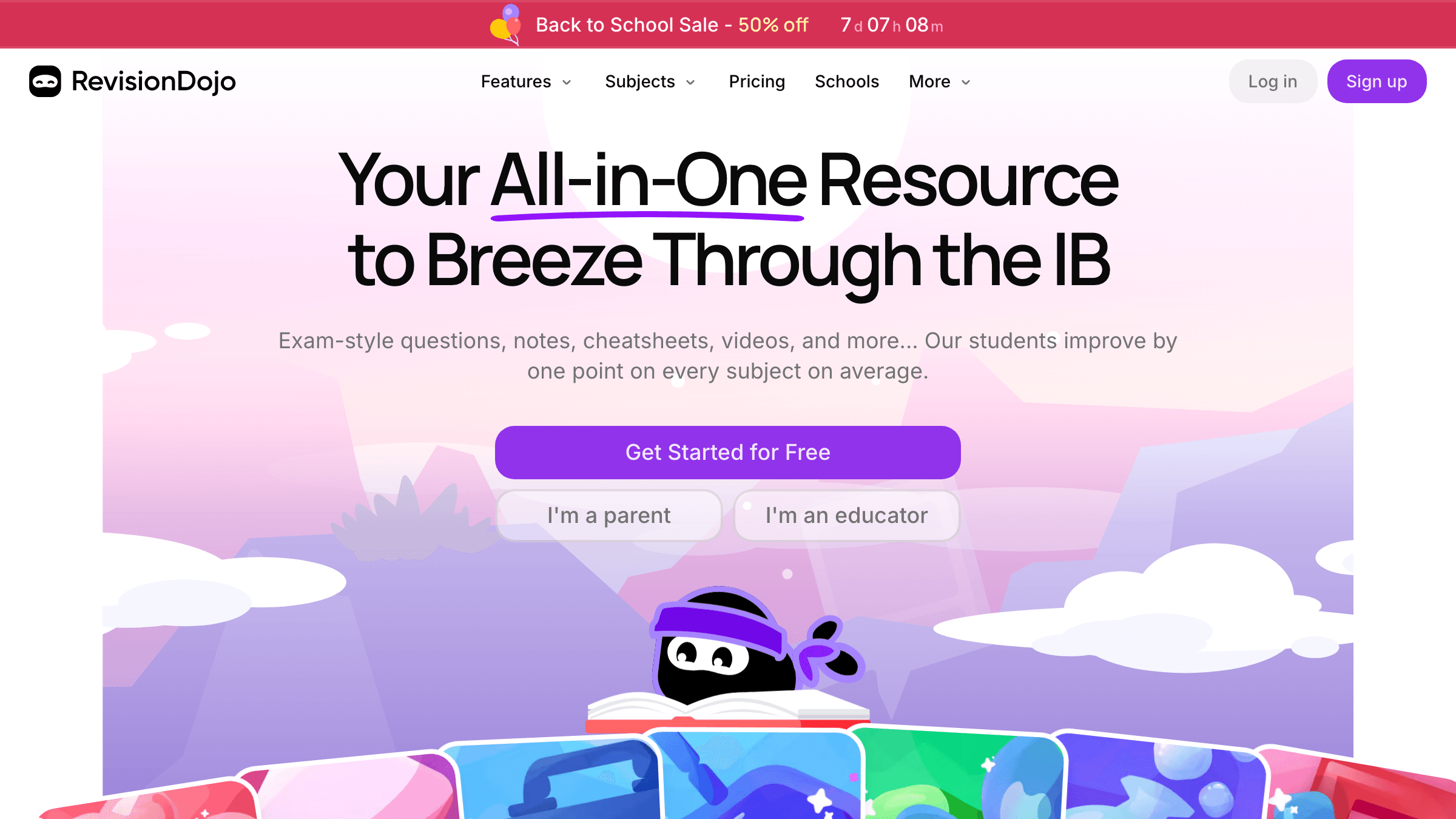
RevisionDojo is an AI-powered study platform for high-stakes standardized exams—starting with the International Baccalaureate—that pairs a curriculum-trained AI tutor named Jojo with examiner-written notes, a large exam-style question bank, and AI grading calibrated to the official mark schemes. The pitch is simple and, for a certain kind of student, electrifying: an AI study partner that knows your exact exam as well as an expensive tutor does, available at 2 a.m. the night before your mock, for a fraction of the price—or free.
The Tutoring Problem Isn't Effort. It's Feedback.
To see why RevisionDojo works, you have to be precise about what a good tutor actually provides.
It isn't information. Information has been free and abundant for twenty years. Any student can find a summary of photosynthesis or a worked example of integration by parts in seconds. The bottleneck was never access to facts.
What a tutor provides is feedback loops. They watch you attempt a problem, see precisely where your reasoning breaks, and correct it before the mistake calcifies. They mark your practice essay against the same criteria the real examiner will use and tell you that your argument was fine but you lost four marks for never engaging the counterpoint. They know that on this exam, this type of question is really testing that skill. That tight, specific, curriculum-aware feedback is the expensive part—and it's exactly what a student studying alone can't manufacture.
The traditional edtech answer was to throw content at the problem: video libraries, digitized textbooks, banks of flashcards. Useful, but it automated the abundant thing (information) and left the scarce thing (feedback) untouched. A student can watch a hundred hours of lecture video and still have no idea whether their own essay would earn a 3 or a 7.
RevisionDojo's insight is to automate the feedback, not the content. The product is organized as a loop—learn, practice, get graded, sit a mock, repeat—with an AI tutor sitting inside every step to tell the student what's actually going wrong.
Why the IB Is the Perfect Place to Start
The single smartest thing about RevisionDojo is where it chose to begin.
The International Baccalaureate is one of the most demanding pre-university programs in the world, taken by hundreds of thousands of students across more than 150 countries. And critically for an AI company, it is standardized and rubric-driven. There is a published curriculum. There are official mark schemes. Examiners award points against explicit, documented criteria. On an IB exam, "correct" and "well-argued" are not vague—they are defined, and the definition is written down.
This matters enormously, because the great fear about AI in education is the same fear that haunts AI everywhere: that a confident model will simply make things up. A tutor that hallucinates a wrong method or invents a mark scheme is worse than no tutor at all. In an open-ended, subjective domain, that risk is hard to bound.
The IB constrains the problem in exactly the way that makes AI trustworthy. Because the curriculum is fixed and the mark schemes are explicit, an AI tutor can be grounded in the real source material and evaluated against a real standard. The question "did the model grade this essay the way an IB examiner would?" has a checkable answer. RevisionDojo isn't asking its AI to have good taste in the abstract; it's asking it to apply a specific, documented rubric to a specific, bounded syllabus. That's a domain where machine feedback can be held accountable—and accountability is the whole product.
It's the same reason serious AI companies tend to win first in domains with crisp ground truth. The IB gives RevisionDojo a curriculum where the AI can be right or wrong in a way you can actually verify.
What Jojo Actually Does
At the center of the platform is Jojo, an AI tutor trained on the IB curriculum, and the design choices around it reveal a real understanding of how learning works.
The most important is that Jojo is built to walk students through problems rather than hand them answers. Ask it a question and it doesn't just dump a solution; it guides—prompting, explaining the method, surfacing the concept the student is missing. This is a deliberate pedagogical stance. A tool that spits out finished answers produces homework; a tool that develops the student's own reasoning produces understanding. In an era where "AI for school" too often means "AI that does the assignment for you," RevisionDojo is explicitly building the opposite.
Around Jojo sits the rest of the stack:
A large exam-style question bank. Tens of thousands of practice questions modeled on the real exams, with instant, mark-scheme-aligned feedback on every attempt—the tight practice-and-correction loop that used to require a human sitting across the table.
Notes written by examiners. Study material authored by people who actually understand how the exam is marked, not generic summaries scraped from the open web. This is the grounding that keeps the AI honest and the content trustworthy.
AI grading of essays and coursework. Jojo can mark long-form work against the official criteria, tell a student where the marks were lost, and point to exactly what a top-scoring answer does differently—complete with exemplars and prediction papers on the higher tiers.
Full mock exams. Timed, realistic practice under exam conditions, so the first time a student sits the format isn't the day that counts.
RevisionDojo is careful to position all of this as a complement to school, not a replacement for it. It sits alongside the classroom and the teacher's own system as the revision layer—the part of the journey that has always happened alone, at a desk, the night before, without help. That's the moment RevisionDojo is trying to own.
Pricing That Meets Students Where They Are
If your thesis is that great tutoring should stop being a privilege, your pricing has to prove it—and RevisionDojo's does.
There's a genuinely usable free tier: students can work through the question bank and get instant, mark-scheme-aligned feedback from Jojo without paying anything. Paid plans layer on more—unlimited content and AI support on the Plus tier, and coursework grading, exemplars, prediction papers, and expanded tutoring on Pro—but the prices sit in the range of a couple of streaming subscriptions, not the hundreds of dollars an hour a human tutor commands.
The most telling decision is on the school side: RevisionDojo offers teachers and partner schools access to its higher-tier tools at no cost, with discounts flowing to students at those schools. That's not just goodwill. It's a distribution strategy that doubles as a mission statement. Put the professional-grade tooling in teachers' hands for free, and the platform reaches exactly the students who could never have afforded a private tutor in the first place—the ones the whole thesis is about.
Consumption-friendly, free-tier-first pricing is what you build when you want ubiquity rather than margin on day one. In education, where the addressable market is "every student sitting this exam," ubiquity is the right thing to chase.
Founders Who Sat the Exam Themselves
RevisionDojo is credible in large part because of who's building it, and the origin story is unusually authentic.
The founding team—Bowen Liu, Janet Liu, and Michael Tong—first connected online over a very specific question: why do some students thrive while others, working just as hard, feel like they're constantly falling behind? Their answer was that the difference is rarely raw ability. It's whether a student has the right support at the right moment. The company, which went through Y Combinator's Winter 2024 batch (originally as StudyDojo) and has raised a $3.4M seed round, is essentially that conviction turned into product.
The domain expertise is real and personal. Janet Liu scored in the top fraction of a percent of IB students worldwide and co-founded the company while studying at the London School of Economics; the team's background spans LSE and Stanford. These are people who lived inside the exact exam they're now building for—who know what it feels like to be a talented student without a great tutor, and who know precisely which forms of feedback actually move a score. That lived understanding is hard to fake and shows up in the product's attention to how the IB is really marked.
The traction suggests the intuition is landing. RevisionDojo reports serving more than 350,000 students across 180+ countries and partnering with 2,500+ schools, with an independent survey it cites showing students preferring it to alternatives by a wide margin and a large majority reporting less exam anxiety after using it. For a young company in a category where students churn ruthlessly the moment a tool stops helping, that kind of reach is a meaningful signal.
The Bigger Shift
Step back, and RevisionDojo is an early instance of a pattern that's going to repeat across education.
For decades, the highest-leverage form of learning—one-to-one tutoring from someone who deeply knows the material and the test—has been fundamentally supply-constrained. There are only so many great tutors, they're expensive, and they cluster where the money is. That scarcity quietly shaped who succeeds on the exams that gate university, and therefore careers. The playing field was never level, and the tilt correlated far too closely with what a family could pay.
AI changes the supply curve. A curriculum-trained tutor that can grade an essay against the real mark scheme and explain the fix doesn't get tired, doesn't cost hundreds of dollars an hour, and doesn't run out at scale. It can be the same patient expert for the student in a well-funded international school and the student studying alone in a country with no tutoring market at all. When the scarce, expensive input becomes abundant and cheap, the thing it was rationing—here, high-quality feedback—stops being a privilege.
The winning products in this shift won't be the ones that bolt a generic chatbot onto a textbook and call it a tutor. They'll be the ones, like RevisionDojo, that ground their AI in a real curriculum and a real standard, design it to build understanding rather than shortcut it, and start in a domain where being right is something you can actually verify. The IB is a sharp wedge, but the same playbook extends to every high-stakes standardized exam in the world—each one a fixed syllabus, a published rubric, and millions of students who could use a tutor and can't get one.
That's the future RevisionDojo is building toward: not a cheaper version of the study guide, but the thing the study guide could never be—a tutor who knows your exam cold, sitting beside every student who wants one.