The rest of the world wants its own Starlink
Satellite internet stopped being a niche product a few years ago. It now keeps ships, planes, farms, mines, and entire rural regions online, and it has become the connectivity of last resort in disasters and war zones. For most of the planet, though, buying it means buying from one company: Starlink, which has launched more satellites than every other operator combined.
That works fine until it doesn't. A telecom operator in Central Asia or a device maker in the Gulf that builds on Starlink is wiring its infrastructure to a single American supplier, subject to American export rules and American foreign policy. Governments have watched access in an active war zone come down to one company's judgment, and they drew the obvious conclusion. Connectivity is now leverage, and nobody wants to be on the wrong end of it.
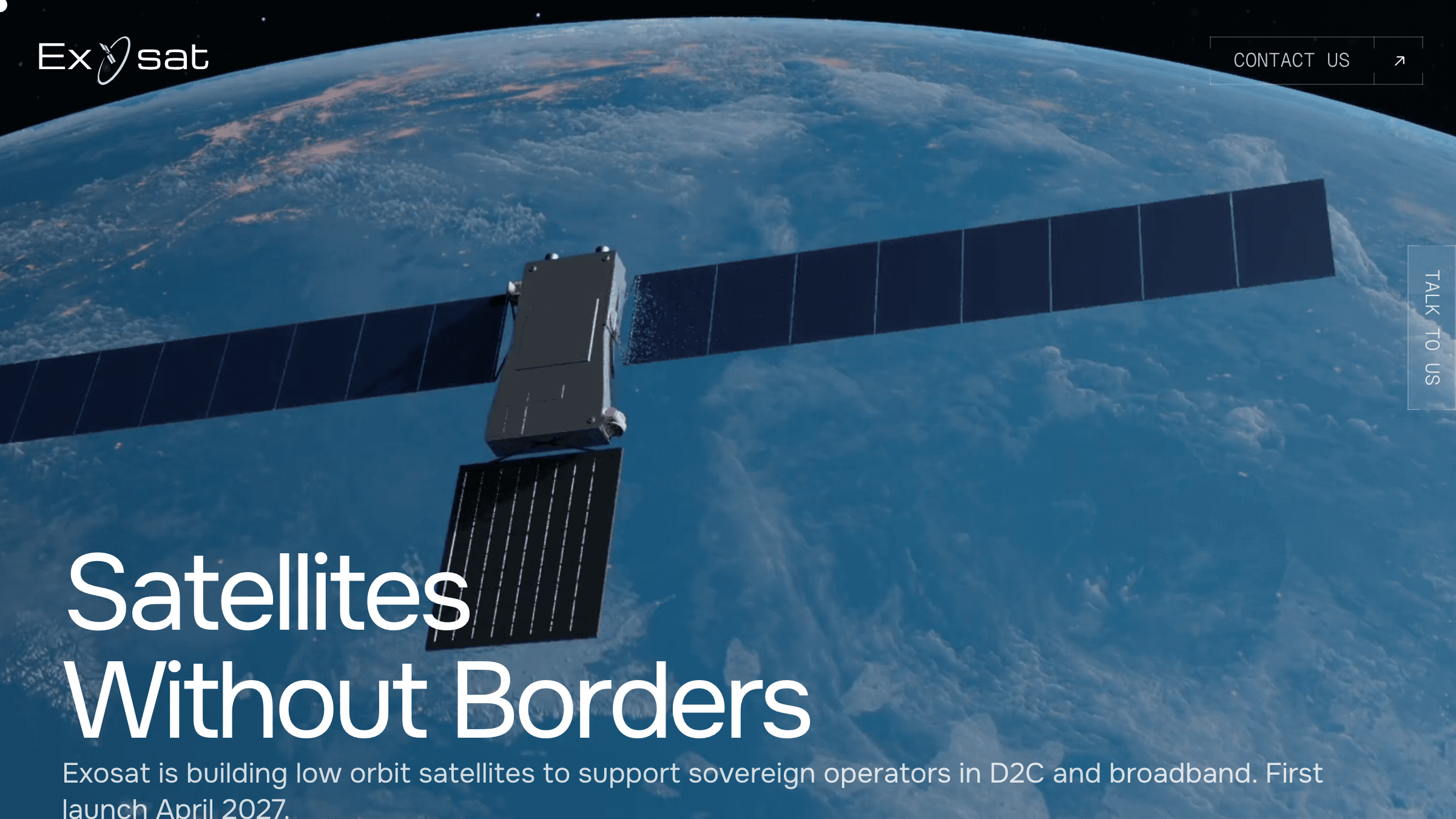
Exosat is a bet that this discomfort is a market. The company, founded in 2026 by Edward Ge and based in Singapore, is designing thousands of low-cost communication satellites to offer what it calls sovereign satellite connectivity: a neutral network that countries and companies can use without tying themselves to any one major power's supply chain. It went through Y Combinator's Summer 2026 batch, holds a filing with the International Telecommunication Union for an 11,000-satellite constellation, and has signed about $400 million in letters of intent with customers across six nations. The first launch is booked for April 2027.
Satellites with nothing on the export-control list
The interesting part of Exosat is not the constellation. Plenty of companies have announced constellations. The interesting part is a design constraint: Exosat satellites contain zero ITAR or EAR-controlled content.
ITAR and EAR are the two American export-control regimes that govern space hardware. In practice, if a satellite contains a controlled American component, the whole vehicle inherits American jurisdiction. Where it can be manufactured, who can buy it, which countries it can be sold into, and which rockets can carry it all become questions for Washington. This is why so much of the global space industry, wherever it is headquartered, still operates on American permission.
Design the controlled content out and the geometry of the business changes. Exosat can have its satellites manufactured anywhere in the world, which it says brings the cost to under a tenth of the usual figure. It can launch from other nations, which does two useful things at once: it bypasses the launch capacity bottleneck that has every Western provider booked out for years, and it opens up equatorial orbits. Those orbits pass over the same band of the planet on every revolution, so a small number of satellites can deliver dense coverage over Southeast Asia, the Middle East, and equatorial Africa, which is exactly where Exosat's early customers are.
None of this is a loophole. It is the deliberate, tedious work of engineering a satellite so that no part of it triggers anyone's export regime. The payoff is a product that a government in Jakarta or Astana can buy without also buying a dependency.
A paper constellation, but real paper
An ITU filing is not hardware in orbit, and the space industry is littered with constellations that never left PowerPoint. It is still worth taking seriously here, for a specific reason: spectrum.
The ITU coordinates which operators may use which radio frequencies from which orbits, and priority goes to those who file first and then actually deploy. Starlink's position today rests as much on its spectrum rights as on its rockets. Exosat's 11,000-satellite filing stakes a claim that, if built out, would be the largest communications network outside the United States and China. Filing early is how a newcomer keeps that option open at all; by the time demand is undeniable, the good spectrum is gone.
The deployment side is what turns the paper real, and that clock starts soon. Exosat has booked its first launch for April 2027, barely a year after the company was founded.
$400 million in signed intent
Letters of intent are not revenue, but they say something about where demand sits. Exosat reports around $400 million in LOIs with operators and device OEMs across Central Asia, Southeast Asia, and the Middle East, spanning six nations, signed before the company has a single satellite in orbit.
That geography is the thesis in miniature. These are regions with large populations coming online, patchy terrestrial infrastructure, and governments that think hard about which superpower's technology sits under their critical systems. They are also, mostly, along the equator, where Exosat's orbital plan concentrates coverage. An operator there currently has three options: build nothing, resell Starlink and accept the dependency, or wait for a Chinese constellation and accept a different dependency. Exosat is pitching itself as the fourth option, and basing itself in Singapore, a country that has made a national brand out of being aligned with nobody, is part of the pitch.
When Y Combinator's Brad Flora introduced the company publicly, the phrase he reached for was "one of the most ambitious, hilariously aggressive startups." Aggressive is the right word for signing nine figures of intent against a constellation that exists as filings and a launch contract. It is also roughly what the early history of every satellite network looks like when it works.
Connectivity first, compute later
Exosat's first product is bandwidth. It sells connectivity to network operators, who extend their coverage through the constellation, and to device OEMs, who build satellite links directly into their hardware. That is a known business with known buyers, and the LOIs suggest the buyers agree.
The second act is stranger and more interesting. Exosat plans to use distributed compute across the constellation to run low-latency AI inference for robots and autonomous vehicles operating in remote and rural areas. A mining truck in the Kazakh steppe or an agricultural robot in rural Indonesia has no data center within a thousand kilometers; a satellite overhead is, counterintuitively, the nearest compute. Round-tripping every camera frame to a cloud region on another continent is too slow for a machine that has to react to the world, so autonomy in remote places either carries all its intelligence onboard or gets help from something closer. A constellation in low Earth orbit is the only infrastructure that is close to everywhere at once.
If the satellites are already flying for connectivity, selling inference from orbit becomes a second revenue line on hardware Exosat has already paid to launch. It also gives the constellation a customer base that terrestrial networks cannot poach, since fiber will eventually reach most towns but will never reach a harvester mid-field.
This is the part of the plan where the founder's history stops being background and starts being the point.
A founder who has already flown hardware
Edward Ge is a second-time space founder, and his first company built almost exactly the component this second act needs. Before Exosat he co-founded Aethero, which makes radiation-hardened edge computers for satellites. Its first product, built around NVIDIA's Jetson Orin, delivers 100 trillion operations per second, against roughly 5 trillion for the space computers in common use. Aethero raised an $8.4 million seed led by Kindred Ventures, grew to millions in revenue with customers including Blue Origin and Booz Allen Hamilton, and put two satellites into orbit, with its first computer flying on a SpaceX Transporter rideshare in 2024.
In other words, the person proposing to run AI inference from orbit has already shipped orbit-rated AI computers, sold them, and watched them survive space. Ge's path there was unusual too: he and his Aethero co-founder grew up in the same small Michigan town and had earlier started Stratodyne, a company building high-altitude balloons for remote sensing. Balloons, then space computers, then a constellation. Each company built the thing the next one would need.
That progression matters for the credibility question hanging over any 11,000-satellite plan. Constellation startups usually die between the deck and the pad, and the graveyard is full of teams that had never flown anything. Exosat is run by someone whose hardware is in orbit right now.
Neutral by design
The easy read on Exosat is "Starlink competitor," and it is wrong in a useful way. Exosat is not trying to out-launch SpaceX or win American consumers. It is going after the demand Starlink structurally cannot serve: buyers whose whole problem is that Starlink is American, just as a Chinese constellation's problem, for them, would be that it is Chinese. A feature comparison will never surface that demand. It lives in procurement rules, in national security reviews, and in the quiet preference of a hundred governments for infrastructure with no flag on it.
The zero-ITAR design, the Singapore headquarters, the manufacturing spread across whoever builds cheapest, the launches from wherever has room: every piece of the company is shaped by the same idea, that neutrality is not a marketing position but an engineering requirement you either design in from the first part or never have.
Whether Exosat can execute a plan this size is the open question it shares with every constellation that ever filed with the ITU. But the demand it is pointed at is real, growing, and unserved, and the company has given itself a near-term test that no amount of framing can fudge. In April 2027, a rocket either carries the first Exosat satellites to orbit or it doesn't.