General Learning runs a different AI tutoring brand for every exam
Nobody studies in general.
A 17-year-old with IB Chemistry in May is not looking for "an AI tutor." She's looking for something that knows Paper 2, the mark scheme, and the difference between a 6 and a 7. A junior in Ohio prepping for the SAT wants adaptive practice for the digital test format, not a chatbot with opinions about the International Baccalaureate. A GCSE student in Manchester has never heard of either exam and never needs to.
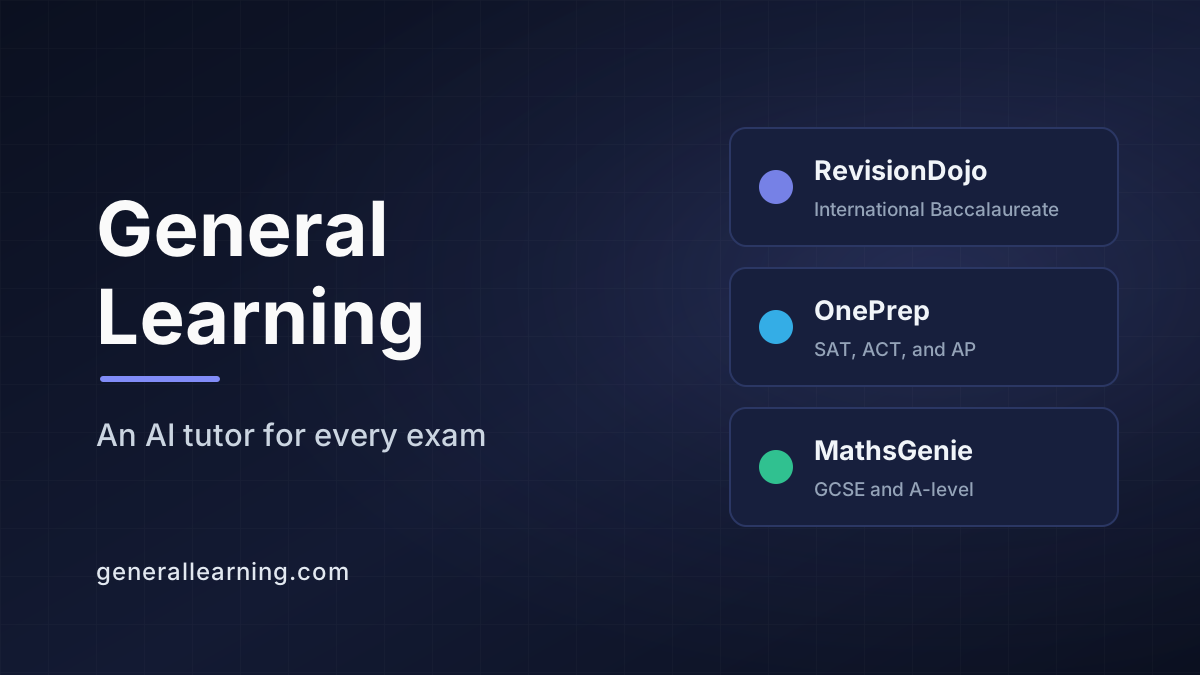
Most education software ignores this. The standard play is one app, one brand, one giant everything-platform, with the actual exams buried three menus deep. General Learning is making the opposite bet. The company builds AI tutoring and ships it as separate, exam-native brands: RevisionDojo for the IB, OnePrep for the SAT, ACT, and AP, and MathsGenie for GCSE and A-level. Each one presents itself as the dedicated platform for its exam, because to the student, that's exactly what it is.
Founded in 2023 and based in Hong Kong, General Learning went through Y Combinator in 2024 and has grown to around 35 people. Its stated mission is accelerating humanity's rate of learning. Its flagship brand alone, RevisionDojo, reports more than 650,000 students and teachers across 180+ countries and over 4,000 schools. That's an unusual amount of reach for a company whose own name most of those students have never seen.
Students shop for their exam, not for tutoring
The brand-per-exam structure looks like a marketing quirk. It's closer to the company's core insight.
Study tools are bought in a moment of specific, deadline-shaped anxiety. The query is never "best AI learning platform." It's "IB Econ Paper 1 past questions" or "digital SAT practice test free." Whoever owns that query, and looks purpose-built for it, wins the student. A general-purpose brand starts every one of those encounters at a disadvantage, explaining to an IB student why a platform that also does the ACT is right for them.
An exam-native brand skips the explanation. RevisionDojo calls itself the AI study platform for the IB. OnePrep positions as the premier AI platform for the SAT, ACT, and AP. MathsGenie claims the same ground for GCSE and A-level maths. Each speaks the dialect of its exam: the paper names, the grade boundaries, the calculator rules. For a student, that specificity reads as trust. A tool that knows your exam's vocabulary probably knows your exam.
There's a second effect that matters just as much. Exams come with cohorts. IB students congregate in the same subreddits and Discord servers; SAT prep spreads through American high school group chats; GCSE revision tips circulate in entirely separate corners of the internet. Word of mouth doesn't cross those borders, so a single brand can't ride it everywhere at once. Three native brands can each spread inside their own cohort, carried by students recommending "the IB thing" or "the SAT thing" to classmates sitting the same test.
Teachers are the third channel, and probably the most durable one. RevisionDojo gives teachers and partner schools access to its higher-tier tools at no cost, with discounts flowing to the students at those schools. A teacher who adopts the platform assigns it to a new cohort every single year, which is distribution no ad campaign can match. More than 4,000 schools now use the IB brand, and that institutional footing is what separates a study tool students find from one they're handed on the first day of class.
One machine behind three storefronts
Underneath the brands, the machinery is shared.
Each platform is built on the same components: large banks of exam-style practice questions, study notes aligned to the official syllabus, mini-lessons, and an AI tutor that adapts to the individual student as they work. RevisionDojo's tutor, Jojo, is deliberately built to walk students through problems rather than hand over answers, grading practice against the real mark schemes and showing where the marks were lost. The same loop of learn, practice, get graded, repeat shows up across the portfolio.
This is where the economics of the strategy get interesting. The expensive engineering, the tutoring engine, the grading, the adaptive practice, gets built once. What has to be redone per exam is the grounding: the curriculum mapping, the question banks, the notes, the mark-scheme calibration. That per-exam content work is real and slow, which is precisely why it's a moat. A generic chatbot can discuss photosynthesis; it cannot tell an IB student how examiners award the third mark on a data-response question, because that knowledge lives in documents and conventions specific to one exam system.
So each new brand is cheaper to build than the last, while remaining hard for a generalist to copy. That's a structure venture investors usually like, and students benefit from it too, since every exam added makes the underlying tutor better calibrated at the one job that matters: feedback against a real standard.
Exams are the right unit for AI tutoring
The deeper reason the portfolio works is that a standardized exam is one of the few places in education where an AI can be checked.
The fear with AI tutors is the same as with AI everywhere: a confident model inventing things. In an open-ended subject, that risk is hard to bound. A major exam bounds it. The IB, the SAT, GCSE: each has a fixed syllabus, published mark schemes, and examiners who award points against written criteria. Whether the AI graded an essay the way an examiner would is a question with a checkable answer. General Learning's whole catalog is built out of domains where its product can be held to a verifiable standard, one exam at a time.
The company's claims about results are, for now, its own. It reports that IB students using RevisionDojo improved by close to a full grade on average. A December 2025 survey of 1,063 OnePrep users found score gains at every starting band, with the largest, up to 378 points, among students who began between 600 and 800. In a survey of 88 IB teachers, 96% said the platform won them back hours of planning and grading time. Self-reported numbers deserve the usual discount, but they're specific, they're recent, and retention across thousands of schools is hard to fake in a market where students drop any tool that stops helping.
The pricing backs up the access story. RevisionDojo keeps a genuinely usable free tier, with paid plans priced like a couple of streaming subscriptions rather than like an hour of a private tutor's time. If the thesis is that the feedback a good tutor provides should stop being a luxury good, the price is where that thesis either holds or collapses, and General Learning has kept it holding.
From one brand to a holding company
General Learning didn't start as a portfolio. It started as one product, StudyDojo, which became RevisionDojo and found its footing inside the IB.
The founding team of Bowen Liu, Janet Liu, and Michael Tong connected over a question most edtech skips past: why do students working equally hard end up with wildly different results? Their answer was access to the right support at the right moment, which the private tutoring market rations by price. Janet had lived the exam side of it herself, scoring in the top fraction of a percent of IB students worldwide before studying at the London School of Economics. The company raised a $3.4M seed round in early 2025 under the RevisionDojo name, backed by Y Combinator, Goodwater Capital, 468 Capital, Amino Capital, and Team Ignite Ventures.
The rename to General Learning is the tell for where this is going. You don't adopt a holding-company name and a mission about humanity's rate of learning if the plan stops at three brands. The world is full of high-stakes standardized exams, each with a fixed syllabus, a published rubric, and millions of students who can't afford the human tutor who knows it cold. India has the JEE and NEET. China has the gaokao. Medicine has the USMLE, law the LSAT, finance the CFA. Every one of them is, structurally, another RevisionDojo waiting to be built on machinery that already exists.
The quiet advantage of being invisible
There's something almost old-fashioned about General Learning's setup. It looks less like a Silicon Valley platform company and more like a consumer goods conglomerate: a parent nobody buys from, brands everybody does. Procter & Gamble doesn't sell you "cleaning." It sells Tide to people doing laundry and Dawn to people doing dishes.
That model made sense for detergent because the buyer's context was everything. It makes the same sense for exam prep. The student's context is the exam, completely and overwhelmingly, for the one or two years it dominates their life. Software that honors that context earns trust faster than software that asks students to care about a platform.
The result is a company that can be simultaneously unknown and everywhere. Ask a student about General Learning and you'll likely get a blank look. Ask an IB student about RevisionDojo and there's a decent chance it's open in another tab. If the playbook keeps working, that gap between the invisible parent and its visible brands won't close. It will just repeat, exam by exam, until a sizable share of the world's test-takers are studying with a tutor built in Hong Kong by a company whose name never appears on the screen.