Henry raised $16.5M to write commercial real estate's deal decks
Every commercial building that trades hands travels inside a document. The industry calls it an offering memorandum: fifty-odd pages of aerial photography, rent rolls, lease abstracts, tenant profiles, and market comps, laid out like a magazine and pitched like a prospectus. Before a broker can sell the building, somebody has to make the book. That somebody is usually an analyst, and it is usually late at night.
The book is one item on a longer production list. To win the listing in the first place, the team prepares a broker opinion of value, a valuation document with much of the same material. To get the deal financed, it prepares a debt package for lenders. All of it runs through Excel, PowerPoint, and InDesign, and all of it is bespoke work on a deadline, because the deck is due when the pitch is scheduled, not when the analyst finishes. By Henry's accounting, producing these materials eats more than 20 hours a week across a brokerage's departments.
Henry was built to do that production work. The company, a Y Combinator Summer 2024 graduate based in New York and founded by Sammy Greenwall and Adam Pratt, generates offering memorandums, broker opinions of value, deal decks, and financing packages from the files brokers already have: the underwriting model, the rent roll, the photos, the property data. This July it announced a $16.5 million Series A led by FirstMark Capital, with strategic participation from Thomson Reuters Ventures and follow-on investment from Y Combinator, alongside a new product, Henry Deal, that pushes the platform past marketing materials and into the deal itself.
The deck is how buildings get sold
It is easy to mistake the materials for overhead. They are closer to the sales motion itself.
A broker competing for a $40 million listing walks into the pitch with a broker opinion of value, and the quality of that document is part of how the owner picks a firm. Once the listing is won, the offering memorandum is what every prospective buyer actually reads; for most of them it is the building, until diligence starts. The financing package plays the same role with lenders. In a business where the product is a transaction, the documents are the packaging, the storefront, and a good part of the credibility.
Which is why the production bottleneck costs more than analyst hours. A deck that takes a week to assemble is a week the listing sits unmarketed, a week of momentum the deal loses, a week during which a lender's terms or a buyer's appetite can move. Greenwall has made the point bluntly: these professionals were losing money every day the deck was being waited on.
The waiting also shapes who gets to compete. Large institutional teams keep in-house marketing and analyst groups to absorb the grind. Smaller shops, where a broker and one analyst cover everything, simply produce fewer and plainer materials, and walk into pitches against firms with a design department. The polish gap is a real competitive gap, and it has nothing to do with who knows the market better.
From a rent roll to a finished book
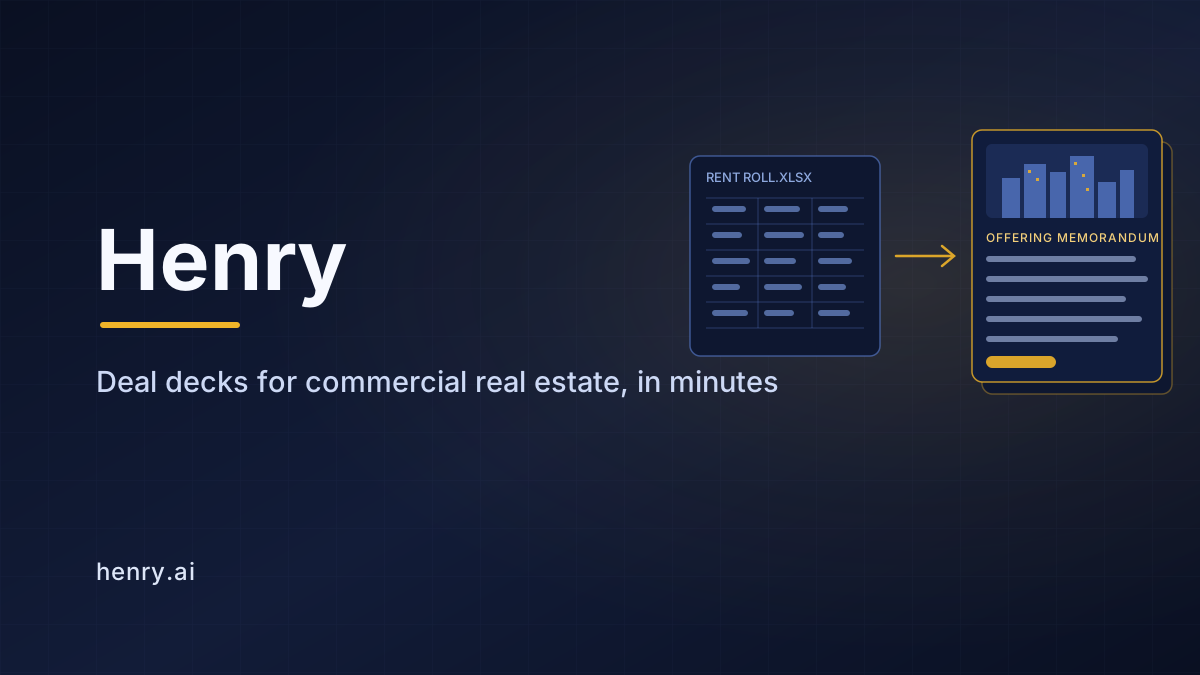
Henry's pitch is that the raw inputs already contain the deck. A rent roll plus an underwriting model plus a property address is most of what an offering memorandum says; the remaining work is extraction, formatting, market data, and judgment about what to emphasize. The first three are now automatable, so Henry automates them.
A broker uploads the deal files, and the platform drafts the document: branded to the firm's template, structured the way the asset class expects, with the tables built from the actual model rather than retyped into slides. Henry pairs the generated draft with a quality-control review before delivery, which matters in a document where a transposed rent number is not a typo but a liability. The broker edits and sends. The deliverable that leaves the building is the firm's own, indistinguishable in form from the one the analyst team would have spent days on.
The numbers Henry cites from customers are the before-and-after you would hope for. Teams at Colliers cut broker opinion of value turnaround from three or four days to under two hours. Compass teams report offering packages that took up to seven hours now taking about 20 minutes. Across the platform, Henry says brokers have produced more than 20,000 client-ready deliverables representing over $150 billion in underlying deal value.
That last number hints at why the wedge works. Deal materials are high-volume, deadline-driven, and structurally similar across deals, the profile of work that automates well. But they are also embedded in the highest-stakes moment a brokerage has, the pitch and the sale, which is why brokers will actually pay for speed here. Plenty of CRE software has died trying to change how brokers manage contacts. Henry slotted into the one piece of their week they were already desperate to hand off.
The founder spent years as the analyst
Greenwall did not discover this problem through customer interviews. He grew up in it. His family ran a commercial property business in the East Bay, he worked industry internships through school, and after college he joined Toll Brothers as an analyst, which in practice meant living inside the deck production he would later automate. He then co-founded Lev, a commercial real estate financing marketplace, and ran revenue there, watching from the capital-markets side as every deal waited on the same documents.
His co-founder is a childhood friend. Adam Pratt, Henry's CTO, had already started and sold a company: Halligan, a software platform for fire departments, acquired in 2019. The pairing is the standard one for vertical AI done well, a founder who has personally produced the artifact being automated and a technical founder who has shipped software into an unglamorous industry before.
They launched Henry in June 2024, went through YC that summer, and raised a $4.3 million seed in early 2025. The Series A followed roughly a year later, by which point the question had shifted from whether brokers would touch AI tooling to how much of the deal lifecycle Henry could cover.
Henry Deal goes after the rest of the transaction
The Series A announcement doubled as a product launch, and the product is the more interesting half.
Henry Deal extends the platform backward and forward from the deck: underwriting at the start, packaging and closing at the end. Reviewers describe starting an underwriting model from a sentence and a rent roll. The thesis is that a brokerage's deal knowledge, its comps, its past models, its market assumptions, the institutional memory that currently lives in senior brokers' heads and old folders, can be turned into working material for the next deal. Commercial Observer described the result as an end-to-end deal-making portal.
The strategic logic of the round matches that ambition. FirstMark partner Adam Nelson joined the board, and Thomson Reuters' venture arm came in as a strategic investor, a notable signature from a company whose business is professional-grade data and documents. Henry has said the money goes to engineering and product headcount.
There is an obvious reading of the trajectory. Deal decks were the beachhead, chosen because the pain was sharp and the output was easy to judge. The real prize is becoming the system a transaction runs through, the place where the underwriting, the materials, and the closing process live together. Henry's own language has grown into that reading; the company now talks about operating infrastructure for the industry's largest firms rather than faster decks.
The hard part was never the model
Commercial real estate brokers may be the toughest software customers in America. The industry is relationship-driven, commission-paid, and famously allergic to tools that add process. The graveyard of CRE point solutions is deep, and the brokers who ignored them were usually right to.
So Henry's adoption curve is the most telling fact about it. The company says teams from all of the largest commercial real estate brokerages are on the platform, more than 150 firms in total, with coverage reporting use at names like Colliers, Compass, and Marcus & Millichap. Two years in, that is not a pilot program footprint. It is what happens when a tool removes work brokers never wanted to own, without asking them to change how they sell.
That is the design decision worth copying. Henry did not ask the industry to adopt a new workflow, learn a new interface for managing deals, or trust an AI's judgment about price. It took the artifact brokers already produce, kept the firm's branding and the broker's authorship, and collapsed the hours behind it. The broker still walks into the pitch with their book. It just no longer costs an analyst's week to make.
The back office that assembled those books is shrinking into software, at Henry and everywhere else. What stays is the part of the job that was always the actual job: knowing the market, knowing the owner, and getting the deal closed. Henry's bet is that brokers would rather do that work than format it, and $16.5 million says the bet is landing.