Miru stops robot fleets from drifting one YAML edit at a time
Every robotics company has a version of this story. A robot in the field starts behaving strangely. Not broken, exactly, just different from its siblings. An engineer spends a day digging and finds the cause: a config file on that one machine was hand-edited months ago, during an on-site visit, to work around a customer request. Nobody wrote it down. The fix never made it back into the repo. The robot has been quietly running its own fork of the product ever since.
Multiply that by fifty robots across a dozen customer sites and you have config drift, one of the least glamorous and most persistent problems in robotics. The software on a robot is only half of what determines its behavior. The other half lives in configuration: YAML, JSON, XML, ROS parameters, Protocol Buffers, loaded at runtime and tuned per machine. A single robot can carry thousands of these parameters. When they diverge from what the team thinks is deployed, debugging turns into archaeology.
Miru is a San Francisco startup built to fix this. The company, founded by Armel Talla, Vedant Nair, and Benjamin Smidt and backed by Y Combinator in its Summer 2024 batch, makes config management for robot fleets: a system to define, version, validate, and deploy configuration to thousands of devices, with the same rigor software teams already apply to code.
The problem hiding in plain text files
Configs exist in robotics for a good reason. Robots ship into environments the engineering team cannot fully predict, so behavior that might change per site, per customer, or per unit gets pulled out of the code and into parameters. Camera exposure for a dim warehouse. Speed limits for a site with narrow aisles. A feature toggled on for one customer and off for everyone else.
The trouble is how those parameters get managed. In most robotics companies, the answer is text files, edited by hand, synced by whatever mechanism was easiest at the time. Vedant Nair, one of Miru's co-founders, laid this out in an essay on the company's blog titled "Robotics Config Management Is a Mess." Values are stored in config files and loaded at runtime, a single device can carry thousands of parameters, and customer-specific changes often mean an engineer editing each robot's config individually.
That workflow fails in predictable ways. Copy-pasting a whole config to create a variant for one robot means every future change has to be applied in multiple places, and eventually one of them gets missed. A typo in a hand-edited file might not surface until the robot does something wrong in front of a customer. And because nothing enforces structure, two robots that should be identical rarely are. The team's mental model of the fleet and the actual state of the fleet drift apart, file by file.
Why the server playbook doesn't transfer
The obvious objection is that infrastructure engineering solved configuration years ago. Put configs in git. Use Ansible or Chef. Use feature flags. Robotics teams have tried all three, and Miru's team has written a whole series of essays on where each one breaks down for robots.
The short version is that robots are not cloud servers. A server sits in a data center with a fast, reliable network connection and no physical consequences when it misbehaves. A robot is on a customer's factory floor, behind their firewall, on Wi-Fi that cuts out when a forklift drives past. It can reboot mid-update because someone hit an e-stop. And when its configuration is wrong, the failure is not a 500 error. It is a machine doing the wrong thing in the physical world.
Git alone versions the files but says nothing about whether a value is valid, which robot should receive which variant, or whether the change actually arrived. Server automation tools assume they can push to a machine that is reachable right now, which a robot frequently is not. Cloud feature flag services assume a constant connection to evaluate flags, and they were never designed to express "this robot, at this site, running this software version, gets this camera parameter."
Configuration for robots needs its own layer, built around intermittent connectivity, per-unit variation, and the cost of getting it wrong.
What Miru actually does
Miru's answer starts from an opinionated position: configs should have schemas. Instead of a loose pile of YAML, a team using Miru defines the structure of its configuration the way it would define an API. The schema says what parameters exist, what types they have, and what constraints they must satisfy. Engineers iterate on that schema locally, alongside the code that consumes it.
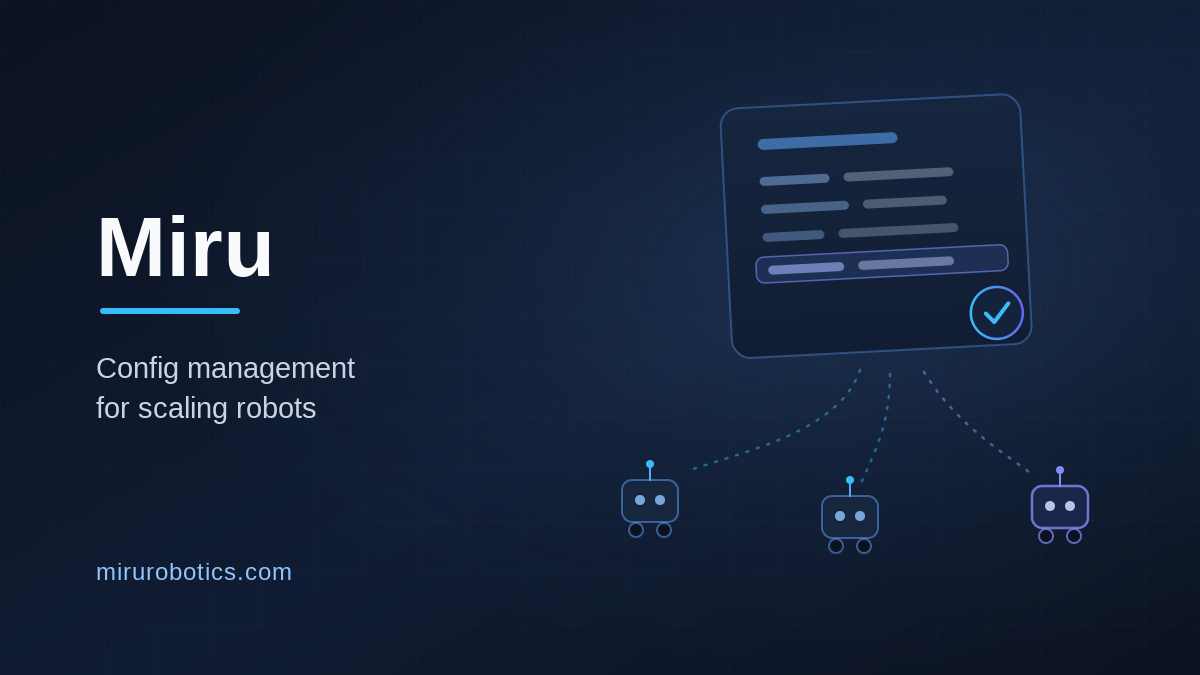
From there, values and override logic live in Miru's dashboard. Rather than copying an entire file to make one robot different, a team defines structured overrides: the base config, plus the specific deviations for a site, a customer, or an individual unit. Miru renders the result into a concrete config instance for each robot, so per-robot variation is expressed as a diff instead of a fork.
Validation runs before anything ships. Schemas catch structural problems and out-of-range values, and validation hooks can check that a config is compatible with the software actually running on the target robot. The company states it plainly: every configuration change in Miru is validated before it can affect a robot. For teams whose current safety net is "an engineer eyeballs the YAML," that is the headline feature.
Delivery is handled by the Miru Agent, a lightweight systemd service that runs on each device and pulls the correct config instance from the cloud. The pull-based design is a deliberate fit for field conditions: the agent is built to survive flaky networks and mid-update reboots, picking up where it left off instead of leaving a robot in a half-updated state. When the deployment matters, teams can scope it, roll it out gradually, and roll it back.
The whole system is built to be driven programmatically. Miru exposes APIs, webhooks, and SDKs, ships a CLI with a GitHub Action to install it, publishes an Ansible collection for provisioning devices, and integrates with git so config changes can flow through the same CI/CD pipelines as code. A config change can be reviewed, approved, and deployed like a pull request, which is exactly how most robotics engineers wish it worked today.
A free tier instead of a sales call
Miru's go-to-market looks more like a developer tools company than a robotics vendor, which makes sense given what it is selling. The free tier covers up to five devices and includes point-and-click deployments, basic validation, and deployment history, enough for a team to wire up a prototype fleet and feel the difference before talking to anyone. The paid tier adds the production features: advanced validation and rollback, scoped deployments, schema-first config management, and version control integration.
That ordering matters in robotics, where buying software has traditionally meant enterprise sales cycles. A robotics engineer who hits the config wall on a Tuesday afternoon can have Miru's agent on a test robot the same day. The product gets adopted the way infrastructure actually spreads inside engineering teams: one frustrated engineer at a time.
Narrowing to the layer that mattered
Miru did not start this focused. When the company launched out of Y Combinator in July 2024, it pitched deployment infrastructure for robotics and IoT: push code to GitHub, and Miru would handle building, staging, and over-the-air delivery to the fleet, along with device provisioning and version management.
Over the following year the company narrowed to configuration management, and the narrowing reads like a lesson learned from customers rather than a retreat. OTA deployment is a crowded category with established players. The config layer underneath it was the part nobody had built properly for robots, and it is the part that touches daily engineering work. Every parameter tune, every site-specific tweak, every per-customer feature flag runs through it. Owning that layer puts Miru in the middle of a robotics team's workflow in a way a deployment pipeline alone never would.
The founders bring an unusual amount of shipped-together history for a company this young. Talla, Nair, and Smidt met as students at UT Austin and previously built Clips AI, an AI video tool, before turning to robotics infrastructure. The through-line is developer tooling: find the workflow where engineers lose the most time, and build the missing system for it.
The boring layer every fleet eventually needs
Robotics is in the middle of a real transition. Fleets that were pilots two years ago are becoming production deployments, and the hard problems are shifting from "can the robot do the task" to "can we operate five hundred of them without the wheels coming off operationally." That shift is what created companies like Miru, and it echoes how cloud computing matured: once the exciting part started working, the companies that won the next phase were the ones that built the unexciting infrastructure underneath it.
Config management is about as unexciting as infrastructure gets, right up until a hand-edited parameter sends a robot into a shelf. Miru's bet is that robotics teams will stop accepting that risk as a cost of doing business, the same way software teams long ago stopped FTPing files to production. Schemas, validation, overrides, and an agent that tolerates the real world are not a dramatic pitch. They are the difference between a fleet you operate and a fleet you chase.