Keet builds a video course on anything you want to learn
Try to teach yourself something practical, like how to pull a decent shot of espresso, and you will quickly discover that the internet has everything except an order to learn it in.
There are hundreds of YouTube videos, each assuming a slightly different starting point. ChatGPT will answer any question you ask, but it answers in fragments, and it never tells you what to ask next. The book you bought covers water chemistry in chapter two, which is not what you needed to know first. You end up with a pile of partial explanations and no path through them, and most people quietly give up somewhere in that pile.
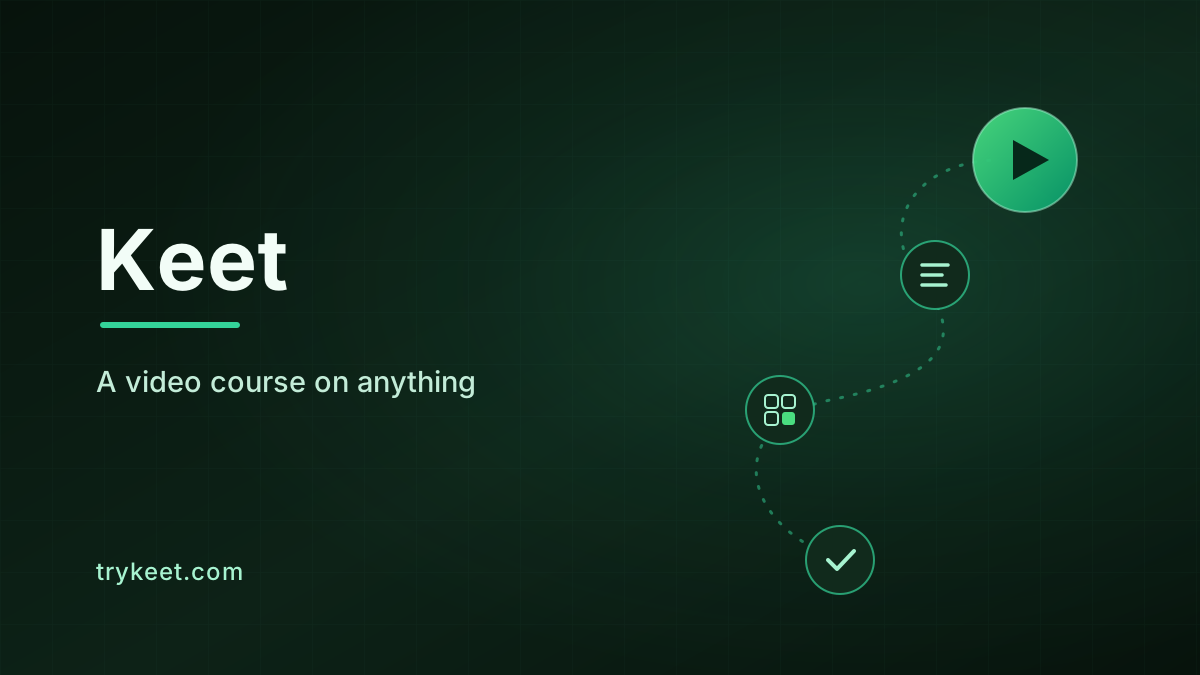
That specific frustration is where Keet came from. Co-founder Zack Ashen was trying to learn coffee brewing and found himself juggling YouTube videos, ChatGPT conversations, and books, with no way to assemble them into one coherent understanding. So he and his co-founder Tommy Tsai built the thing they wanted: an app where you type in a topic, any topic, and it generates a complete course: a structured roadmap of bite-sized lessons, each pairing a short explainer video with interactive games that make the material stick.
Keet is an iOS app, currently in private beta through TestFlight, built by a two-person team out of Y Combinator's Summer 2024 batch and backed by Orange Collective. It launched publicly on Hacker News in August 2026.
The structure problem
The gap Keet is aiming at is easiest to see through the one company that solved it for a narrow slice of subjects.
Duolingo figured out years ago that what keeps people learning is not better content. It is structure and reinforcement: a visible path, lessons short enough to finish, and game mechanics that pull you back to practice what you half-remember. The formula works well enough that millions of people who would never sit through a grammar textbook have worked their way through one, disguised as a green owl's obstacle course.
But that formula has only ever been applied to subjects where a company could afford to hand-build the course. Languages, mainly, plus math and music. The curriculum design, the exercises, the sequencing all get authored by teams of experts over years. Nobody is going to hand-build a Duolingo course for espresso extraction, or options trading, or the immune system, or any of the thousands of topics people actually try to teach themselves. The economics don't allow it.
Keet's bet is that generation changes those economics. If an AI system can design the roadmap, write the lessons, produce the videos, and build the games the moment a learner asks, then the long tail of topics gets the structured treatment that only languages used to justify. The course doesn't exist until you ask for it, and then it exists just for you.
What a Keet course looks like
When you give Keet a topic, it generates a roadmap: a sequence of small lessons that build on each other, visible from the start so you can see where you are going.
Each lesson has two parts. First a short video explains one idea, the way a good tutor would sketch it on a whiteboard. Then a round of games checks whether it landed. The games come in several formats, including multiple choice, swipe, ordering, and connections, plus custom formats generated to fit the material, so the reinforcement doesn't collapse into an endless string of identical quizzes.
The courses are built for the person who asked, inside the app. There is no publishing step, no export, no audience features. Keet is built for the person doing the learning rather than for creators who want to teach an audience, and that focus shapes how the whole product works. A course on bike maintenance generated for you doesn't need to satisfy anyone else's syllabus. It needs to get you from what you know to what you wanted to know.
During the beta, new users get a couple of courses free, with further generations bought as credits. The founders have said a subscription that grants monthly course credits is the planned model.
Videos rendered with code, not a video model
The most interesting engineering decision in Keet is invisible if the product works: where the videos come from.
The obvious 2026 answer would be a generative video model. Prompt something in the Veo family, get back thirty seconds of footage. Keet does the opposite. Its videos are rendered programmatically with Remotion, a library that produces video from React components, and coverage of the launch reports that math-heavy content uses Manim, the animation engine behind 3Blue1Brown's videos. The AI writes the lesson; code renders the picture.
The founders are open about one reason: cost. Rendering a video from components is dramatically cheaper than sampling one from a diffusion model, and a product that generates whole courses on demand lives or dies on generation cost. A course might contain dozens of videos. At video-model prices, that is an expensive artifact to hand out in a free tier. At render-from-code prices, it is closer to a web page.
The quieter reason is accuracy. A video model asked to illustrate a supply and demand curve will produce something that looks like economics, with axes that wobble and labels in almost-English. A chart rendered from code is simply correct. The text is real text. The diagram shows the relationship the lesson is about, because the lesson's content is what generated it. For a product whose entire job is explaining things, deterministic rendering means the visuals can't hallucinate independently of the script, which removes a whole category of ways an AI-generated course could teach you something wrong.
It also makes the videos editable. A rendered component can be corrected, restyled, or regenerated in pieces. Thirty seconds of model-sampled footage cannot.
This is the kind of choice that reads as modest and turns out to be load-bearing. Plenty of teams would have reached for the flashier technology. Keet picked the one that makes the product cheap enough to give away and reliable enough to trust.
The second idea, which is usually the real one
Keet did not start as a learning company. It entered Y Combinator as "APIs for any website," a developer infrastructure product that let software act on a user's behalf inside sites that never shipped a public API, with a Plaid-style link component for connecting accounts. Real technology, aimed at a real problem, in a crowded field of agent and automation startups.
Then the founders did the thing YC companies are famously permitted to do: they noticed the problem they actually kept coming back to and pivoted toward it. The coffee-brewing frustration became the company. By the time of the August 2026 launch, YC's directory described Keet as an app for generating courses on any topic, and the API product had become history.
It is worth saying plainly that this is a strength, not a blemish. Ashen and Tsai are Cornell computer science graduates building in New York, and the infrastructure work wasn't wasted; a team that can maintain authenticated sessions across arbitrary websites is comfortably equipped to orchestrate course generation pipelines and programmatic video rendering. The pivot traded a market where they were one of many agent-infrastructure startups for a consumer product with a personal origin and almost no direct competition in its specific shape. Plenty of companies pivot from something dull toward something fashionable. Pivoting from fashionable infrastructure toward teaching people things is the more contrarian direction, and the more telling one.
The open questions, and why the architecture helps
An honest look at Keet today is a look at a very young product. It is iOS-only, invite-gated, and the hard question for any generated course is the same one teachers have always faced: is the material actually good, and is it actually true?
Keet's architecture gives it better odds than most AI learning tools. Because lessons are structured data rendered into video, not opaque footage, the content can be reviewed and corrected at the source. Because every lesson ends in games, the app gets a constant signal about which explanations are landing and which are leaving learners confused, the kind of feedback loop a YouTube tutorial never gets. A course that learners keep failing is a course the system knows to fix.
The deeper advantage may be motivational rather than technical. The reason most self-teaching fails is not that explanations are scarce. It is that nobody finishes. Structure, visible progress, and a bit of game pressure are unglamorous tools, but they are the tools with a track record. Keet is applying them to every topic at once.
Duolingo spent years of expert labor making a small number of subjects feel this way. Keet generates the course in the time it takes to type the topic. If the quality holds, the pile of half-watched YouTube videos and abandoned ChatGPT threads gets replaced by the thing it always wanted to be: an actual course, with a path, that was built because you asked.