Modus helps companies never over-hire as they scale
At most companies, the single largest expense is people. And yet the plan that governs that expense gets built once a year, in a spreadsheet, over a few exhausting weeks of negotiation between finance and department heads. Then the year starts, reality diverges from the model, and the most expensive plan in the company quietly stops being true.
Nobody over-hires on purpose. It happens one reasonable requisition at a time. A team misses a quarter and asks for two more reps. A manager backfills a role that attrition had already solved. A department's plan assumed a product launch that slipped six months. Each decision looks defensible up close. In aggregate, the company wakes up a year later with a cost structure built for a business it doesn't have, and the correction, when it comes, is painful for everyone.
Modus was built on the conviction that this cycle is avoidable. The Austin company, backed by Y Combinator in its Summer 2024 batch, makes AI-powered headcount management software with a stated goal that doubles as a filter for its customers: help companies never over-hire as they scale. Its founder, Lin Ling, ran business operations at HashiCorp as the infrastructure company grew from roughly 100 employees to 2,500 and went public at a $14 billion valuation. She spent years inside the exact planning process Modus now replaces.
The most expensive plan nobody owns
The strange thing about headcount planning is how little infrastructure exists for it, given the stakes.
Consider what the process looks like almost everywhere. Finance builds an annual model. Department leaders submit asks, negotiate through a few review cycles, and land on a plan. That plan gets frozen into a budget, and everyone goes back to work. From that moment on, the plan and the organization start drifting apart. People quit. Offers get declined. Hiring takes ninety days instead of forty-five. A re-org moves twenty people between cost centers. None of this flows back into the model, because the model is a spreadsheet on someone's laptop.
The data needed to catch the drift exists, but it lives in systems that don't talk to each other. The HRIS knows who actually works at the company. The applicant tracking system knows what hiring is really in flight. The finance model knows what the plan said in January. Reconciling the three is a manual job that most companies do quarterly at best, which means a plan can be wrong for months before anyone notices. By the time the variance shows up in a budget review, the extra hires are made, the offers are signed, and the only remaining options are bad ones.
The asymmetry is what makes the drift so expensive. A team that under-hired can usually catch up next quarter with a few more offers. A team that over-hired has no cheap path back: unwinding it means severance, bruised morale, and managers spending a quarter on reshuffling instead of the roadmap. Headcount mistakes are sticky in one direction, which is exactly why they deserve earlier warning than a quarterly budget review provides.
Modus sits in this gap: a layer above the systems of record that watches all of them and tells operators when the plan and the organization have stopped agreeing.
What Modus actually does
Modus connects to the tools a company already runs, its HRIS and its ATS, and continuously analyzes workforce data across the organization. The product is aimed at CFOs and operators, the people who own the number, rather than at recruiters or HR generalists.
The core of the product is detection. Modus's AI engine monitors workforce data for patterns and flags anomalies as they emerge: resource gaps where a team is thinner than its plan assumes, compensation that has drifted from benchmarks, hiring that is running ahead of the model. The pitch is that the software inspects the workforce plan the way monitoring software inspects a production system, surfacing the deviation when it is small enough to correct cheaply.
Planning in Modus is built around simulation rather than static targets. Before committing to a hiring plan, a team can model how it holds up against the variables that usually break one: attrition running higher than expected, win rates coming in lower, offers taking longer to close. For sales organizations, the product goes deeper into capacity planning, tying headcount directly to quota coverage and flagging early coaching opportunities for reps who are falling behind, so the fix can be development rather than a backfill. Annual planning draws on historical trends and variance analysis instead of starting from last year's spreadsheet plus ten percent.
The company has also done the unglamorous work that selling to finance teams requires. Modus is SOC 2 compliant, a baseline requirement when the data in question is everyone's compensation, and it has joined the Workday Partner Network, which matters because Workday is where the HR data of the mid-market and enterprise actually lives.
Revenue per employee, the metric of the moment
Underneath the product is an argument about what companies should measure, and it is the most interesting thing about Modus.
The traditional status metric for a growing company is headcount. Founders recite it in pitch decks, reporters use it as shorthand for momentum, and managers build empires on it. The problem is that headcount measures input, not output. A company of 500 doing the revenue of a company of 200 is not more impressive for the extra 300 people. It is less.
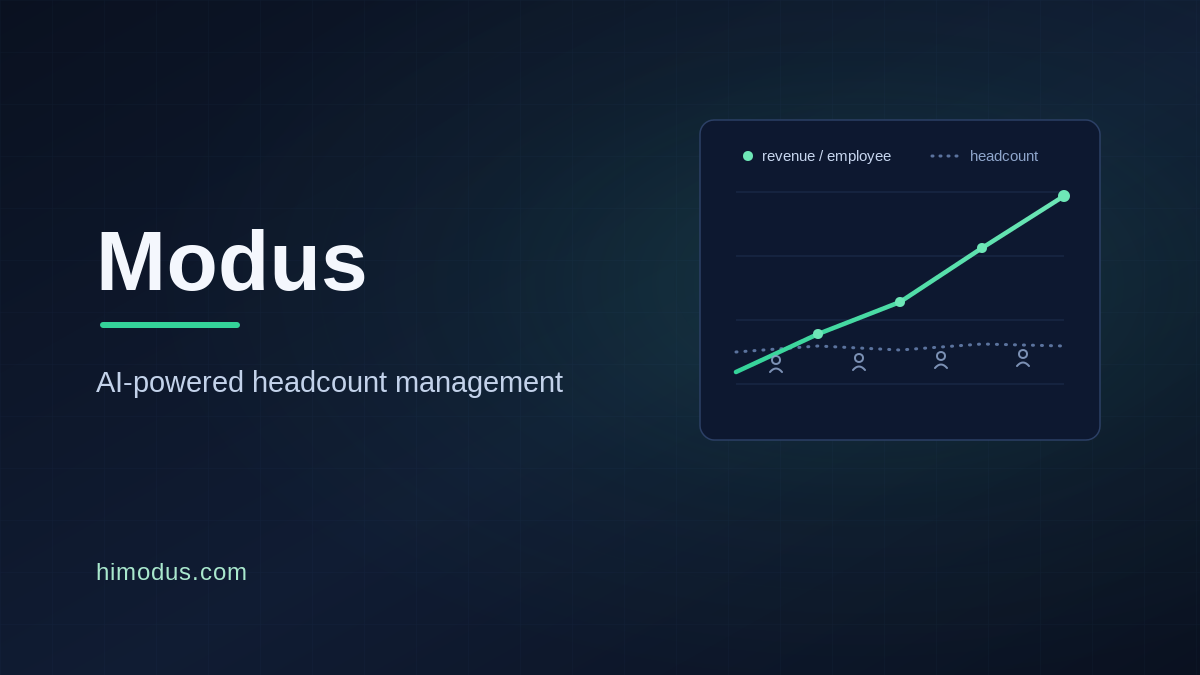
Modus's YC profile states the premise bluntly: companies should have the fewest employees possible, and the number to maximize is revenue per employee. When the company launched, Y Combinator CEO Garry Tan called revenue per employee "the most important metric to building a hardcore culture at your startup" and described Modus as the way to track it, crediting Ling's HashiCorp run and framing the product, in his words, as a way "to unlock FOUNDER MODE."
The timing of that argument is not an accident. The companies most admired in this cycle are the ones doing extraordinary revenue with startlingly small teams, and AI tooling is pushing that frontier further every quarter. When software can absorb more of the routine work in sales, support, and operations, the marginal hire has to clear a higher bar, and the companies that internalize this early end up structurally leaner than competitors who grew up in the era when more funding meant more people. A whole generation of founders watched the over-hiring of 2021 turn into the layoffs of 2022 and 2023 and drew the obvious conclusion.
What has been missing is tooling. Revenue per employee is easy to compute once a quarter and surprisingly hard to manage to, because managing it means knowing continuously how every team's actual size, pipeline, and output compare to plan. That is a data problem before it is a discipline problem, which is why it makes sense that the fix is software.
The operator behind it
Founder-market fit matters more than usual in this category, because headcount planning is a process you cannot understand from the outside. The spreadsheet rituals, the horse-trading, the way a plan decays, the politics of taking a requisition away: this is tacit knowledge that only accumulates by running the process.
Ling ran it at one of the defining infrastructure companies of the last decade, through the stage transitions where planning gets hardest. Going from 100 to 2,500 employees means the planning process has to be rebuilt several times over, and doing it on the way to an IPO means doing it under the scrutiny of public-market reporting. The people who have done that job tend to carry around a precise list of what they wished existed. Modus reads like that list, built.
It is also a familiar YC pattern: an operator automates the function they used to run. The best products in finance and operations software have repeatedly come from people who lived inside the workflow rather than studied it, because they know which alerts an operator will actually act on and which dashboards die unopened.
The control system for lean companies
There is a version of this product that is just reporting, a prettier dashboard on top of the HRIS. Modus is betting on something more active: software that detects, inspects, and corrects the workforce plan, continuously, the way modern teams manage cloud spend. That comparison is worth sitting with. A decade ago, cloud costs were an opaque line item reviewed quarterly, until a category of tooling emerged to watch them in real time, and the companies that adopted it gained a durable cost advantage. Payroll is a bigger line item than cloud ever was, and at most companies it is still managed the old way.
The bet has an obvious tailwind. Every board meeting in this market now includes a conversation about efficiency, and every founder is being asked why the next hire is necessary at all. The companies that scale through this era will be the ones that treat headcount as a number to be engineered rather than a trophy to be accumulated.
For them, never over-hiring has little to do with frugality. It is how revenue per employee stays high, how culture stays dense, and how the next downturn gets survived. Modus is building the instrument panel for running a company that way.