RemoteJobs.org and the Enduring Market for Remote Work
Every few months, a major company announces a return-to-office mandate. The headlines follow predictably. "Remote work is dead." "The office is back." "The experiment failed."
And every few months, the actual data contradicts the headlines.
Remote job postings continue to grow. Workers continue to prefer flexibility. Companies that offer remote options continue to attract better talent from wider pools. The structural economics of remote work haven't changed just because some CEOs prefer full offices.
The market for remote work is not shrinking. It is normalizing. And as it normalizes, the infrastructure around it matures.
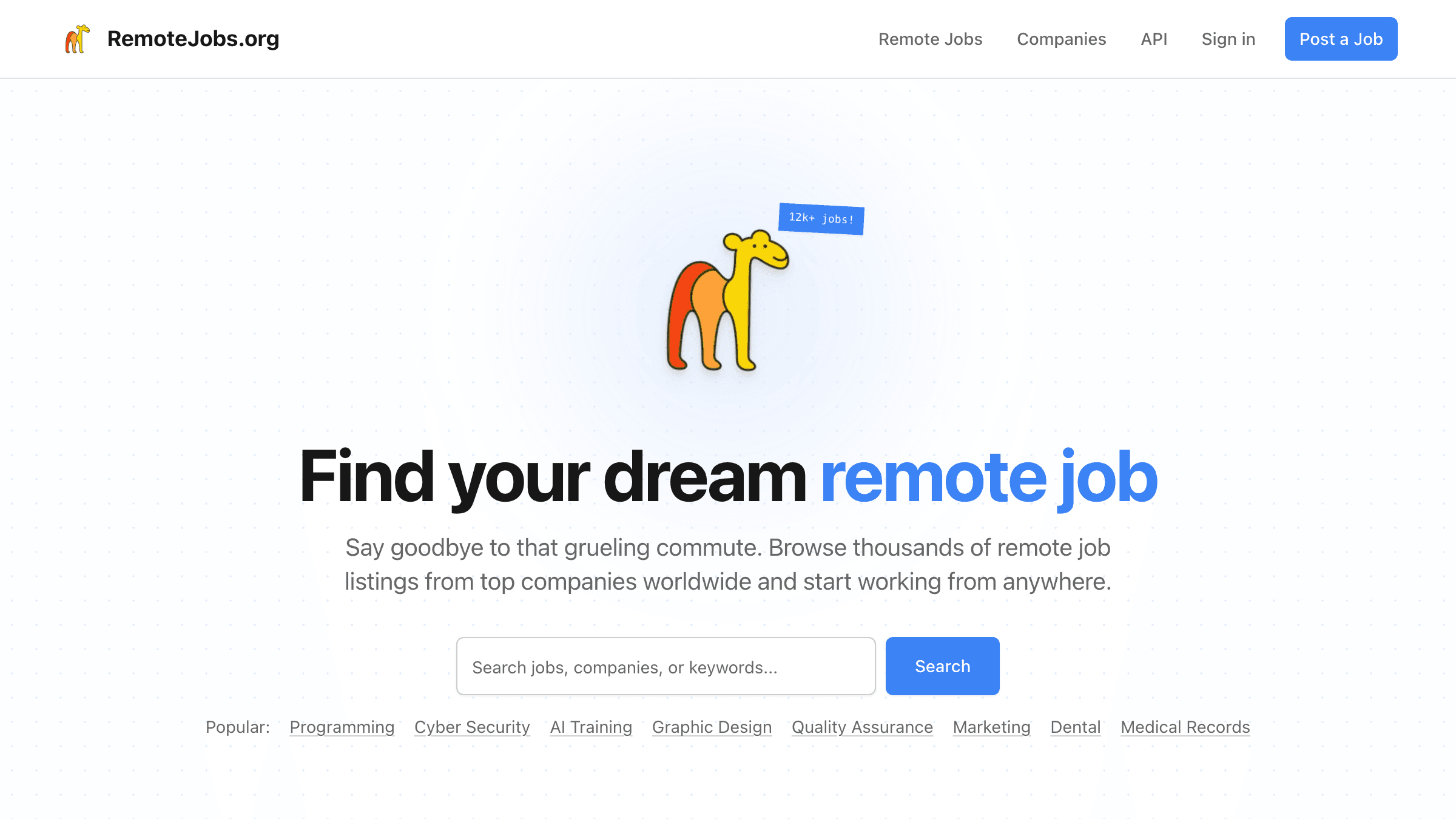
RemoteJobs.org is part of that infrastructure. A focused job board aggregating over 12,000 remote positions across 30+ categories, it serves both the job seekers looking for location-independent work and the companies looking to hire from a global talent pool.
It's not a flashy product. It doesn't need to be. It solves a real discovery problem at a moment when the market needs it most.
The State of Remote Work in 2026
The remote work conversation has moved past the binary debate. It's no longer "remote versus office." It's a spectrum, and different companies land at different points.
Some companies are fully remote. Some are hybrid with flexible days. Some require office presence but hire across geographies for specific roles. Some are remote-first but maintain optional offices.
What all of these models share is a need to find candidates who want remote or flexible arrangements. The talent pool for a "must be in San Francisco" role is fundamentally different from the talent pool for a "work from anywhere" role. Companies posting remote positions need to reach the second pool.
Traditional job boards like LinkedIn and Indeed serve both audiences, but they don't specialize. A remote-first company posting on a general board competes for attention with thousands of in-office listings. Their remote position gets lost in the noise.
Specialized platforms exist precisely to solve this signal-to-noise problem. When a candidate visits RemoteJobs.org, every single listing is remote. There's no filtering required. No hoping that "remote" in the title actually means remote. The entire platform is curated for one specific arrangement.
This focus creates value for both sides of the market.
Why Vertical Job Boards Persist
The internet was supposed to consolidate everything into mega-platforms. In many categories, it did. But job boards have stubbornly resisted full consolidation.
Specialized job boards continue to thrive because hiring is fundamentally about matching. The better the match quality, the more valuable the platform. And match quality improves with specialization.
A remote-focused job board attracts candidates who specifically want remote work. These aren't people casually browsing. They're people who have made a deliberate lifestyle choice. They may have moved to a lower cost-of-living area. They may be caregivers who need flexibility. They may be digital nomads. They may simply perform better without a commute and an open office.
When a company posts on a remote-specific board, they're reaching an audience that is pre-qualified on the dimension that matters most for the role. The candidates aren't going to accept the job and then complain about not having an office to go to.
This pre-qualification reduces hiring friction. Fewer mismatched applications. Shorter time-to-hire. Better retention because expectations are aligned from the start.
RemoteJobs.org's structure reinforces this. Listings are organized by category: programming, design, marketing, sales, customer support, and dozens more. Candidates can browse by function or by geography. Companies can target specific talent pools within the already-filtered remote audience.
The Discovery Problem
Finding a remote job in 2026 is simultaneously easier and harder than it was in 2020.
Easier because more positions exist. Harder because they're scattered across hundreds of company career pages, general job boards, niche platforms, Slack communities, Twitter threads, and newsletter listings.
A job seeker committed to finding remote work faces a fragmented landscape. Do they check LinkedIn? AngelList? Individual company pages? Reddit? Twitter? The cognitive overhead of searching across dozens of sources is significant.
Aggregation platforms solve this by doing the searching once and presenting the results in a single interface. RemoteJobs.org aggregates listings from employers across industries and geographies, providing a single destination for remote job discovery.
This aggregation function is more valuable than it appears. In a fragmented market, the platform that reduces search costs captures attention. And in hiring, attention is the scarce resource. A company's listing needs to be seen by the right candidates. A candidate needs to find the right opportunities without spending hours searching.
The 12,000+ listings across 30+ categories represent a breadth that individual company pages can't match and that general job boards bury beneath non-remote noise.
The Economics of Remote Hiring
Companies hire remotely for multiple reasons, and cost arbitrage is only one of them.
Access to talent. A company based in Austin that only hires locally is competing with every other Austin company for the same pool. A company that hires remotely across the US (or globally) accesses 10x or 100x the talent pool. For specialized roles, this isn't a nice-to-have. It's the difference between filling the position and not.
Retention. Workers who have remote flexibility report higher job satisfaction and lower intent to leave. In a market where replacing an engineer costs 6-9 months of salary, retention improvements have direct financial impact.
Real estate savings. Office space in major metros costs $50-100+ per square foot annually. A 100-person company going fully remote saves $500K to $1M+ per year in real estate alone. Even hybrid arrangements reduce the footprint.
Productivity. The evidence on remote work productivity is now extensive. For focused, individual contributor work, most studies show equal or higher productivity in remote settings. The collaboration and mentoring trade-offs are real, but for many roles, the net is positive.
Companies that understand these economics are actively seeking remote candidates. They need platforms that help them reach those candidates efficiently.
Geographic Expansion
One underappreciated aspect of remote job boards is their role in geographic economic development.
When a software engineer in rural Montana can find and land a job paying San Francisco wages, that's a direct wealth transfer from a high-cost market to a low-cost one. The engineer's quality of life improves. The local economy benefits from their spending. The company gets the talent they need.
Remote work platforms facilitate this redistribution by making opportunities visible to people who would never have found them through local channels.
RemoteJobs.org includes geographic filtering by US state, acknowledging that even within remote work, geography matters. Some "remote" roles have time zone requirements. Some require occasional in-person meetings. Some are only open to specific countries for tax or compliance reasons.
This geographic granularity helps candidates find genuinely compatible opportunities rather than applying to positions that technically say "remote" but practically require Pacific time availability.
The Platform Maturity Cycle
Remote work platforms are following a maturity cycle that other job market verticals went through years ago.
Phase 1: Scarcity. Few remote jobs exist. Any listing platform is valuable simply because supply is limited.
Phase 2: Growth. Remote jobs proliferate. Multiple platforms emerge. Competition is on coverage and freshness.
Phase 3: Maturation. The market is large enough to support specialization within specialization. Remote jobs for designers. Remote jobs in healthcare. Remote executive roles. The platforms that win are those with the best matching, the freshest listings, and the strongest network effects.
We're entering Phase 3. The total remote work market is large enough that platforms need to differentiate beyond "we list remote jobs." They need category depth, geographic intelligence, company verification, and candidate matching.
RemoteJobs.org's 30+ category structure and company directory suggest it's building toward this maturity. It's not just a listing page. It's organizing the remote work market into navigable segments.
The Counter-Narrative
The return-to-office headlines deserve some response, because they shape perception even when they don't shape reality.
When a large company mandates office return, it makes news precisely because it's notable. It's a policy change. It affects thousands of workers. It generates strong opinions.
What doesn't make news: the thousands of companies that are quietly remote-first and have been since founding. The startups that never leased office space. The enterprises that expanded their remote policies without press releases. The established companies that tried mandating return and then quietly softened the requirement after losing talent.
The data tells the real story. Remote and hybrid job postings remain at historically elevated levels compared to pre-2020. Worker preference surveys consistently show strong demand for flexibility. And companies competing for scarce technical talent continue to offer remote options because their competitors do.
The market for remote work isn't declining. The narrative is simply catching up to the reality that remote work is now a permanent feature of the labor market, not a temporary pandemic adaptation.
What Comes Next
The remote work infrastructure market will continue to evolve. Job boards are one layer. Collaboration tools are another. HR and payroll platforms that handle distributed teams are another. Legal and compliance services for multi-state and international employment are another.
RemoteJobs.org occupies the discovery layer, which is where the journey begins for both candidates and companies. Before you can hire remotely, you need to find each other. Before tools and compliance matter, you need a match.
Discovery platforms benefit from a virtuous cycle: more listings attract more candidates, which attracts more companies posting listings. The platform that achieves sufficient density in its category becomes the default starting point for anyone entering the market.
With 12,000+ active listings, RemoteJobs.org has critical mass. The question going forward is how it deepens that position through better matching, better company verification, and better candidate experience.
The remote work market doesn't need hype anymore. It needs infrastructure. Reliable, comprehensive, well-organized infrastructure that makes finding remote work as straightforward as finding any other kind of work.
That's what platforms like RemoteJobs.org are building. Not a revolution. A normalization.
And normalization, in the end, is how real markets get made.