Who Is Jessica Livingston and Why Is She So Influential?
Here is a strange fact about one of the most important institutions in the history of technology: most people think it was started by one person.
Y Combinator has funded Airbnb, Stripe, Dropbox, Coinbase, Reddit, Twitch, DoorDash, and thousands of other companies. It has shaped how an entire generation thinks about building startups. And when people talk about where it came from, they almost always say the same thing. Paul Graham started it.
He didn't. There were four co-founders. And the one who arguably had the most influence on what Y Combinator actually became—the internal culture, the selection of founders, the thing that made it work instead of just being an interesting experiment—was Jessica Livingston.
If you've never heard of her, that's sort of the point. Understanding why requires understanding both who she is and what kind of contributions the world tends to overlook.
Before Y Combinator
Livingston grew up in Minneapolis, raised mostly by her father and grandmother. She went to Phillips Academy, then Bucknell University, where she studied English. Not computer science. Not business. English.
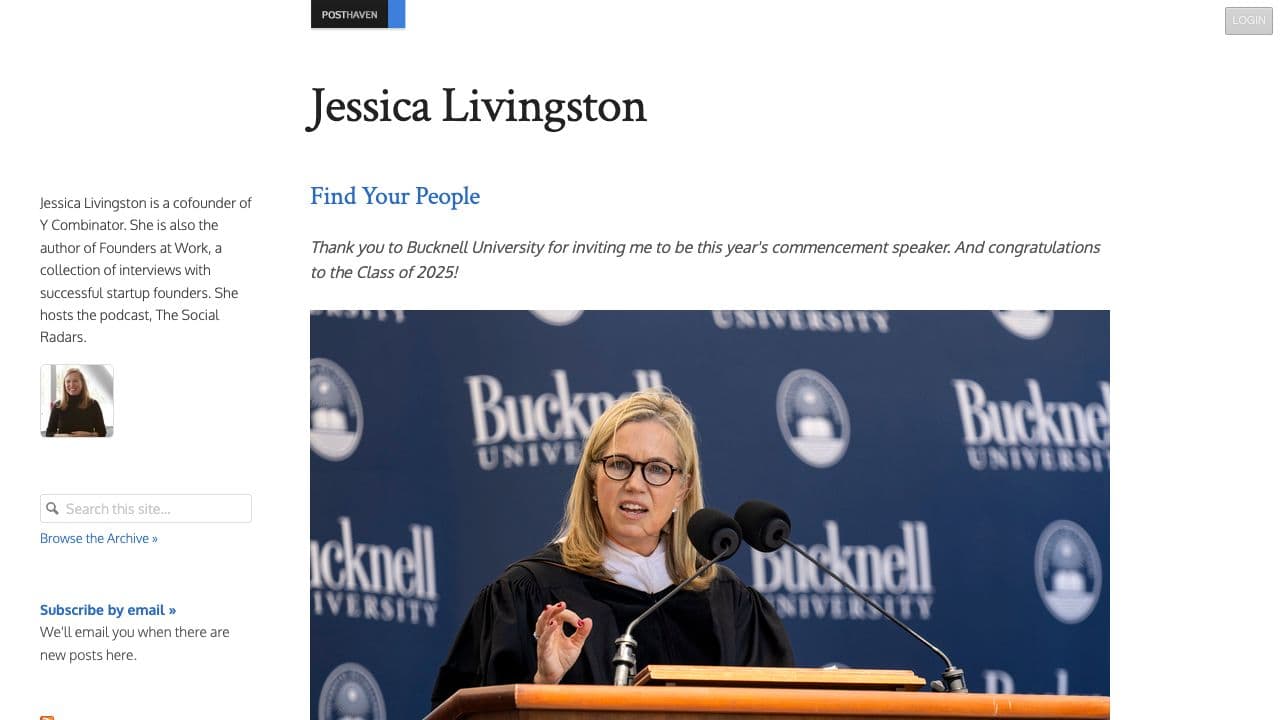
After college, she had no plan. She's been remarkably honest about this. In a commencement speech at Bucknell in 2025, she told the graduating class that she spent a decade after college drifting. She worked at Fidelity Investments answering phones about mutual funds on the night shift. She worked at Food & Wine magazine. She worked at a wedding planning service, at an automotive consulting firm, and eventually became VP of marketing at Adams Harkness, a small investment bank in Boston.
None of these jobs were part of a master plan. She was doing what a lot of smart people do when they finish school without a clear direction—taking the next thing that seemed reasonable and trying to figure out what she actually wanted.
The way she describes it, the turning point wasn't a single event. It was meeting people who were doing interesting things. Specifically, startup people. She went to a party in Cambridge and met Paul Graham, Robert Morris, and Trevor Blackwell. She got fascinated by the startup world. Not by the technology per se, but by the founders. Who were they? What made them tick? Why did some succeed and others fail?
That fascination led to a book. She started interviewing founders—Steve Wozniak, Max Levchin, Sabeer Bhatia, Caterina Fake—and asking them about the very earliest days of their companies. Not the polished origin stories you'd read in a press release. The real stories. The ones where everything almost fell apart and they figured it out anyway.
The result was Founders at Work, published in 2007. It's one of the best books ever written about startups, and it works because of something Livingston does that most interviewers don't. She actually listens. She asks the obvious follow-up question. She gets people to say the thing they wouldn't normally say. You finish the book with a visceral understanding of what starting a company actually feels like, which is very different from what most startup content communicates.
But by the time the book came out, she'd already started something bigger.
How Y Combinator Actually Started
The standard story is that Paul Graham had the idea for Y Combinator and went and built it. The real story is messier and more interesting.
In 2005, Graham, Livingston, Morris, and Blackwell created Y Combinator together. Graham brought the intellectual framework and the writing that attracted the first applicants. Morris and Blackwell brought deep technical credibility. And Livingston brought something that turned out to be the most important ingredient of all: the ability to judge people.
This sounds like a small thing. It isn't.
Y Combinator's entire model depends on making bets on founders at a stage when there's almost nothing else to evaluate. The company might be two people with a half-built prototype. There's no revenue. There's no product-market fit. There's barely a product. The only real question is: are these the kind of people who will figure it out?
Livingston was extraordinarily good at answering that question. Paul Graham has described her as having "x-ray vision for character." She could see through fakers almost immediately. Not in a cynical way—in a precise way. She could tell when someone was performing confidence versus actually having it. She could tell when co-founders had real trust versus a polite arrangement that would fall apart under pressure. She could tell when someone was genuinely obsessed with a problem versus when they'd picked it because it sounded fundable.
Within Y Combinator, she earned the nickname "the Social Radar."
This wasn't just a personality trait she happened to bring along. It became the foundation of how YC worked. The organization's most important decision, three times a year, was which founders to fund. And Livingston's judgment was central to that process. According to Graham, "she had the last word. Everything we did as an organization went through her first."
Think about what that means. Every company Y Combinator funded—every billion-dollar outcome, every founder who got their start because YC took a bet on them—went through Jessica Livingston's filter. Not Graham's essays. Not the application form. Her read on the people.
The Culture No One Talks About
Y Combinator is famous for a lot of things: the batch model, demo day, the standard deal terms, the alumni network. What it's less famous for, but what arguably matters more, is its culture.
Early YC felt like a family. Graham and Livingston hosted weekly dinners for their founders at their home near Cambridge. These weren't networking events with name tags and elevator pitches. They were actual dinners. Founders sat around a table and talked about their problems honestly because the environment made honesty feel safe.
This culture was Livingston's creation. Graham has said it plainly: "Early YC was a family, and Jessica was its mom. And the culture she defined was one of YC's most important innovations."
That might sound soft. It wasn't. The culture had direct, measurable consequences.
Because YC selected founders of strong character—Livingston's specialty—the alumni network developed an unusual level of trust. YC founders help each other. They make introductions. They share hard-won knowledge. They invest in each other's companies. The network is widely considered one of the most valuable things about going through the program. And it works because the people in it were selected, in large part, by someone with an exceptional eye for character.
You can't build that with a clever incentive structure. You can't get it by writing it into a terms sheet. It comes from consistently choosing good people, and then creating an environment where good behavior is the norm rather than the exception. Livingston did both.
Why You Haven't Heard of Her
So here is a person who co-founded one of the most influential institutions in technology, whose judgment shaped which companies got funded, whose cultural instincts defined the organization's soul, and who wrote one of the definitive books on startup founders.
And most people in tech have never heard of her.
Graham has written about this directly. He identified several reasons, and they're all worth sitting with.
The first is that Graham himself was a prolific writer. His essays attracted enormous attention and became closely identified with Y Combinator's brand. When people thought about YC, they thought about the person whose words they'd been reading. This was a natural association, but it was misleading. The essays described the philosophy. Livingston built the institution.
The second reason is temperament. Livingston doesn't seek attention. She actively avoids it. She dislikes bragging. She gets anxious about public speaking, even though she's good at it when she does it. She has no interest in building a personal brand or becoming a public intellectual.
In a world that increasingly equates visibility with importance, this means she became invisible.
The third reason is darker. Graham described an incident where Livingston tried to engage with the press. A reporter came to interview her—ostensibly about her expertise on startups. Instead of writing about her deep knowledge of what makes founders succeed, the reporter sensationalized a trivial personal anecdote. After that experience, Livingston pulled back from public engagement.
And then there's the gendered dimension of all of this, which is impossible to ignore. The contributions Livingston made—reading people, building culture, creating emotional safety, making good judgment calls about character—are the kinds of contributions that tend to be described as "soft skills." They get attributed to personality rather than expertise. They get treated as support rather than leadership.
But think about what Y Combinator would have been without them. An accelerator that couldn't pick good founders. A network without trust. A program without a soul. It would have been a funding mechanism, not a community. And it probably would have been outcompeted by the dozens of accelerators that launched in the years after.
The hard truth is that Livingston's contributions were structurally undervalued because they're the kind of contributions that usually are. The person who writes the essays gets remembered. The person who selects the founders and builds the culture doesn't. Not because her work was less important, but because it's less legible from the outside.
Founders at Work
It's worth spending a moment on the book, because it reveals something about how Livingston thinks.
Founders at Work is a collection of interviews with startup founders about the very earliest days of their companies. The format is simple. Livingston asks questions. The founders answer. There's no grand theory imposed on top. No framework. No listicle of "7 Things Great Founders Do."
What there is, instead, is genuine curiosity. Livingston asks the questions that a thoughtful, non-technical person would ask. Not "what was your tech stack?" but "what did it feel like when everything was falling apart?" Not "how did you scale?" but "how did you convince the first person to use this?"
The result is that the book captures something most startup content misses entirely: the emotional reality of building a company. The doubt. The improvisation. The moments where the founders had no idea what they were doing and just kept going anyway.
This is not an accident. Livingston's superpower—reading people—shows up in her interviewing. She creates a space where founders tell the truth instead of performing. And the truth turns out to be far more useful than the performance.
The book came out in 2007 and remains relevant nearly twenty years later. That's because the human experience of starting a company hasn't changed, even as the technology and the funding landscape have transformed completely. The founders in 2026 face different markets and different tools, but they face the same emotional gauntlet. Livingston's book is one of the few resources that actually prepares them for it.
The Quiet Influence
After Y Combinator's early years, Livingston continued to shape the organization in ways that were important but, characteristically, not highly visible. She oversaw Startup School, YC's free program for a broader audience of founders. She launched the Female Founders Conference in 2013, one of the first major events specifically designed to support women building startups. She created the Summer Hackers Program, which provided stipends and tuition for women learning to code.
These weren't PR initiatives. They came from a genuine observation that the startup world was leaving out a huge number of talented people, and a practical desire to fix it.
She also backed OpenAI, making her one of the early supporters of what became one of the most important AI organizations in the world.
When Graham stepped back from YC's day-to-day operations, Livingston expanded her involvement. Sam Altman, who succeeded Graham as president, called her "essential to the transformation of Y Combinator into a startup ecosystem." Not a nice-to-have. Essential.
What She Actually Knows
Here is perhaps the most remarkable thing about Jessica Livingston, and the thing that makes her obscurity most frustrating.
Through her work at Y Combinator and her interviews for Founders at Work, she has spent more time studying what makes startup founders succeed than almost anyone alive. Not in an academic sense. Not through case studies. Through direct observation of thousands of founders at the most critical moments of their companies' lives.
She has the dataset and she has the perceptiveness to interpret it. She can tell you what the best founders have in common and what the failures share. She understands the patterns at a granular level—not just "be persistent" or "find product-market fit," but the specific character traits that predict whether someone will actually do those things when everything is falling apart.
Graham has argued that this makes her one of the world's foremost experts on "the most important factor in the growth of mature economies"—the qualities of the people who start successful companies. And she remains largely unknown to the public.
The Lesson
There's a temptation to turn this into a simple story about credit. Jessica Livingston didn't get the recognition she deserved. That's true, but it's not the most interesting part.
The more interesting part is what her story reveals about how we evaluate contributions.
We notice the visible things. The essays. The speeches. The tweets. We attribute organizational success to the people who are most publicly associated with it. And we systematically undercount the contributions that happen in private—the judgment calls, the culture-building, the quiet decisions that determine whether an organization thrives or merely functions.
Livingston's career is a case study in a particular kind of influence. Not the kind that comes from being loud or prolific or constantly in the public eye. The kind that comes from being right about people, over and over, in moments when it really matters.
Y Combinator works because someone was very good at a thing that's very hard to do and very hard to see from the outside. The founders got chosen well. The culture felt right. The network held together. These things didn't happen by accident. They happened because someone made them happen, week after week, batch after batch, year after year.
Jessica Livingston co-founded the institution that transformed how startups get built. She selected the founders. She set the culture. She wrote the book that showed the world what founding a company actually looks like. And she did it all while being almost completely invisible to the industry she helped create.
If you're building something, there's a lesson in that. The most important work often doesn't look like the most important work. And the people who do it often don't look like the people who get credit for it.
Pay attention to the ones who are good at reading people. They tend to be building more than you realize.