A voice agent for India has to switch languages mid-sentence
Most of the voice AI you have heard demoed was built for a caller who speaks one language, speaks it clearly, and is sitting in a quiet room.
India is not that caller. A customer in Bengaluru might open a call in English, slide into Hindi to explain the problem, drop a Kannada word for something that has no clean translation, and do all of it in one breath. The line is a mobile connection in a market or on a bus. The accent shifts by district. The call is one of more than a billion that happen across the country every day, and a large share of them still run through call centers and legacy phone systems that were never designed to be automated.
A voice agent trained mostly on clean American English falls apart in that environment. It mishears the code-switching, it stumbles on the accent, and it pauses half a second too long, which on a phone call feels like the line went dead. That gap between what voice AI can demo and what actually works on an Indian phone call is the problem Bolna is built around.
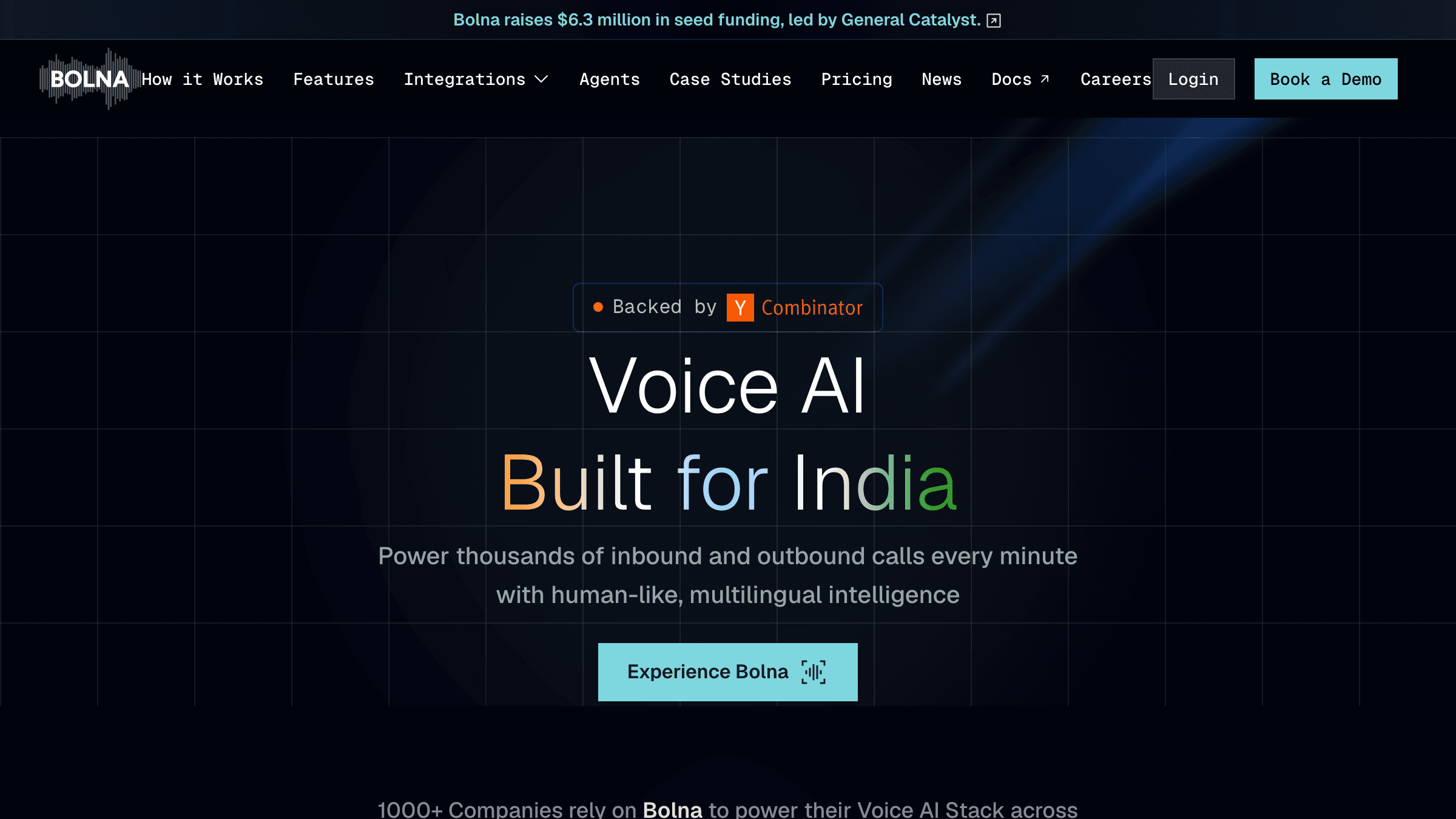
Bolna is a voice AI orchestration platform built for Indian enterprises. It handles the full backend of a voice agent, so a company can design, deploy, and monitor agents that hold a phone conversation in the languages its customers actually use, without hiring an in-house AI team to assemble the plumbing.
The stack under a single phone call
To see why orchestration is the hard part, it helps to break down what has to happen in the second after someone says hello.
The audio has to be transcribed in real time by a speech recognition model. The transcript goes to a language model that decides what to say. The reply gets turned back into speech by a text-to-speech model. All three run over a live phone connection through a telephony provider, and the whole loop has to close fast enough that the caller does not notice the machinery. Miss the latency budget and the agent talks over people or leaves dead air. Pick the wrong model for a given language and the transcription quality collapses.
No single vendor is best at all of this, and certainly not across a dozen Indian languages. The best speech recognition for Tamil is not the best for Marathi. The right language model for a simple appointment booking is overkill for a delivery confirmation. Bolna's answer is to sit above the individual providers and route each call to the best-fit combination based on language, context, and use case. Its open-source roots make this concrete: the framework orchestrates speech-to-text, an LLM, and text-to-speech over websockets, and it plugs into telephony from Twilio and Plivo, transcription from Deepgram and Azure, and language models from OpenAI, Llama, Mistral, and others.
The strategic point is that Bolna is not betting on owning any one of those models. It is betting that stitching them together reliably, at low latency, in Indian conditions, is a real product in itself. That is a familiar shape for infrastructure companies. The value lives in the orchestration layer, not in any single component underneath it.
Why India is a different engineering problem
It would be easy to describe Bolna as a localized version of the voice AI platforms coming out of the US. That undersells what changes when you build for this market from the start.
Language is the obvious part. Bolna supports more than ten Indian languages, but the harder requirement is handling the way people actually speak, which is rarely one language at a time. Hinglish, the fluid mixing of Hindi and English, is the default register for a huge number of urban callers, and plenty of conversations mix English with Tamil or another regional language the same way. An agent that can only switch languages between calls, not within a sentence, is not really speaking the way its callers do.
Then there is the accent range. Bolna's platform is tuned to adapt across a wide spread of regional accents, because an agent that works in one state and fails in the next is not deployable for a national enterprise. And there is the physical reality of the line itself. These calls happen over ordinary mobile telephony in noisy places, so the models have to hold up against background sound and patchy connections rather than the clean audio of a product demo. Bolna targets response latency under half a second and builds in interruption handling, so a caller can cut the agent off the way they would cut off a person.
None of this is a feature checklist bolted onto a generic product. It is the reason the product exists. The team's framing is that India runs on voice, and the software to automate that voice layer has to be designed for how the country talks rather than adapted from somewhere else.
From open source to platform
Bolna did not start as a polished enterprise product. It started as an open-source project: a framework developers could use to build LLM-driven voice agents by wiring together their own choice of speech, language, and telephony providers.
That origin matters for a couple of reasons. It gave the company early distribution and credibility among the developers who would end up evaluating a voice platform, and it forced the core orchestration engine to be genuinely modular, because outside developers were swapping components in and out from the beginning. The commercial platform that Bolna launched in 2025 is the managed version of that idea. A business gets the same orchestration underneath, plus the parts that open source does not hand you: a self-serve interface to build and test agents, monitoring, and the operational work of running voice reliably at scale.
The self-serve angle is worth sitting with, because it defines who Bolna is for. Most enterprise voice AI has been sold as a services engagement. A vendor scopes a project, spends weeks or months on implementation, and charges accordingly. That model prices out everyone below the largest buyers and moves at the speed of a consulting contract. Bolna's platform lets a company design and deploy an agent from its own transcripts and FAQs without that implementation cycle, through no-code tools for business teams and APIs for developers. The company you are automating for does not need to employ machine learning engineers to get an agent live.
The traction that convinced investors
Voice AI is a crowded category, so the signal that matters is whether real businesses are putting live calls through the platform. Bolna's numbers since its commercial launch in May 2025 suggest they are.
The company has said it scaled from around 1,500 calls a day to more than 200,000, serving over a thousand customers across sectors including ecommerce, financial services, and logistics. Those are not pilot-desk figures. Handling that call volume across regulated industries like BFSI means the platform is carrying production traffic where mistakes have consequences, which is the bar a voice agent has to clear before an enterprise trusts it with customers.
That traction is what backed a $6.3 million seed round in early 2026, led by General Catalyst with participation from Y Combinator, Blume Ventures, Orange Collective, Pioneer Fund, and others. The round reads as a bet on a specific thesis: that the voice layer of India's economy is large, underserved by tools built elsewhere, and ready to be automated by software designed for it. Bolna went through Y Combinator's Fall 2025 batch, where it was the rare India-focused company in the cohort.
Founders who watched the problem from inside
The team fits the problem in a way that is easy to miss from the outside.
Bolna was founded in 2024 by Maitreya Wagh and Prateek Sachan, both graduates of IIT Delhi. Wagh started out at Bain before moving into an operating role at Probo, one of India's fast-scaling consumer platforms, where he saw firsthand how quickly customer communication becomes a bottleneck as a company grows. Sachan came from the engineering side, having built and scaled systems at companies like Zomato and BrowserStack, products that had to work reliably for enormous numbers of Indian users.
That combination maps cleanly onto what the company has to get right. One founder has watched the business pain of communication that will not scale with headcount. The other has shipped consumer-scale infrastructure in exactly the conditions Bolna's agents have to survive. Voice AI at this level is as much a reliability and operations problem as a modeling one, and the founders' backgrounds sit on both sides of that.
Voice as the interface for the next billion
Step back, and Bolna is a bet on how a very large number of people will interact with software.
For the slice of India that is comfortable with apps and typing in English, the graphical interface works fine. For a much larger group, the phone call is the interface. It is how they talk to their bank, book a service, follow up on a delivery, or answer a recruiter. That layer has been staffed by people and run on old telephony because there was no software good enough to automate it in the languages and conditions that matter. Large language models and modern speech systems have changed what is possible, but only if someone does the work of making them reliable on a real Indian phone call.
That is the opening Bolna is building into. If the company is right, voice becomes a practical software interface for hundreds of millions of people who were never going to be reached through a screen first, and the businesses serving them get to automate a channel that used to scale only by hiring. The company's own line for this ambition is to enable India's next billion, and the phrase is doing real work rather than sounding good. The next billion users are far more likely to speak to software than to type at it.
Getting there means solving the unglamorous version of voice AI: the code-switching, the accents, the noisy lines, the half-second latency budget on a mobile connection in a market. That is exactly the part most platforms built elsewhere skip. Bolna decided to start there, which in this market is where the actual product is.