Keye turns the data room grind into analysis a deal team can audit
Every private equity deal starts the same way: a data room opens, and someone junior loses two weeks of their life.
Inside is everything and nothing. Hundreds of files. Financial statements as scanned PDFs, a revenue file exported from a CRM nobody at the fund has used, management's board deck with numbers that don't quite tie to the trial balance. Before anyone can form a view on the deal, an analyst has to rebuild the company in Excel: re-key the figures, reconcile the tabs, pivot revenue by segment, stitch together cohorts. Only then does the actual investing start.
The deal clock does not wait for any of this. Bankers set the timeline, competing bidders set the pace, and the fund that needs three weeks to understand a business is negotiating from behind the one that needed three days.
This is the problem Keye is built to remove. Keye is an AI diligence platform built specifically for private equity. It connects to the data room, reads the messy PDFs and spreadsheets as they are, and turns them into structured datasets and ready-to-use analysis in minutes rather than weeks. The pitch to a deal team is blunt: thousands of complex analyses in seconds, with every figure traced back to the exact source document it came from.
The company went through Y Combinator's Fall 2024 batch and came out of stealth in July 2025 with a $5 million seed round led by Sorenson Capital. What it is selling is speed, but what makes it credible is the part most AI products skip: the math is deterministic, and you can check it.
Deals die in the data room
To see why this matters, look at where diligence time actually goes.
A fund evaluating a target doesn't start with strategy. It starts with data hygiene. The quality-of-earnings work, the revenue bridges, the customer cohort tables: all of it depends on first getting the target's raw files into a usable form, and targets are under no obligation to make that easy. A lower-middle-market company might run its books in QuickBooks and its sales in a spreadsheet named FINAL_v7. The data room reflects that reality.
So the early days of every deal are spent on ingestion. Analysts copy numbers out of PDFs. They normalize charts of accounts. They find that the management presentation says one thing and the general ledger says another, and they burn an afternoon figuring out which one to believe.
The brutal part is the funnel math. Most deals a fund looks at die, and they should die; that is what a funnel is for. Which means most of this painstaking manual work is performed on companies the fund will never own. Keye's framing of the payoff is telling: investors who can generate a full data pack from the raw data room instantly get to evaluate more deals, and they get to say no sooner. In a business where returns come from seeing more opportunities than the next fund and wasting less time on the wrong ones, faster no is nearly as valuable as faster yes.
From raw files to a working data pack
Keye's product begins where the analyst's pain begins, at the data room itself.
The platform connects to the virtual data room, ingests whatever is in it, and converts the contents into structured datasets. From there it builds what deal teams call a data pack: the standard battery of analyses that every process requires, from revenue cohorts and customer retention to segment pivots, along with the anomalies and risk flags that determine whether a deal gets a second meeting.
Two design choices stand out, because both show the product was built by people who have sat through an investment committee.
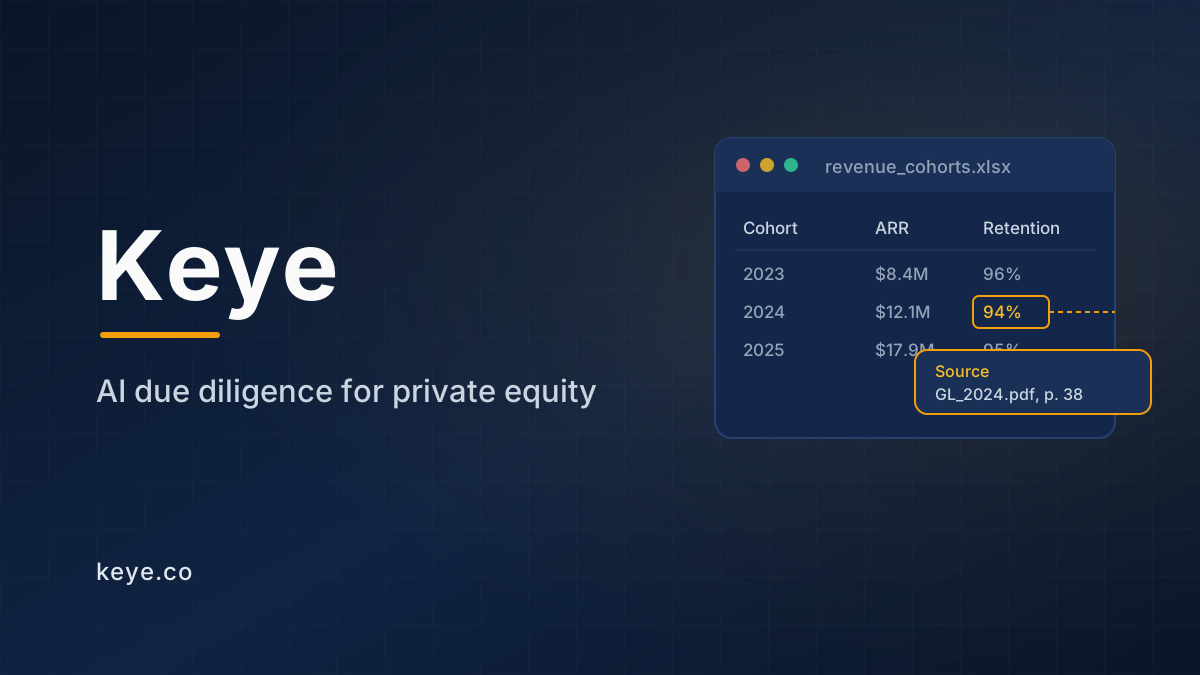
Every figure is traceable. Each number in Keye's output links back to the source document and cell it came from. When a partner asks where the 94 percent gross retention figure comes from, the answer is a citation, and the response takes a click instead of a scramble through the data room at midnight.
The output is Excel, not a dashboard. Keye exports its analysis as Excel workbooks with live formulas. That sounds mundane and is anything but. Private equity runs on Excel; a tool that traps its results in a web dashboard forces the analyst to re-key them into the model, which recreates the original problem. A workbook with working formulas drops into the fund's existing process with nothing lost in translation.
A customer quoted in the seed coverage said Keye has largely automated the fund's data ingestion process, which is exactly the layer where the hours go. And because the inputs are confidential deal documents, the company reports SOC 2 Type 2 certification and a zero-data-retention policy, meaning client files aren't kept or used to train models.
The math never comes from the model
Large language models have a specific weakness that finance cannot live with: they are superb at reading and alarmingly confident about arithmetic they got wrong.
For most AI products, an occasional numerical slip is survivable. In diligence it is fatal, because a fund is about to commit nine figures based partly on these tables. One hallucinated number in an IC memo ends the tool's tenure at the firm that day. Every deal professional knows this, which is why so many funds have been slow to let AI anywhere near the model.
Keye's architecture takes the objection seriously instead of waving it away. The language model does what language models are genuinely good at: reading documents, understanding what an analyst is asking for, mapping messy inputs onto a structure. The actual computation runs as code, through auditable formulas. The model interprets; it does not calculate. Ask the same question of the same data twice and you get the same answer, which is what deterministic means and what no raw LLM can promise.
In January the company shipped the clearest expression of that philosophy: Odin, which Keye calls the first fully deterministic co-pilot for private equity due diligence. A deal professional asks a question in plain English, and Odin returns audit-ready analysis with the computation done in code and the sources attached. Keye's own description draws the line plainly: it doesn't summarize data or guess.
The company describes Odin as the first step toward an autonomous deal team. That phrase is doing a lot of work, and the destination is still a long way off. But the sequencing is right. Nobody will delegate deal work to an autonomous system whose numbers can't be checked, so determinism is the admission ticket to everything Keye wants to build next.
Founders who did the grind themselves
Keye's founding team has the specific scar tissue this product requires.
CEO Rohan Parikh spent his career on the finance side, rising to director at Natixis's corporate and investment bank in the Americas after earlier stints in credit ratings and consulting. He is a CFA charterholder with a Wharton MBA and a master's in mathematical finance, which is to say he has personally built the spreadsheets this product replaces. Co-founder and COO Conor Brown invested at Vista Equity Partners and banked at Goldman Sachs before starting SecureFlow, an M&A deal-insights platform, so he has seen the diligence problem from the buyer's chair at one of the most process-driven PE firms in the world. CTO Lalit Lal brings the third leg: years of building SaaS products from the ground up.
That mix shows up in the product's judgment calls. The Excel-native output, the obsession with source citations, the refusal to let a model near the arithmetic: these are the choices of people who knew exactly which failure would get the product thrown out of a fund, because they used to be the ones doing the throwing.
A seed round from investors who know the buyer
The $5 million seed, announced in July 2025, was led by Sorenson Capital with participation from General Catalyst, Y Combinator, ERA, Tiferes Ventures, Dunamu Ventures, and Palm Drive Capital. Sorenson's own write-up of the deal captured the pitch in four words: from months to minutes.
Traction suggests the message is landing with the hardest audience in software. Keye says funds representing more than $1.4 trillion in assets under management already use the platform to cut days off each deal. That figure comes from the company, but the direction is consistent with the hiring page, where Keye is recruiting a founding private equity strategist to keep translating fund workflows into product.
The competitive context makes the wedge clearer. General-purpose AI research platforms can summarize a data room, and plenty of tools will answer questions about documents. Keye is betting that private equity doesn't want a smarter search box; it wants the data pack built, the math verifiable, and the output in the format the fund already uses. Depth over breadth, for a customer whose willingness to pay for saved deal-time is almost unmatched.
Trust is the product
The first wave of AI tools for finance sold intelligence. The next wave will be sorted by something less glamorous: whether the numbers can be trusted enough to act on.
That is the race Keye is running. Compressing weeks of ingestion and analysis into minutes gets a fund's attention. Showing the formula and the source behind every figure is what gets the output into an IC memo. If Keye keeps winning on that second test, the funds that adopt it will simply look at more deals, kill the bad ones earlier, and move faster on the good ones than the funds that don't.
In private equity, that edge compounds. So does trust.