OrgOrg bundles the 20 small tools every company buys anyway
Audit the software a fifty-person company actually pays for and a pattern shows up fast. Google Workspace or Microsoft 365 covers the big things: mail, documents, calendar, video calls. Then comes the long tail. A tool for short links. A tool for screen recordings. A scheduling tool. An org chart tool. Something for engagement surveys, something for peer recognition, something for on-call rotations, something for tracking laptops. None of these is expensive on its own. Together they are a pile of subscriptions, each with its own seat price, its own admin console, its own login, and its own renewal date that nobody remembers until the card gets charged.
OrgOrg was built on the bet that this pile is really one product. The company, founded by Wayne Crosby and backed by Y Combinator in its Summer 2024 batch, sells a suite of internal tools as a single add-on to Google Workspace. Its launch pitch named the problem directly: it is not unusual for a company to run twenty or more minor SaaS products just to handle organizational chores. OrgOrg's answer is to put those chores in one place, under one price, behind the accounts employees already have.
The layer the big suites never covered
The office suite wars settled the center of the stack decades ago. Nobody buys a standalone word processor or a standalone calendar anymore; Google and Microsoft bundled those into suites so complete that the individual apps stopped being purchasing decisions.
The layer just underneath never got the same treatment. Call it the chores layer: the tooling a company needs to run itself rather than to produce its product. Who reports to whom. Where the link to the expense policy lives. Who is on call this weekend. How the new hire learns what "GTM sync" means on their second day. What questions employees want answered at the all-hands. The big suites mostly ignored this layer, and a generation of point solutions grew up to fill each gap one subscription at a time.
The result is familiar to anyone who has run operations at a startup. The tools do not talk to each other, so the org chart app and the survey app and the on-call app each maintain their own copy of who works at the company, and all three copies drift. Procurement happens one tool at a time, so every addition means another vendor review, another SSO configuration, another seat count to true up. And because each product has to justify its own price, each one is built out with features most teams never touch, while the basic version a small company actually needs hides behind a sales call.
Inside the largest technology companies, this layer looks completely different. Google does not buy twenty vendors for internal chores; it builds internal tools, and some of them, like go links, the short memorable URLs that redirect anywhere, became so loved that ex-Googlers have been recreating them at every subsequent employer for years. OrgOrg's suite reads like a catalog of exactly that kind of internal tooling, packaged for companies that will never have an internal tools team.
What comes in the box
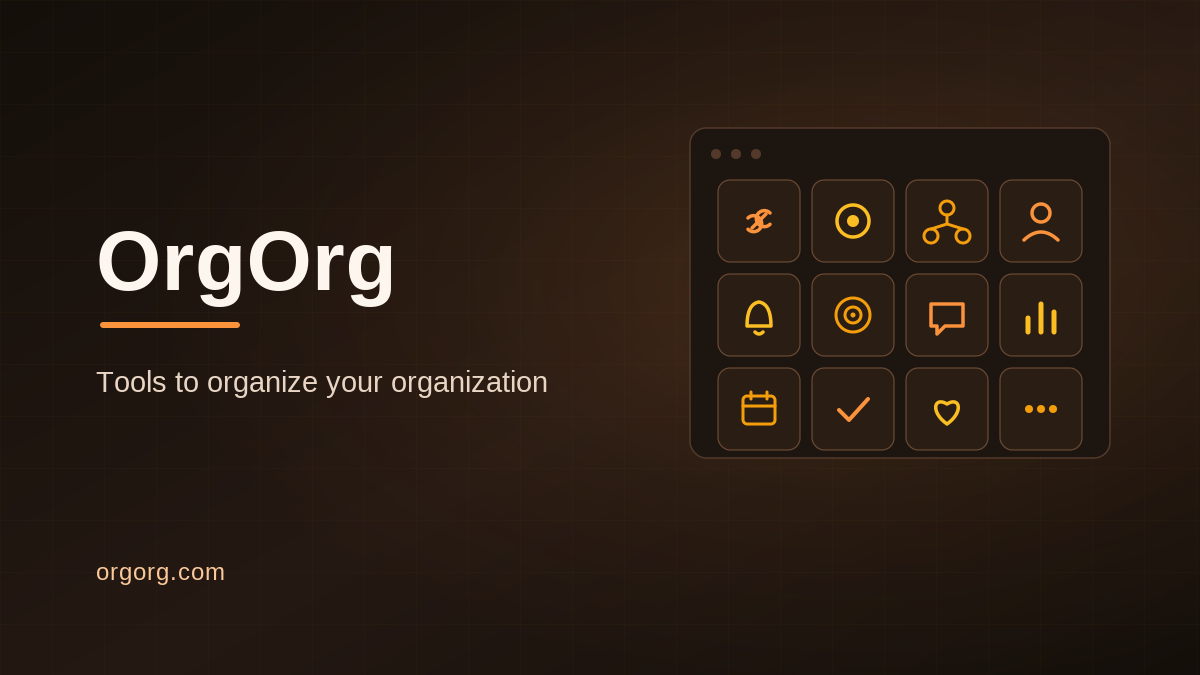
OrgOrg describes itself as an integrated suite of productivity and culture tools, and the current lineup runs to more than fifteen apps.
The productivity side includes go links, a new tab page branded for the company, a screen recorder, task tracking, calendar sync, people profiles, smart groups, an org chart, goals tracking, on-call rotations, IT asset management, and data retention controls. The culture side covers engagement surveys, peer feedback, a recognition app called Thanks, an Ask Me Anything app for collecting and voting on questions ahead of an all-hands, and a company glossary for decoding the acronyms every organization accretes.
The individual apps are deeper than the bundle framing suggests. The go links app supports variables and per-country routing along with click analytics, which puts it at feature parity with dedicated products that charge per seat for the same thing. The screen recorder works from the browser through OrgOrg's extension, mixes a round camera bubble and microphone audio over the tab being recorded, and drops the finished video into OrgOrg to share, which is the core of what most teams use Loom for. OrgOrg is comfortable making that comparison itself: its site maintains head-to-head pages against GoLinks.io, Loom, Calendly, 15Five, and Officevibe, in each case arguing that a capable version of the product is included in a suite that costs less than the point solution alone.
The pricing is built to make adoption easy. Teams of up to five get every app free. Past that, the Pro plan is $10 per member per month for the whole suite. At launch the company charged $5 per person and reported more than 400 organizations using the product, a figure worth reading as self-reported but consistent with how cheap the product is to try.
The founder has shipped this stack before
Suites are harder to build than single products, and OrgOrg's credibility here comes down to its founder's résumé, which maps onto this exact product with unusual precision.
Wayne Crosby's first startup was Zenter, a collaborative presentation tool from Y Combinator's Winter 2007 batch. Google acquired it, and Zenter became the basis of Google Slides. Crosby then spent about a decade at Google, where his teams included G Suite, the productivity bundle OrgOrg now attaches to, along with Machine Intelligence and Google+. After Google he co-founded Humu, a people-science company that raised over $100 million and applied behavioral research to how employees actually work before being acquired by Perceptyx in 2023. Along the way he became a visiting group partner at Y Combinator, and in 2024 he went through the batch again as a founder, nearly two decades after his first time.
Read that history against OrgOrg's app list and the fit is hard to miss. The productivity half of the suite is the territory Crosby worked in at Google, at the company whose internal tools the suite visibly echoes. The culture half, the surveys and recognition and feedback, is Humu's territory. Most founders attacking the internal tools space have lived one side of it. Crosby has shipped both halves at scale, once as an acquired founder, once inside the world's biggest productivity suite, and once as a CEO selling people-tooling to enterprises.
That experience shows in the quietest design decision OrgOrg made: it is an add-on to Google Workspace, not a replacement for anything. The suite assumes your identity, mail, and documents stay where they are, and it attaches the missing layer to them. A founder who spent ten years inside Google's productivity organization would know better than most that the center of the stack is unwinnable, and that the opportunity is everything the center never absorbed.
Bundles win on the buying decision
The strategic argument for OrgOrg is the oldest one in software. Jim Barksdale's line was that there are only two ways to make money in this business, bundling and unbundling, and the chores layer has been in its unbundled phase for fifteen years.
Unbundling made sense while each product category was being invented. Someone had to figure out what a good screen recorder was, and a company that did only that could do it best. But a mature category sold per seat eventually runs into arithmetic. Five point products at $8 to $15 per seat each cost more than most companies' entire office suite, for tools any one employee touches a few times a week. That gap between what the tools cost and how often each one gets used is the margin a bundler attacks.
The bundle changes the buying decision even more than the invoice. Buying five tools means five evaluations, five admin consoles, and five renewals; every new need reopens the question of whether solving it is worth another vendor. With a suite, the marginal app is simply there. The day a team decides it wants an AMA for all-hands meetings or an on-call rotation, the tool is already deployed, already connected to the same employee directory as everything else, already paid for. Tools too small to ever justify their own procurement, a company glossary, say, get to exist because they ride along with the tools that do.
There is also a data argument that compounds over time. Because the apps share one model of the organization, the profile, the org chart, the smart groups, the on-call schedule, and the survey all agree about who works at the company and how the teams fit together. That single source of people-truth is exactly what the twenty-vendor version of this stack never achieves, and it makes each app in the suite a little better than its standalone equivalent.
Small companies, big-company tooling
The companies best served by all this are the ones least able to build it. A three-hundred-person startup feels every one of these gaps and cannot spare an engineer to close them; a free tier for five people means even the smallest team starts with the same tooling.
That is the promise underneath the bundle: the internal tooling experience of a company with a dedicated platform team, rented for $10 a head by companies that will never have one. The chores layer stayed fragmented this long because no single chore was worth a suite. OrgOrg is betting that together, they are.