Anara and the Trust Problem: AI That Cites Its Sources
Ask a general-purpose chatbot to summarize the literature on a niche scientific question, and you'll get something that reads beautifully.
It will produce a fluent paragraph, name a few papers, and attach citations that look exactly right—authors, journal, year, the works. The problem is that some of those papers don't exist. The model, trained to produce plausible text, has invented references with the same confidence it uses for real ones. For most tasks, that's a harmless quirk. For a researcher, it's disqualifying.
This is the single biggest reason general AI tools have struggled to break into serious research work. A scientist, a graduate student, an analyst at a pharma company—none of them can build on an insight they can't verify. When the cost of a wrong citation is a retracted paper or a failed experiment, "usually right" isn't good enough. The tool has to show its work.
That is the problem Anara is built to solve.
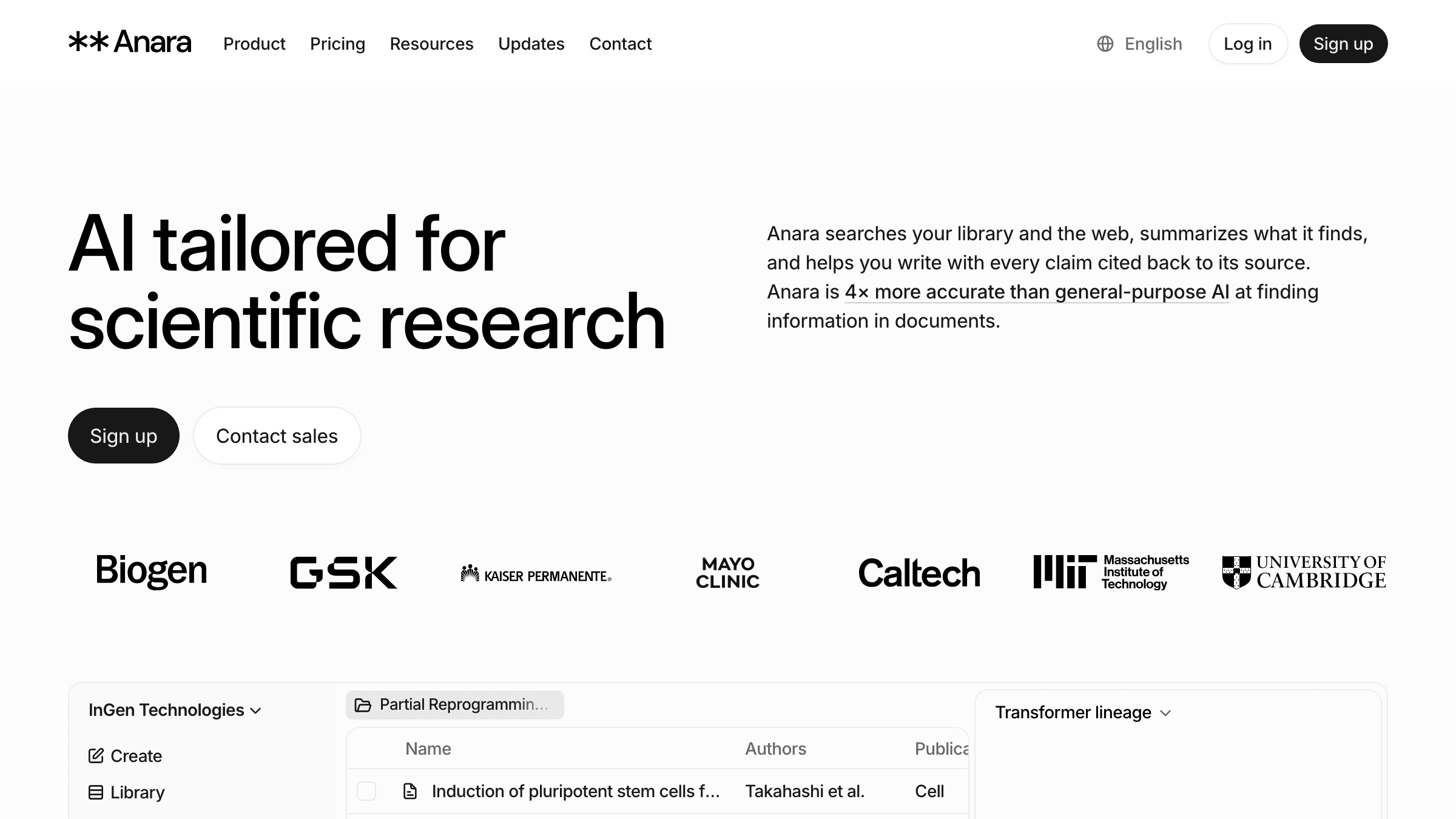
Anara is an AI research assistant that reads, cites, and writes—used by more than three million researchers at institutions including Stanford, MIT, and Johns Hopkins. Its defining design choice is deceptively simple: every answer it gives is grounded in sources you provide, and every claim links back to the exact place in the exact document it came from. In a category where the whole game is trust, Anara made verifiable citation the product rather than an afterthought.
Why Research Was the Hardest Market for AI
It's worth appreciating why research has been such stubborn ground for AI tools, even as they've swept through coding, marketing, and customer support.
Most knowledge work tolerates a margin of error. If an AI drafts a marketing email with a slightly off statistic, someone catches it or nobody notices. The stakes are low and the feedback loop is fast. Research is the opposite. The entire enterprise is built on provenance—on being able to trace every claim back to evidence, and every piece of evidence back to its source. A finding you can't verify isn't a weaker finding. It's not a finding at all.
This makes the hallucination problem uniquely fatal here. A general chatbot that fabricates a citation hasn't just made a small mistake; it has violated the core rule of the domain it's trying to serve. Worse, it does so invisibly. The fabricated citation looks identical to a real one. A busy researcher who trusts it, cites it in their own work, and gets caught pays a reputational price that no time savings could justify.
So researchers did the rational thing: they mostly kept AI at arm's length for anything that mattered. They might use it to rephrase a sentence or brainstorm, but not to actually engage with the literature. The workflow that consumes the most time—reading dozens of dense papers, extracting the relevant findings, tracking who said what, and synthesizing it into something new—stayed almost entirely manual.
Anara's insight is that the answer isn't a smarter model that hallucinates less. It's a system architected so that hallucinated sources are structurally impossible.
Grounding the Answer in the Source
The mechanism behind Anara is what makes it credible to a skeptical audience.
Rather than answering from the open-ended sea of its training data, Anara answers from documents you give it. You upload your papers, reports, and files, and the assistant's responses are constrained to that library. When you ask a question, every statement in the answer carries a hyperlinked citation that points directly to the passage in the specific PDF where the information lives. Click it, and you land on the exact spot. You're never asked to take the model's word for anything—the evidence is one tap away.
That single design decision changes the relationship between the researcher and the tool. With a general chatbot, verification is your job and it's tedious, so most people skip it. With Anara, verification is built into the interface. The citation isn't a claim about a source; it's a link to the source. The burden of proof sits with the software, where it belongs.
On top of that grounding, Anara handles the full shape of real research material. It reads PDFs, Word documents, and slide decks, but also images, audio, video, and YouTube links—with OCR and semantic image recognition so that figures and scanned pages aren't dead ends. Research doesn't arrive in one tidy format, and a tool that only ingests clean text papers would miss half of what a scientist actually works with.
Reading, Then Writing
Where Anara becomes more than a smarter search box is in how it spans the whole research workflow, from first read to final draft.
Literature review across a whole library. You can group related papers into collections and ask questions that range across all of them at once. Instead of reading twenty papers in sequence and holding the comparisons in your head, you can ask the assistant to compare findings across studies, surface where they contradict each other, and pull out common themes. This is the part of research that's most valuable and most punishing—and the part where grounded citation matters most, because a synthesis you can't trace is worthless.
Chatting with a document. At a smaller scale, you can open a single dense paper and interrogate it directly—what's the method, what's the sample size, what did they actually conclude—and get answers pinned to the relevant passages. It turns a two-hour read into a focused conversation without sacrificing the ability to check the original.
Writing with citations attached. The final step of research is producing something new, and Anara carries the grounding forward into drafting. A system of specialized agents you can invoke with an @-mention handles the mechanical parts of scholarly writing—including formatting references in your citation style of choice. The through-line is consistency: the same sources that grounded your reading stay attached as you write, so the citations in your draft trace back to real evidence rather than being reconstructed from memory at the end.
Taken together, these aren't three separate tools bolted into one app. They're one continuous workflow—find, understand, write—held together by the same principle of verifiable provenance at every step.
From Unriddle to Anara
The company's own history reflects a sharpening of exactly this focus.
Anara began as Unriddle, a tool founder Naveed Janmohamed built during a summer 2023 builder cohort. The early product was pitched broadly—an AI that could help anyone make sense of dense documents. It found real traction, but the broad framing undersold where the product was genuinely differentiated. The users who loved it most, and for whom the citation-grounding mattered most, were researchers.
In 2025 the company rebranded to Anara and committed fully to that audience. The renamed product dropped the generalist positioning and aimed squarely at researchers, scientists, and research teams. That's a harder market—more demanding, more skeptical, less forgiving of error—but it's one where Anara's core strength is a genuine moat rather than a nice-to-have. In a market full of tools racing to serve everyone, choosing to serve one demanding audience exceptionally well is a bet that specificity beats breadth.
Janmohamed frames the ambition in terms bigger than a better PDF reader. His stated goal is to build "the research assistant of the future: a human-AI hybrid that's an order of magnitude more effective than any single researcher." That's the right way to read Anara—not as a chatbot that happens to cite sources, but as an attempt to change the unit of research productivity itself.
Trust as the Growth Engine
The clearest evidence that the approach is working is who's using it and how fast.
Anara reports more than three million users, spanning hundreds of universities and research-led companies, with adoption at institutions like Stanford, Johns Hopkins, and MIT and among research teams at organizations such as GSK. The company says it's approaching eight figures in annual revenue, and it has raised backing from Y Combinator—where it went through the S24 batch—along with the founders of GitHub and Reddit and early-stage investors including Orange Collective.
What's notable about that growth is the mechanism behind it. In most software categories, adoption is driven by features and marketing. In research, it's driven by trust, and trust compounds differently. A grad student who verifies that Anara's citations actually hold up starts using it for real work. Their advisor notices. The lab adopts it. Colleagues at other institutions hear about it. The product spreads along the same networks that academic credibility itself travels—slowly at first, then all at once, because researchers are conservative about their tools precisely until one earns their confidence.
This is why the "grounded in your sources" design isn't just a safety feature. It's the growth engine. Every verifiable citation is a small proof to a skeptical user that the tool won't embarrass them. Multiply that by three million people whose professional reputations depend on getting citations right, and you have a product whose central design decision and its distribution strategy are the same thing.
The Broader Pattern
Step back, and Anara is an early instance of a lesson the whole AI industry is learning: the way to win high-stakes knowledge work is not to make the model sound more authoritative, but to make its outputs verifiable.
For a while, the dominant instinct in AI products was to hide the machinery—to present a smooth, confident answer and let users assume it was right. That works in low-stakes settings and fails badly in high-stakes ones. The domains where AI has struggled most—medicine, law, science, finance—are exactly the domains where an unverifiable answer is useless no matter how fluent it is. In each of them, the winning products are converging on the same move Anara made: constrain the model to trusted inputs, and make every output traceable back to them.
Anara is running that playbook in research, which may be the purest expression of the problem. Nowhere is provenance more sacred, nowhere is a fabricated source more damaging, and nowhere is the payoff of getting it right larger. The literature is vast and growing faster than any human can read; a tool that lets a researcher engage with all of it while never losing the thread back to the evidence isn't a convenience. It's leverage on the rate of discovery itself.
If the last generation of AI tools asked researchers to trust the machine, Anara asks the opposite: trust nothing, and check everything—here's the link. That inversion is why a demanding audience that kept AI at arm's length for years is now three million strong and growing. And it's a good bet that the research assistant of the future looks a lot less like a confident oracle and a lot more like this: an assistant that reads everything, writes alongside you, and never once asks you to take its word for it.