Revi turns M&A target hunting into work agents do end to end
Every acquisition starts with a question that sounds simple and isn't: who should we buy?
Ask how that question actually gets answered inside an investment bank or a private equity firm and the glamour drains out fast. An analyst exports a few thousand rows from a financial database, filtered by industry code, geography, and revenue band. Someone culls the list by hand. Associates spend evenings on company websites trying to figure out whether a "logistics software provider" actually sells software or is three consultants with a WordPress site. Then the team cold-emails its way down the survivors, knowing that the same database, the same filters, and roughly the same list sit on the screens of every competing fund.
That last part is the quiet scandal of deal sourcing. The industry calls proprietary deal flow its most valuable asset, then generates most of its pipeline from tools every rival also subscribes to.
Revi attacks this from a different angle. Revi is an AI-enabled deal origination platform for investment banks, private equity firms, and corporate development teams. Instead of handing deal teams a bigger database to screen, it uses agentic workflows to replicate the team's own end-to-end origination process: define the thesis, search everything, research each candidate, rank the results, and keep watching the market afterward. The company went through Y Combinator's Fall 2024 batch, and its customers already include names like KPMG and platform companies backed by KKR and Nordic Capital.
Precision or scale, pick one
Deal origination has always forced a trade-off that nobody inside the industry really accepts but everyone lives with.
You can be precise. Take a sharp thesis, say, founder-owned industrial services companies in the Midwest with sticky maintenance contracts, and put an analyst on it. The analyst reads websites, calls around, builds conviction company by company. The output is excellent and the throughput is terrible. A person can deeply research a handful of companies a day, and the fund is paying investment banking salaries for what is substantially reading.
Or you can be scalable. Run broad screens across a structured database and generate a thousand names in an afternoon. The problem is what a database row can't tell you. Financial data vendors are built on structured, reported information, which private companies mostly don't publish. Revenue figures are estimates, descriptions lag reality by years, and the qualitative things a thesis actually turns on, like customer concentration or whether the founder is approaching retirement, aren't in the schema at all. The precision collapses, and the analysts go back to manual culling, which is the first problem again.
Most of the industry oscillates between these two modes and fills the gap with conferences, buy-side advisors, and luck. Revi's pitch is that agentic AI dissolves the trade-off rather than picking a side: agents that research with something close to an analyst's judgment, at something close to a database's scale.
What the product actually does
Revi's workflow starts where a deal team's does, with criteria. A customer describes what it is hunting for: sector, geography, size, and the softer qualities that make a target fit a thesis. The platform takes it from there.
The search runs on the open web, not just structured feeds. Revi ingests web-scale sources alongside curated proprietary data, drawing on thousands of primary sources rather than a single vendor's schema. That matters because the information that distinguishes a good target from a name on a list mostly lives in unstructured places: company sites, news, filings, job postings, the digital exhaust a business gives off as it operates. This is exactly the material a conventional screen can't read and an AI agent can.
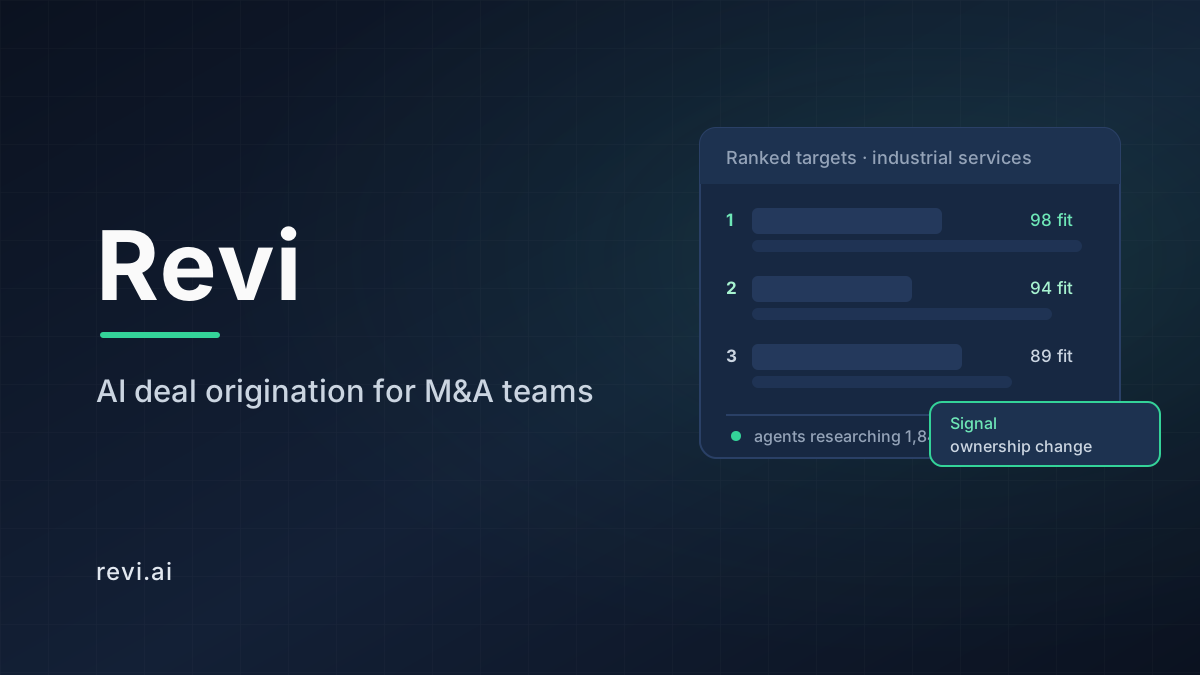
The output is a researched answer, not a longer list. Instead of dumping rows into a spreadsheet, Revi returns ranked target lists with company dossiers and the market and competitive context around them. The ranking reflects the customer's actual criteria rather than whatever filters the database happened to support, and the dossier means the first associate to open a name isn't starting from a blank browser tab.
Teams can also query the platform in natural language, which changes who gets to run a search. A traditional screen forces the thesis through whatever industry codes and numeric filters the database supports, and a lot of nuance dies in that translation. Asking for "family-owned HVAC businesses in Texas with commercial service contracts and an owner near retirement" is a different kind of request than filtering on an industry code, and it's the kind deal teams actually have in their heads. Revi also tracks M&A signals in real time, so a universe built for a thesis stays alive as companies raise money, change leadership, or start looking like sellers. Sourcing stops being a quarterly screening exercise and becomes something closer to standing surveillance of a market.
The through-line in all of it is Revi's own framing: the agentic workflows replicate the customer's end-to-end deal origination process. It's a deliberate design choice. Deal teams don't want a new research tool bolted onto their process. They want the process itself to run without consuming the junior half of the firm.
Founders who started on the origination desk
Revi was founded by Max Nuyen and Benjamin McKinzey, who met in London in 2023, became flatmates, and decided to build the company together. Before launching, the pair worked with mid-market investment banks on exactly these origination workflows, which is where the thesis came from: watching how imprecise traditional sourcing was from inside the process that produced it.
The timeline since then says something about pace. A first version of the product shipped in September 2023, a full year before the company's Y Combinator batch in Fall 2024, and its client base now spans the US, UK, EU, and APAC.
That sequencing matters in this market. Financial services buyers are brutally unsentimental about tooling, and M&A professionals in particular have watched a parade of "deal sourcing platforms" come and go, most of which turned out to be the same database with a different login screen. A product that wins a Big Four firm and PE-backed platform teams does it by surviving contact with people whose job is diligence.
Why serious acquirers are the right first customers
Look at who Revi says is using the platform and a pattern emerges. KPMG. Platform companies backed by KKR, Nordic Capital, and ICG. These are the most systematic acquirers in the market.
A PE-backed platform company running a buy-and-build strategy might need to evaluate hundreds of small targets to close a handful of add-ons a year. Corporate development teams carry standing mandates to know every company in their space. Advisory firms originate for many clients at once. For all of them, origination is a production process that runs all year, and the economics of automating a production process are easy to understand. The volume is there, the pain is constant, and the cost of the manual alternative is denominated in analyst years.
There is also a competitive clock ticking. Sourcing is one of the few places in M&A where an edge compounds quietly. The fund that sees a founder-owned company eighteen months before it hires a banker gets a proprietary conversation and maybe a proprietary price. The fund that finds it in a sell-side process bids against everyone. If agents genuinely widen the funnel and sharpen the filter at the same time, the firms that adopt them early will simply meet more of the right owners earlier, and that advantage won't show up in a competitor's dashboard until the deals are already done.
The pattern underneath
Step back from M&A and Revi is an instance of something happening across professional services: AI agents taking over the research layer that used to be junior headcount.
Deal origination is almost a pure case. The work is text-heavy, judgment follows explicit criteria, the source material is scattered across the open web, and the output feeds a decision made by senior people who were never going to be replaced by software. Agents don't have to run the deal. They have to do the reading, remember everything, and never get bored on company number four hundred. That is a realistic job description for current AI, which is why the category is moving now after a decade of deal-sourcing tools that overpromised.
The winners in that shift tend to share a trait: they automate the process as practitioners actually run it, rather than shipping a clever feature and asking the industry to reorganize around it. Revi's insistence on replicating the end-to-end origination workflow, thesis to ranked targets to ongoing tracking, puts it squarely in that camp.
Buyers have always known the next great acquisition is out there, sitting in some database row with a stale revenue estimate, or missing from the database entirely. The firms that find it first have historically been the ones willing to burn the most analyst hours looking. Revi's bet is that the search now belongs to agents, and that the firms who hand it to them will see the market sooner, and more completely, than the ones still paging through exports.
The question who should we buy isn't getting easier. Answering it is.