Ångström AI wants the experiment to be a computation
Somewhere in a pharma lab right now, a chemist is waiting to find out whether a molecule dissolves in water.
The molecule was almost certainly designed on a computer. Software proposed its structure, scored it against targets, and checked the patent landscape around it. But the question of whether it actually dissolves, which decides whether a pill can ever carry it into a bloodstream, still gets answered the old way: synthesize the compound, ship it to a lab, run the assay, wait. One loop takes weeks. A drug program runs that loop over and over, across solubility and a dozen other properties, for hundreds of candidate molecules.
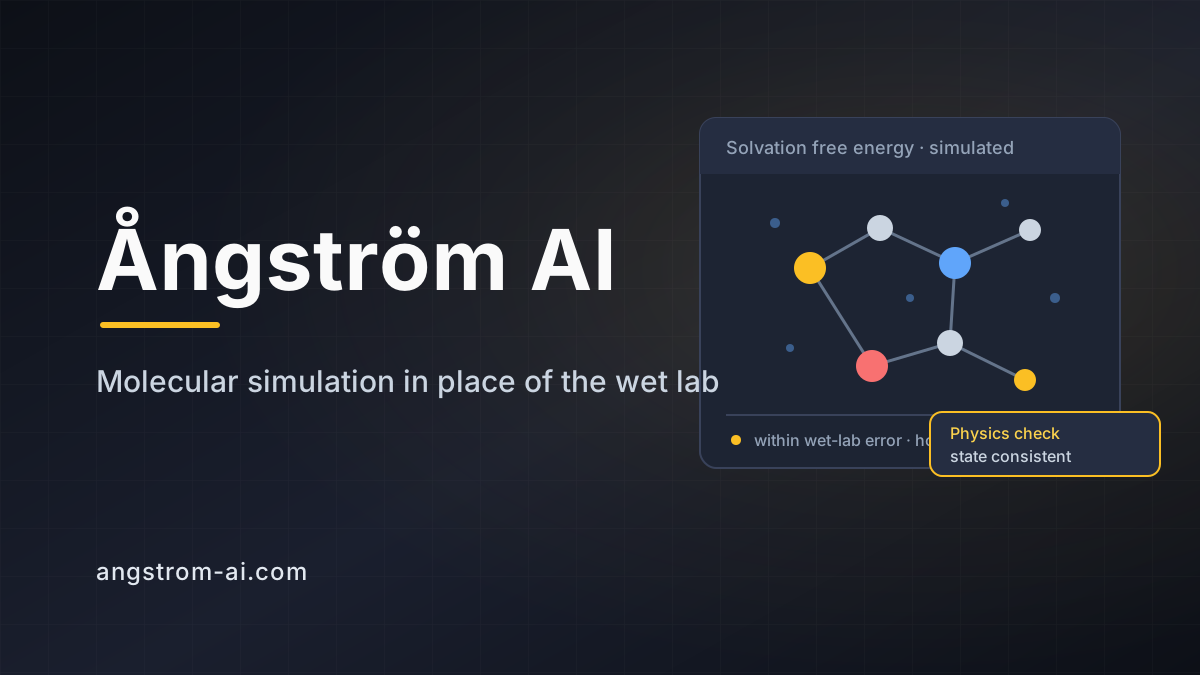
Ångström AI thinks most of those experiments can become computations. The San Francisco company, founded in 2024 and backed by Y Combinator, builds generative AI molecular simulations designed to substitute for wet-lab experiments in the preclinical drug pipeline. The pitch is blunt: simulations that match the accuracy of the wet lab while running more than 100x faster. What makes the claim credible is what the generative model is not allowed to do. Ångström keeps its simulations inside the laws of physics, so the usual failure mode of generative AI, confidently producing plausible nonsense, has nowhere to hide.
Why simulation never replaced the lab
Computational chemistry has been promising to replace experiments for about fifty years, and medicinal chemists have heard every version of the promise. The reason it never fully landed is a trade-off that sits at the bottom of the whole field.
You can simulate molecules with quantum-mechanical accuracy, using methods like density functional theory that track how electrons actually behave. Those answers are good enough to act on. They are also brutally expensive: a single high-fidelity calculation of the kind drug developers care about can occupy a rack of GPUs for a week, for one molecule. Nobody screens a thousand candidates that way.
Or you can simulate molecules cheaply, with classical force fields that approximate atoms as balls and springs. Those simulations run fast and scale wide, and when a real decision hangs on the number, nobody quite trusts them. The error bars are too loose for the questions that matter, like whether a compound will bind its target or survive formulation.
So pharma settled into a division of labor. Computation generates and filters ideas. The wet lab decides. Every digital prediction eventually queues up for a physical experiment, which means the lab sets the tempo of the whole pipeline.
AI-driven drug design has made this worse in an ironic way. Generative design tools now propose candidate molecules in enormous volume, and a large share of them fail experimental validation for mundane reasons, with poor solubility near the top of the list. Design went digital. Verification stayed analog, and the queue at the lab got longer.
Generative AI with physics as a hard constraint
Ångström's system rests on two pieces, and the company's founders had a hand in building both traditions.
MACE makes quantum accuracy affordable. MACE is a machine-learned interatomic potential that reproduces quantum-mechanical interactions at a small fraction of their usual cost. Instead of recomputing electron behavior from scratch at every step, it learns that behavior once and evaluates it quickly, which collapses the price of quantum-grade accuracy. It came out of the Cambridge group of Gábor Csányi, who is now Ångström's head of science.
Diffusion models skip the trajectory. A conventional molecular dynamics simulation has to march through time honestly, computing every tiny step along a molecule's path. Almost all of that compute is spent on the journey. But the properties drug developers buy, such as free energy differences, depend on the distribution of states a system settles into, not on the route it took to get there. Ångström's diffusion-based models exploit that. They jump directly between states, and every state they generate is kept consistent with physics, while the transitions between states are deliberately non-physical shortcuts. The simulation skips the trajectory and still arrives at the equilibrium answer.
That architecture is also Ångström's answer to hallucination. When a language model invents a plausible fact, catching it requires a human who knows better. When a generative model proposes a molecular configuration, physics is sitting right there to check the work. A state that violates the energy landscape is detectably wrong, not persuasively wrong. The company leans on this constantly in how it describes the product, and it should: it is the difference between generative AI as a demo and generative AI as something a pharma company will stake a program on.
From that machinery, Ångström computes the quantities that preclinical teams currently buy from labs: whether a drug binds a protein, free energy differences, binding conformations, hydration sites, solubility, lipophilicity, and the stability of crystal structures.
Solubility first
For its opening market, Ångström picked the least glamorous property on that list, and probably the smartest one.
Solubility decides whether a molecule can be absorbed, formulated, and dosed. It is also one of the main reasons computationally designed drugs die in validation: the model that dreamed up the structure had no reliable way to know the compound would refuse to dissolve. Every failed candidate represents synthesis cost and weeks of calendar time spent learning something a good simulation could have said upfront.
It is also a well-posed target. A solubility assay has known error bars, so "as accurate as the wet lab" stops being a slogan and becomes a measurable finish line. Ångström says it has published the first molecule water-solubility results that land within wet-lab error ranges, and the commercial side has started to follow: a $150K pilot with a pharma company to estimate solubility, two paid pilots with multinational chemical companies, and four letters of intent with pharma and biotech firms. Early numbers, but the right kind. These are customers paying for predictions about their own molecules, which is the only benchmark that counts.
The wedge logic is easy to see. A chemist who has watched Ångström's solubility numbers hold up against their own assays for six months will listen when the same engine starts quoting lipophilicity, hydration sites, and binding.
Two PhDs and two Cambridge professors
Ångström describes its founding team as two PhDs and two Cambridge professors, which is accurate and still undersells the fit.
Laurence Midgley and Javier Antorán are the PhDs, both out of Cambridge's machine learning world. José Miguel Hernández-Lobato, Ångström's head of AI, is a Cambridge professor whose research sits squarely in probabilistic machine learning and its application to molecules. And Csányi is the Professor of Molecular Modelling whose group co-created MACE itself. This company needed exactly two disciplines, generative machine learning and atomistic simulation, and it has a founder at the top of each.
The team also publishes. Work with Ångström affiliations has appeared on computing hydration free energies of small molecules with first-principles accuracy, and on solvation free energies that reach experimental accuracy across a wide range of organic molecules. A crystal structure prediction model, CSP-MACE-Å, was developed with AstraZeneca. For this customer base, that openness is strategy, not vanity. Computational chemists at pharma companies are professional skeptics who will try to reproduce a vendor's claims before a contract gets signed, and a published method gives them the means to do it.
When the experiment becomes a query
Walk the logic forward and the interesting part is not any single prediction. It is what happens to the design loop.
Today, a medicinal chemistry team designs a batch of candidates, sends the promising ones for synthesis and assay, waits weeks, and designs the next batch around what came back. If simulation genuinely matches assay accuracy at 100x the speed, that loop closes in hours. A chemist could sketch four hundred variants on Monday and rank them by predicted solubility before Friday, reserving the wet lab for confirming the handful of survivors rather than interrogating every idea. The lab stops being the filter and becomes the final check.
Other engineering fields have already lived through this transition. Chip designers stopped breadboarding prototypes decades ago, once simulation became trustworthy enough that fabrication could be the last step instead of the iterative one. Aerospace moved the same way with computational fluid dynamics. Chemistry has stayed stubbornly physical because molecules were too hard to simulate at decision-grade accuracy for a price anyone could pay. That is precisely the constraint Ångström is attacking, with machine-learned physics on one side and generative shortcuts through simulation time on the other.
The chemist waiting on that solubility assay will still be waiting next quarter; labs do not disappear because a startup published good numbers. But the preclinical pipeline is a sequence of questions currently answered by synthesis, shipping, and waiting, and Ångström has now shown that at least one of those questions can be answered by a model that respects physics, inside wet-lab error, in a fraction of the time. Drug programs are measured in years and burn rates in millions per month. A company that converts experiments into queries, one assay at a time, is working on one of the few levers in pharma that moves both.