Metorial makes MCP something you deploy, not something you build
There's a moment in the life of every AI agent project where the demo meets reality.
The demo was easy. The agent reasons, calls a tool or two, produces something impressive. Then someone asks for the version that actually ships, and the requirements list grows teeth. The agent needs to read Gmail, post to Slack, file Linear tickets, pull records from Salesforce. Each of those needs OAuth flows, token refresh, rate-limit handling, and error recovery. Each needs somewhere to run, some way to log what happened, and, if you have more than one customer, a way to keep customer A's credentials from ever touching customer B's session.
None of that is agent work. It's integration plumbing, the same plumbing every team building agents ends up rebuilding, badly, under deadline pressure.
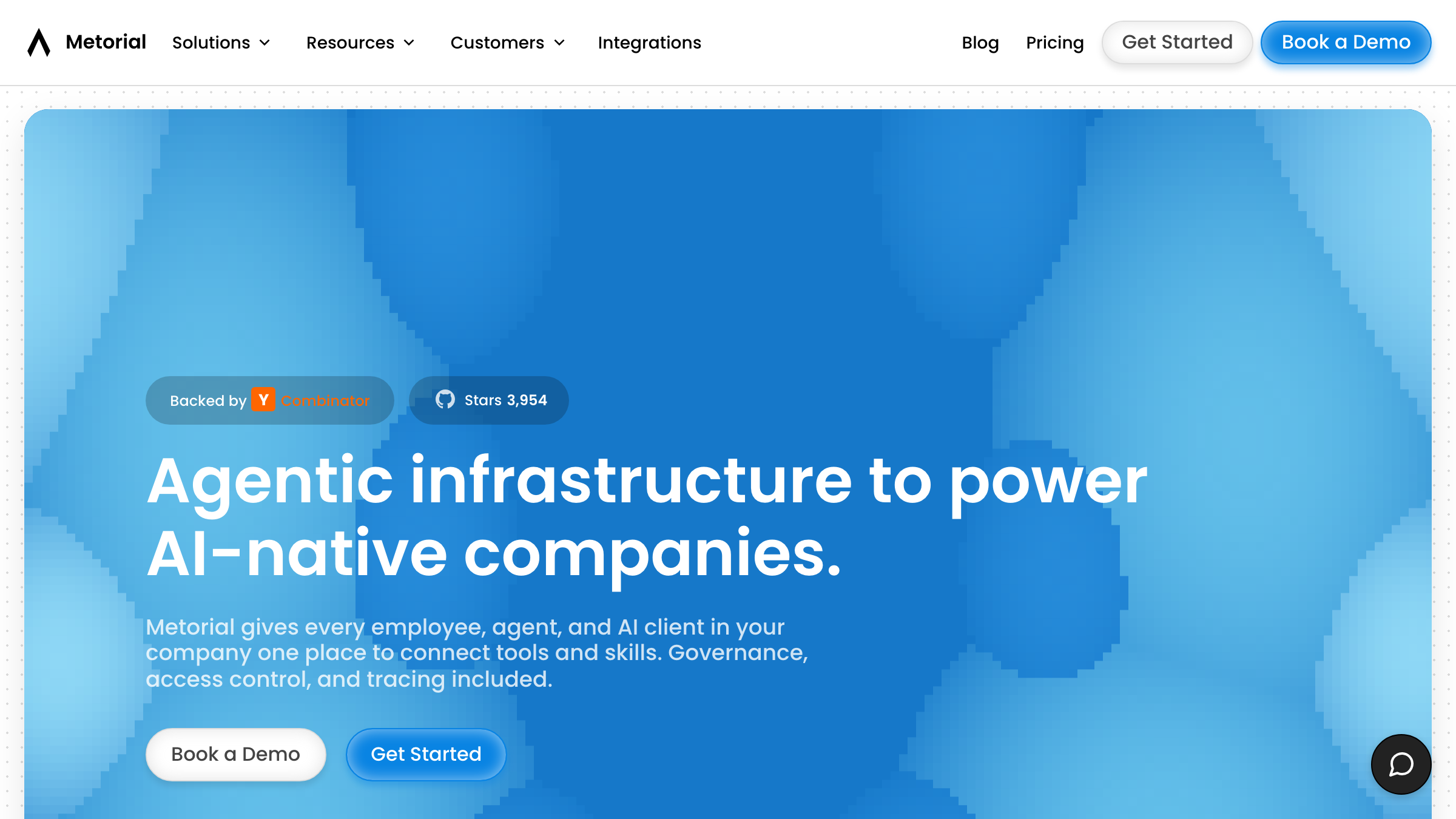
Metorial exists to make that plumbing someone else's job. The company, part of Y Combinator's Fall 2025 batch, runs an open source platform that hosts Model Context Protocol servers as a managed, serverless service. Pick from a catalog of more than 600 integrations, deploy one in three clicks, and connect it to your agent with a single function call from the TypeScript or Python SDK. Metorial handles the OAuth, the infrastructure, and the observability. The founders describe it as Vercel for MCP, and the analogy is earned: the same way Vercel turned "set up a deployment pipeline" into "git push," Metorial turns "build an integration" into "pick one from a list."
MCP standardized the protocol, not the operations
To see why this is a real company and not a convenience script, it helps to look at what the Model Context Protocol did and didn't solve.
MCP, introduced by Anthropic and since adopted across the industry, gives AI models a standard way to talk to external tools and data sources. Before MCP, every agent framework had its own tool format, and every integration was bespoke. After MCP, a server that exposes, say, GitHub or Notion can work with any client that speaks the protocol: Claude, Cursor, a custom agent, whatever comes next. That standardization is why thousands of MCP servers now exist for nearly every popular API.
What MCP deliberately doesn't cover is operations. An MCP server is a program. Someone has to run it, keep it patched, give it credentials, restart it when it falls over, and record what it did when a customer asks why the agent deleted the wrong calendar event. In production, that "someone" turns out to be a lot of work.
The multi-tenant case is where it gets genuinely hard. A developer connecting their own Cursor to their own GitHub can run an MCP server on their laptop. A SaaS company whose product includes an agent has a different problem entirely: every one of their users needs their own connection, authenticated with their own tokens, isolated from every other user. Running a dedicated server per user is expensive, since most connections sit idle most of the time. Sharing servers between users is a security incident waiting for a date. And MCP connections are stateful and long-lived, which is exactly the shape of workload that conventional serverless platforms handle worst.
So teams building serious agent products faced a bad menu: burn months building MCP infrastructure in-house, keep paying for fleets of mostly-idle processes, or quietly cut the integrations that made the product compelling.
What three clicks actually buys you
Metorial's answer is to treat MCP servers the way modern platforms treat web apps: a catalog, a deploy button, and a runtime someone else worries about.
The catalog indexes over 5,000 MCP servers, with more than 600 integrations ready to deploy directly, covering the range from developer tools like Sentry and Linear to enterprise systems like Salesforce and QuickBooks. Deploying one takes three clicks. Where an integration needs user authorization, Metorial handles the OAuth flow itself, which removes one of the most tedious and error-prone pieces of integration work. Custom servers get the same treatment: if the integration you need doesn't exist, you can build your own MCP server and deploy it to the same runtime.
On the agent side, the SDKs collapse the connection to a single function call. Your code asks Metorial for a session, and the platform spins up the right servers with the right credentials and hands your agent its tools. The dashboard includes an MCP Explorer for poking at a server's capabilities before writing any code, and every session is recorded, so when an agent misbehaves you can replay exactly which tools it called with which arguments and what came back. Anyone who has debugged an agent from scattered application logs will understand why session replay is the feature that makes people stay.
The platform is open source under a Functional Source License, and the whole thing can be self-hosted. That matters for the buyers Metorial ultimately wants: companies with compliance requirements don't adopt closed integration layers that sit between their agents and their customers' data. Publishing the code is how an infrastructure startup earns the right to be in that position.
The runtime is the moat
The catalog is the visible product. The interesting engineering is underneath, in the runtime, and it's where Metorial makes its boldest claim: theirs is the only serverless MCP platform built for multi-tenant systems, with sub-second cold starts and stateful hibernation.
Hibernation is the key trick. An agent might open a connection to a CRM integration, use it for thirty seconds, then leave it alone for an hour before the user asks another question. Keeping a container warm for that hour wastes money. Killing it breaks the session. Metorial's runtime, built around a custom engine written in Go with MCP servers running in isolated containers, puts idle servers to sleep while preserving their state, then wakes them in under a second when the next request arrives. The agent never notices; the bill does.
Combine that with per-user isolation and the multi-tenant problem starts to look solved. Each user of your product gets what behaves like their own dedicated MCP server, with their own credentials and their own state, while the underlying platform only pays for compute when a connection is actually doing something. That's the same economic shape that made serverless computing win for web workloads, applied to a class of workload that serverless platforms have historically dropped on the floor.
This is also why "Vercel for MCP" is more than a fundraising slogan. Vercel's insight was that deployment infrastructure was undifferentiated work that every team rebuilt, and that owning the runtime under a standard (Next.js, then broader) compounds. Metorial is making the same bet one layer up the stack, on the standard that connects agents to the rest of the software world.
Zero config for the vibe coders
Metorial also ships a consumer-grade on-ramp called Magic MCP, and it says something about how the company thinks about distribution.
Magic MCP connects any MCP client, including Cursor, Claude Code, and Claude Desktop, to the full catalog of 600+ integrations with no configuration. No JSON files, no token wrangling, no per-server setup. It runs on the same infrastructure that powers the platform's production deployments, so an individual developer wiring Linear into their coding assistant gets the same sub-second wakes and observability as an enterprise customer.
The distribution logic is straightforward. The developers connecting integrations to their editors today are the ones who will be building agent products at work next quarter, and they'll reach for the platform they already know. Every big developer-infrastructure company of the last decade, from Stripe to Vercel itself, grew along that exact path: win the individual developer with something free and frictionless, then be standing there when their employer needs the production version.
Two friends from a Viennese technical school
Metorial is built out of Vienna by Tobias Herber and Karim "Wen" Rahme, who met at a technical high school in Austria and have been building things together for over a decade.
Their backgrounds split neatly across the company's two halves. Rahme previously founded Valicit, an event ticketing startup that sold more than two million tickets and ran ticketing for artists including Travis Scott and 50 Cent. Ticketing is a brutal operations business, spiky load, real money, zero tolerance for downtime, and it's decent preparation for selling infrastructure that other companies bet their products on. Herber comes from the systems side, with a background in AI, distributed systems, and system software, and an IEEE best paper award to his name. He's the kind of founder you want holding a claim like "stateful hibernation with sub-second cold starts," because that claim lives or dies in the engine code.
The YC story has a nice wrinkle: they applied twice. The first application earned an interview and a rejection. The second got them into the Fall 2025 batch, and afterward they published the full application on their blog for other founders to learn from. Alongside YC, the company is backed by investors including Orange Collective, Pioneer Fund, and Valia Ventures.
The layer that decides whether agents are useful
Strip away the protocol acronyms and Metorial is a bet on a simple observation: an AI agent is only as useful as the systems it can touch.
Model capability is no longer the constraint for most agent products. The models reason and use tools well enough. What separates a clever demo from software people rely on is whether the agent can act inside the tools where work actually lives, safely, for thousands of users at once, with an audit trail. That's an integration problem, and integration problems have a long history of being worth more than they look. Companies like Plaid and Twilio were built on the unglamorous work of wrapping messy external systems in clean APIs, and each became essential precisely because nobody wanted to rebuild that work themselves.
MCP gives the agent era its standard plug. Metorial wants to be the grid behind it: the place those plugs are hosted, secured, and observed. If agents keep spreading into production software, and every signal says they will, then somewhere under most of them there will be a runtime quietly waking integration servers in under a second and putting them back to sleep when the conversation moves on.
Metorial's founders would like that runtime to be theirs, and they've put the code on GitHub for anyone who wants to check their work.